
 E-Paper



Chandigarh’s air quality plummets to ‘severe’ category
Environmental experts attributed the reason behind the deterioration to bursting of crackers, fall in temperature and cloudy weather


At 444, the air quality worsened to ‘severe’ category in Chandigarh on Wednesday, a day after it had slipped from ‘poor’ to ‘very poor’. Environmental experts attributed the reason behind the deterioration to bursting of crackers, fall in temperature and cloudy weather.
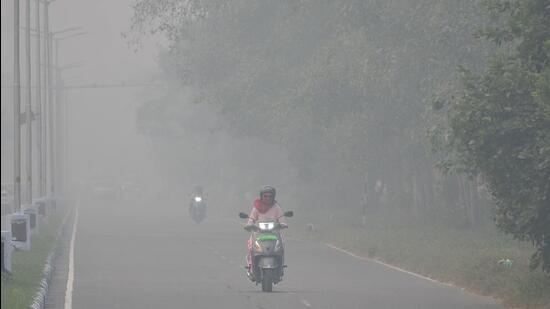
Around 8am on Wednesday, the average air quality index (AQI) recorded at the Continuous Ambient Air Quality Monitoring Station (CAAQMS) in Sector 53 was 404, while it was 360 at Sector 22 and 259 in Sector 25. The air quality dropped later in the day with Sector 53 centre registering the level at 444. Sector 22 and 25 centres recorded the AQI at 397 and 345, respectively, around 7pm.
AQI between 401 and 500 is considered ‘severe’ that affects healthy people and seriously impacts those with existing diseases.
PM 2.5 and PM 10 were the main pollutants in the city on Wednesday.
The AIQ had remained ‘poor’ on Monday, but began to worsen by Tuesday in some parts of the city. The AQI recorded at Sector-53 station was highest at 314 around 11pm on Tuesday, which was followed by 266 at Sector 22 and 191 at Sector 25. The air quality between 301 and 400 is considered ‘very poor’ and can cause respiratory illness on prolonged exposure.
Even after Diwali on October 25, the average AQI in Sector 53 was logged at 119, while it was 130 in Sector 22 and 114 in Sector 25.
UT director, environment, Debendra Dalai said, “The AQI is worsening due to fall in temperature and high pressure in the atmosphere. Also, for the past two days, the sky is overcast and in conditions where sunlight is not adequate, AQI often increases. The situation deteriorated on Wednesday due to bursting of crackers on Gurpurab on Tuesday.”
Dr Sonu Goel, professor at PGIMER’s department of community medicine, said, “The AQI is increasing due to unfavourable weather conditions, including low wind movement and drop in temperature. Other reasons like stubble burning, vehicular movement and industrial pollution tend to compound the problem further when the weather is not favourable.”
“Vulnerable people like elderly and children should stay indoors till AQI is in severe category as it can cause health problems like lung infection. Also, people should wear masks, especially the N-95 variant, during outdoor activities to avoid inhalation of pollutants,” he added.
The last time city’s air quality had reached ‘severe’ category was on Diwali last year. The festival was celebrated on November 5 when the average AQI had shot up to 465 at the Sector-25 quality monitoring station.
Breather likely with light rain
While cloudy weather will continue on Thursday, there are chances of light rain up to 20 mm in the city, which can help clean the air. Chandigarh IMD director Manmohan Singh said, “A western disturbance was active in the city on Wednesday which was why the weather remained cloudy and smog built up in the city. The western disturbance is more active in Himachal Pradesh, but some effect is expected in the city also on Thursday when the system peaks.”
Visibility also continued to stay low for the third day in a row and remained below 2,000 metres, IMD officials said.
Maximum temperature went up from 27.1°C on Tuesday to 27.6°C on Wednesday, but was still 1.6° below normal. Minimum temperature went up from 15.2°C on Tuesday to 18.1°C on Wednesday, 5.7° above normal.
In the next three days, maximum temperature will hover around 27°C while minimum temperature will be near 17°C.


