
 E-Paper



Despite having machines, Punjab farmers prefer to burn loose paddy straw: Report
Challenges to ending stubble burning persist, such as timely access to CRM machines, lack of proper training to use them and misperceptions over reduced yields and pest attacks on wheat sown using them.


Nearly half of Punjab farmers using in-situ crop residue management (CRM) machines still burn some loose paddy straw to ensure the machines’ efficient operation and for pest control, revealed a survey released by a Delhi-based think tank on Tuesday.
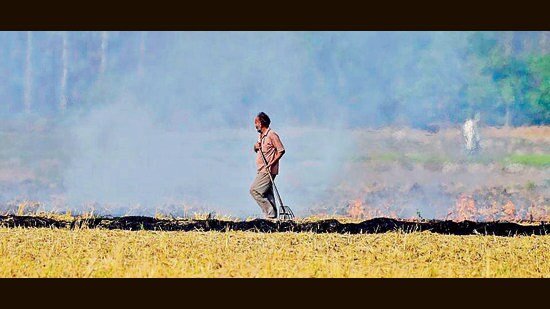
The report, ‘How Can Punjab Increase the Adoption of Crop Residue Management Methods?’ by Delhi-based independent think tank Council on Energy, Environment and Water (CEEW), revealed that 58% of the surveyed farmers managed straw using machines like super seeders and rotavator. However, challenges to ending stubble burning persist, such as timely access to CRM machines, lack of proper training to use them and misperceptions over reduced yields and pest attacks on wheat sown using them.
As many as 1,478 farmers across 11 districts of Punjab were surveyed for the study.
Dr Abhishek Kar, senior programme lead, CEEW, said, “While adopting in-situ and ex-situ methods has become common among Punjab’s farmers in recent years, accessibility, affordability, and cost-effectiveness are still significant determinants to replacing conventional burning. As Punjab gears up for the paddy cycle of 2024, it is crucial to plan phase-wise measures to ensure optimal adoption of CRM machines, clearing farmers’ misconceptions about the sustained adoption of these machines and securing a viable market for paddy straw. These will help the state realise its zero-burn target.”
Kurinji Kemanth, programme associate, CEEW, said, “Incorporating 100% paddy straw back into the soil is challenging, considering its quantum and the limited time window between the intensive rice-wheat monocropping seen in northern India. We see that more and more farmers in Punjab are inclined towards ex-situ methods due to ease of operations and scope for additional income. But the sector’s growth warrants industry leadership. As India awaits Budget 2024, the focus should be on boosting the demand for crop biomass use, increasing the incentives for ex-situ CRM approaches and encouraging more participation in the biomass supply chain.”
According to CEEW’s report, nearly 33% of the surveyed farmers opted for ex-situ methods of crop residue management, and 66% of these farmers had formerly employed in-situ methods to manage their stubble. This indicates a rising preference for ex-situ options due to their ease of operation and the relatively higher costs associated with in-situ methods.
The CEEW report also found that personal connections are valued over digital solutions when it comes to accessing or renting crop residue management machines. Nearly 82% of farmers who rented CRMs rented them from friends or relatives. Only one per cent used the Punjab Remote Sensing Centre’s i-Khet app to access rental services for farm machinery. To address challenges and help Punjab become a zero-burn state, the CEEW report proposes several strategies, including a comprehensive guide on best practices for using CRM methods, making the i-Khet Punjab app more farmer-friendly to improve access to rental machinery, and setting a price floor for crop biomass to incentivise ex-situ management.


