
 E-Paper



Exiled Tibetans find echoes of home during Dalai Lama 89th birthday celebrations
Sikkim chief minister Prem Singh Tamang attended the function as the chief guest, while Arunachal Pradesh MP Tapir Gao also attended the function at Tsuglakhang Temple at McLeodganj near Dharamshala


Hoping to return to his homeland, Tibetan spiritual leader in exile, the 14th Dalai Lama, turned 89 years old on Saturday.
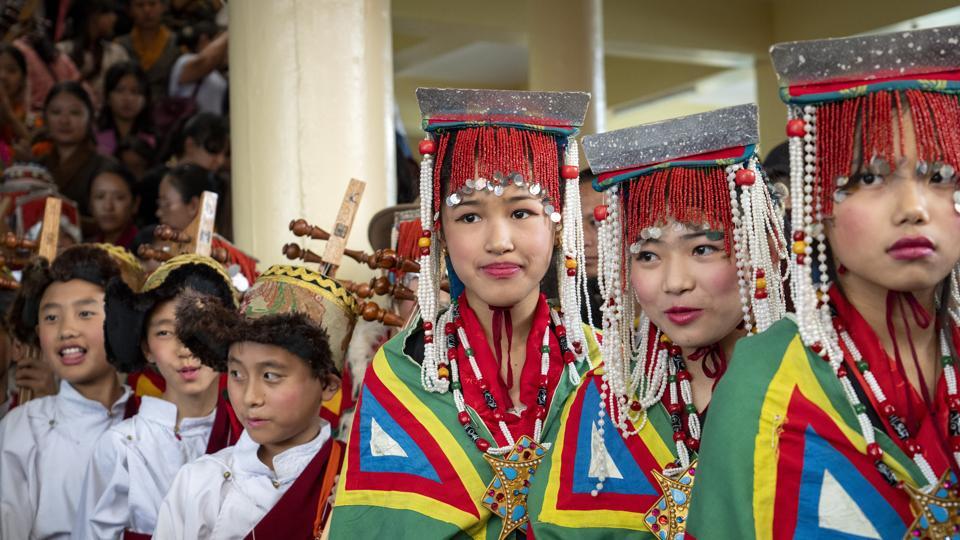
While the Dalai Lama is in the US for knee treatment and is recovering now, hundreds of Tibetans, including monks, nuns, school students and foreign followers gathered at the event to mark the 89th birthday of the ageing spiritual head.
In his birthday message, the Dalai Lama said, “I am nearly 90 now but I do not feel unhealthy, except for the slight discomfort in my legs. I am basically healthy. I would like to thank all my fellow Tibetans in and outside Tibet for your prayers on my birthday.”
“I was born in the land of Dhomay (Amdo) and I bear the title of Dalai Lama. I did my best while I was in Tibet and after coming into exile, I have served to the best of my ability. Accordingly, it seems I have been beneficial to a good measure. There is a growing interest in the Tibetan cause in the world and I feel I have made a small contribution towards it. I wish to ask everyone, especially the fellow Tibetans inside Tibet to feel at ease and be relaxed,” he added.
Sikkim chief minister Prem Singh Tamang attended the function as the chief guest, while Arunachal Pradesh MP Tapir Gao also attended the function at Tsuglakhang Temple at McLeodganj near Dharamshala.
“We are happy to celebrate the birthday of his holiness at the holy place of Mcleodganj in Dharamshala. Although His Holiness had to face many ups and downs during his childhood, nevertheless his holiness has continued to advocate peace and harmony in the world. No longer is his grace bounded by political borders, his spiritual teachings flourished beyond all boundaries. It is commendable that the whole world is now benefiting from the teachings of His Holiness,” Tamang said.
Addressing the gathering, the Sikyong (president) of the Tibetan government-in-exile, Penpa Tsering, said after the Resolve Tibet Act was passed in both houses of the US Congress last month, a seven-member high-level bipartisan US Congressional delegation purposely visited Dharamshala and presented a framed copy of the legislation to His Holiness the Dalai Lama.
“The legislation aimed at resolving the Sino-Tibet dispute recognises the Sino-Tibet dispute as unresolved and that the legal status of Tibet is as yet to be settled under international law, as the official policy of the US government. It acknowledges the Tibetan people’s right to self-determination, points out the distorted narrative of Tibetan history by the Chinese government, and urges negotiations,” he said.
Tsering said the Kashag will strive to work towards similar policy adoption in other free democratic nations as well and urged every Tibetan and Tibet supporter everywhere in the world to join in the common effort.
US Congress passed a bill urging China to re-engage with the Dalai Lama and other Tibetan leaders to resolve the dispute over the status of Tibet. The talks have been frozen since 2010.
Meanwhile, the Tibetan parliament-in-exile, in its statement, said the situation in Tibet continues to be such that Tibetan people are being subjected to false criminal charges, violent repression, beatings, arrests and detentions, and imprisonment without any fair judicial procedure.
“China continues to implement in Tibet genocidal policies that trample on the Tibetan people’s human rights and that are designed to decimate them as an ethnic group. These have been continuously criticised and reported on internationally,” the parliament said.
The high-level US delegation after meeting the Dalai Lama in McLeodganj last month, delivered speeches during that event, affirming unwavering and selfless strong continued support on the issue of Tibet.
“The event sent a clear message to the government of China that the Tibetan people are not alone in their struggle against its rule. It also gave a new fillip and a renewed hope to the Tibetan people’s struggle. Besides, it gave a new boost to the Tibetan people’s struggle and became a source of renewed encouragement to them,” the parliament said.
Born as Tenzin Gyatso on July 6, 1935, in a humble farming family at Taktser village in the Amdo province of China-occupied Tibet, the 14th Dalai Lama’s life has been one of extraordinary resilience. Following the unsuccessful uprising against the Chinese occupation in 1959, the Dalai Lama sought refuge in India, where he set up the government-in-exile in Dharamsala, and became the global face of the struggle. Though the Dalai Lama had anticipated a temporary exile, Beijing’s control over Tibet has only strengthened, making his return to his homeland increasingly impossible.


