Police and local administrations started removing farmers from some of the protest sites in Haryana and western Uttar Pradesh on Thursday morning and vacated several toll plazas occupied by members of farm bodies demanding repeal of the three new agriculture laws.
Farmers across rural Haryana and western Uttar Pradesh held local maha-panchayats to discuss the future course of action on Thursday, deciding to intensify the protest after a few days. They blamed the government for the violence at Red Fort and Delhi’s ITO on Republic Day.
Late on Wednesday night, local police used mild force to remove protesting farmers from a highway in Bhagpat in western Uttar Pradesh. Farmer leaders alleged that police were harassing families of farm union leaders and protesting farmers in villages.
At Ghazipur on Delhi border, the local administration snapped electricity and water supply to the protesting farmers and asked them to remove the blockade going on for the past two months. Ghaziabad district magistrate Ajay Shanker Pandey asked the farm leaders to vacate the site by Thursday night. “The district administration has asked protesters to vacate the dharna site by tonight,” said a district officer.
“I will not vacate the place,” said Bharatiya Kisan Union leader Rakesh Tikait. His supporters in Muzaffarnagar urged him to continue, declaring that thousands of farmers would get themselves arrested if Tikait was taken into custody.
{{/usCountry}}“I will not vacate the place,” said Bharatiya Kisan Union leader Rakesh Tikait. His supporters in Muzaffarnagar urged him to continue, declaring that thousands of farmers would get themselves arrested if Tikait was taken into custody.
{{/usCountry}}A small farmers’ group, which had started a dharna (sit-in) against three new agriculture reform laws at a college ground in the Bajna area of Mathura district on December 2, suspended their agitation on Thursday after talks with Mathura police and district administration officials.
“We have suspended our agitation for one month after assurances (were) given to look into our local issues,” said Ram Babu Katelia, the national president of the Bhartiya Kisan Kalyan Samiti.
Farmer leaders in Haryana said that the district administration and police were mounting pressure on them to clear the toll plazas and ensure free movement of vehicles.
Azad Palwan, a farm leader from Jind, said district officials called them and asked to vacate Khatkar and other toll plazas in the district. “The farmers have refused to vacate the toll plazas in the district until our demands are met,” he said.
Balwant Nambardar, head of Phogat Khap, along with four other farmers had a meeting with Bhiwani deputy commissioner, Jaibir Arya, and told him that they will not vacate the Kitlana toll plaza, where hundreds of farmers have been protesting for over a month. “We will clear the toll plazas in the district after our top leaders call,” he said.
The farmers protesting at Masani village in Rewari have vacated their protest site and shifted to Shahjahanpur on the Haryana-Rajasthan border in the neighbouring state’s territory. Rewari deputy commissioner Yashendra Singh, said they have cleared the National highway 8, which connects Delhi to Jaipur, in their territory. The protest is continuing at Shahjahanpur on the Rajasthan side.
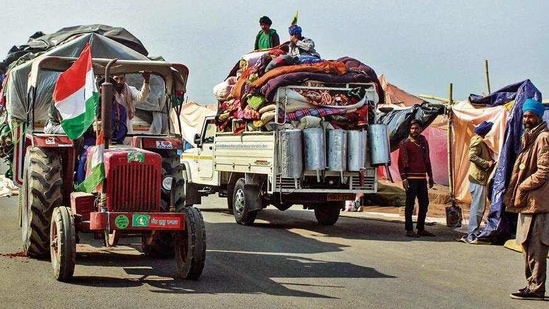
Police cleared the Palwal protest site on the Kundli-Ghaziabad-Palwal (KGP) expressway on Thursday morning. “The nearby villagers had requested them to vacate the sites on Wednesday late evening. The protesters had assured them that they will leave early morning and had packed their stuff at night and left on tractors and other vehicles,” said Jangsher, inspector of Gadpuri police station, in whose jurisdiction the protest site falls. The protesters at this site had tried to break police barricades and enter Delhi on January 26, said Deepak Gahlawat, superintendent of police, Palwal.
In UP’s Muzaffarnagar, two kisan panchayats held on Thursday reiterated their support to Tikait and said they would intensify their agitation in the coming weeks.
At least 12 khap panchayats in Jind and Hisar districts of Haryana reiterated their support to the farmer protests in Delhi. “They (khap panchayats) have unanimously decided to support the ongoing farmer protest. The attack at Red Fort was a government conspiracy,” said Sahil Rukaya, who participated in the meeting in Hisar.
On Thursday, mobile internet services in three districts of Haryana – Sonepat, Jhajjar and Palwal – were suspended till 5pm on January 29, a government order said. The services were shut down on the evening of January 26 for 24 hours initially.