
 E-Paper



GI tag to flourish Kashmiri carpet trade, boost export
With the government providing GI tags to hand-woven Kashmiri carpets, artisans and exporters see this as a big step towards the revival of the carpet trade


Away from the city’s hustle and bustle, 45-year-old Bashir Ahmad Dar is busy weaving Kashmiri silk carpet on a wooden loom at a nondescript Sonawari village in north Kashmir’s Bandipore district.
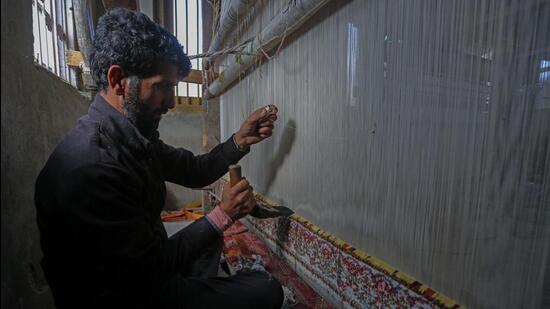
Dar takes months and at times years to weave a fine silk carpet along with other weavers on his loom and the wages he earns are a lifeline for his family comprising six members. With the government providing GI tags to hand-woven carpets, artisans and exporters see this as a big step towards the revival of the carpet trade.
Annually, carpets worth ₹300 crore are exported from Kashmir to various European countries and the United States. After GI tagging, exporters are hoping the sales will rise manifold. “The business was good and we used to earn handsome money till 2014 Kashmir floods. Since then, things neither have been good for weavers nor the exporters,” said Dar, who is currently working on a carpet for an exporter. “The GI tagging of the carpets is the best news and could see Kashmir carpets flourishing. Now buyers can distinguish between hand and machine-made carpets,” said Dar whose village Gadekhoud is known for carpet weaving and artisans here have been weaving carpets for decades. “People here have been weaving carpets for generations. I learned this from my uncle. Unfortunately, due to fewer dividends, younger people don’t see good prospects in carpet weaving,” said Bashir Ahmad, another weaver from the same neighbourhood.
Kashmiri’s silk carpets are famous the world over for their design, yarn and weaving qualities but it has neither fetched good money for weavers nor the exporters who after spending lakhs get these carpets weaved for customers. Now there is a fresh hope that could change the fate of this industry which was slowly losing its sheen and glamour, especially the past few years have been tough for those associated with the carpet industry. Now the hand-knotted carpets woven on the looms of Kashmir are being provided GI tags. The first batch of carpets with GI tags are ready for export to European countries where there is a special clientele for the product.
Sheikh Ashiq, the owner of Ferozsons carpet exporters, says the GI tagging of Kashmir carpets will give new lease of life to the carpet trade in Kashmir.
“Due to a series of factors, the trade was dying. Now with GI tagging, our carpets will fetch good prices,” he said, adding that the carpets weaved in Kashmir will get GI tagged which will stop the sale of fake products. “After GI tagging and QR code, the carpets made in Kashmir will fetch handsome prices across the globe. We have got dozens of hand-knotted carpets GI tagged and the first consignment is ready for exports from our Delhi office,” said Sheikh Ashiq, who is also on the board of directors, Carpet Export Promotion Council set up by the ministry of textile. He said only hand-holding by the government can uplift the carpet industry. “There is a proposal for the establishment of a carpet village in the Sonawari area and once it gets established not only jobs for weavers will be created but it will be a big boost for the industry as well as the tourism sector. So far signs for the establishment of carpet village by the government are encouraging.”
Director, Indian Institute of Carpet Technology, Srinagar, Zubair Ahmad said it’s the first in the world that carpets will have GI tags. “We have created a mechanism for certification of carpets that will be done at our institute. A customer before purchasing any carpet by scanning the QR code attached with the carpet will get every detail about the carpet, its raw material, colour, size, even the name of the weaver. It will be self-explanatory and can’t be removed,” he said, adding that carpets around ₹250 to 300 crore are exported from Kashmir. “Earlier, we used to export more carpets, but Covid and other factors brought down the sales. We hope GI tags will be a game-changer for Kashmir carpets.”


