
 E-Paper



Haryana okays Jan Vishwas Ordinance to decriminalise 164 provisions
The Haryana Jan Vishwas Ordinance, 2025, seeks to decriminalise 164 provisions contained in 42 state Acts administered by 17 departments

 Prefer HTon Google


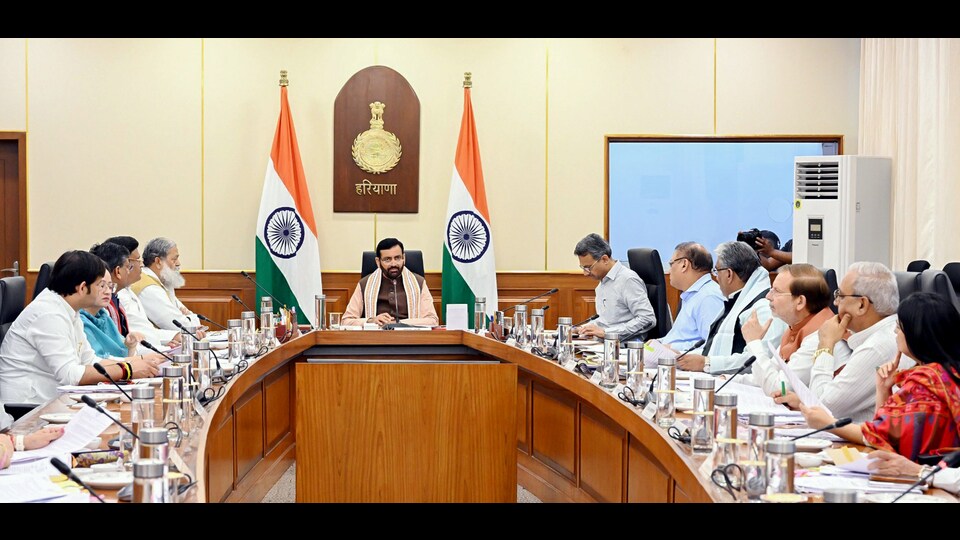
The Haryana Council of Ministers, which met under the chairmanship of chief minister Nayab Singh Saini here on Sunday, approved the proposal to introduce Haryana Jan Vishwas (Amendment of Provisions) Ordinance, 2025. This initiative aligns with the Union government’s vision of reducing compliance burdens and decriminalising minor offences across various sectors.
The Haryana Jan Vishwas Ordinance, 2025, seeks to decriminalise 164 provisions contained in 42 state Acts administered by 17 departments. The ordinance replaces criminal penalties for minor technical and procedural lapses with civil penalties and administrative actions. It also removes obsolete and redundant clauses, ensuring that the legal framework is more transparent, efficient and facilitative.
This reform initiative follows the enactment of the Jan Vishwas (Amendment of Provisions) Act, 2023 by the central government, which decriminalised 183 provisions across 42 central Acts.
“In pursuance of the advisory issued by the Union government, Haryana has undertaken a comprehensive review of its laws to adopt a similar approach at the state level,” a government spokesperson said.
The introduction of the Haryana Jan Vishwas Ordinance, 2025, was identified as a key action item during the 4th chief secretaries’ conference and forms an important component of the ongoing Compliance Reduction and Deregulation (CRD) exercise being coordinated by the cabinet secretariat.
“This ordinance marked a major shift from enforcement-based to trust-based governance,” said the spokesperson, adding that this ordinance represents the most extensive decriminalisation effort undertaken by any state government to date, with the highest number of criminal provisions proposed for removal.
Panchayati Raj (Amendment) Ordinance
The cabinet gave nod to amend Haryana Panchayati Raj Act, 1994, and issued Haryana Panchayati Raj (Amendment) Ordinance, 2025. Under it, the quorum of a gram sabha meeting shall be 40% of the members for consideration and approval of identified eligible beneficiaries of any government scheme. However, in the first and second adjourned meetings, the quorum shall be 30% and 20% of gram sabha members, respectively. This decision will not only bring transparency in the Panchayati Raj system but will further improve their functioning as well, the spokesperson said.
Merger of housing board and HSVP
Approval was given to the proposal to introduce the Haryana Housing Board (Amendment) Bill, 2025, during the next assembly session. The move is aimed at enabling the merger of the Housing Board Haryana (HBH) with the Haryana Shehri Vikas Pradhikaran (HSVP).
The amendment seeks to streamline urban development and housing functions by eliminating administrative overlap and enhancing efficiency in service delivery to citizens. The amendment does not carry any direct financial implications, as the operational aspects of the merger will be managed through existing administrative mechanisms, the spokesperson said.
Amendment in common land rules
The cabinet gave nod to amend Rule 6(2) of the Punjab Village Common Lands Rules, 1964, for making provision that out of the land proposed to be leased out for cultivation, 4% land shall be reserved for persons with benchmark disability of 60% or above.
The cabinet also approved amendment in Rule 6(2A), making provision for lease of land for the purpose of establishing “gau abhyaran” by animal husbandry department or Haryana Gau Sewa Aayog for a period of 20 years at the rate of ₹5,100 per acre per year on certain terms and conditions.
Approval was also granted that gram panchayats would be able to prepare the utilisation plan for the land up to 250 acres at its own level. Earlier, this limit was up to 100 acres. In case, a panchayat samiti or zila parishad does not agree or approve the plan within a specified period, the gram panchayat may make an application before the state government for appropriate decision.
Women’s employment in factories
The cabinet approved an amendment in the Punjab Factories Rules, 1952, permitting employment of women in certain processes in factories. The proposed amendment will allow the online submission of fees applicable under the rules and employment of women in all categories of work subject to prescribed safety conditions. The amendment will eliminate gender disparity, expand employment opportunities for women, and promote inclusivity in industrial sectors such as engineering, chemicals and manufacturing where women’s participation was earlier restricted, the spokesperson said.
The amendment ensures that pregnant women and lactating mothers are excluded from hazardous employment categories.
Habitual offender defined
The cabinet approved amendments in the Haryana Prison Rules, 2022, to incorporate the definition of habitual offender. Under the amended Haryana Prison (Amendment) Rules, 2025, habitual offender will mean a person who during any continuous period of five years, has been convicted and sentenced to imprisonment on more than two occasions on account of any one or more of the offences committed on different occasions and not constituting parts of same transaction, such sentence not having been reversed in appeal or review.
“Provided that in computing the continuous period of five years referred to above, any period spent in jail either under sentence of imprisonment or under detention shall not be taken into account,” reads the amendment.
AIDS prevention
The cabinet gave nod to framing state rules under sub-section (1) of Section 49 of the Haryana Human Immunodeficiency Virus and Acquired Immune Deficiency Syndrome (Prevention and Control) Act, 2017. These rules also define the functions and responsibilities of the ombudsman, with a focus on protecting the rights and entitlements of children as well as persons affected by HIV, a government spokesperson said.
The Haryana government will involve the private medical sector in delivering diagnostic and treatment services to HIV-positive persons. Private healthcare providers will have to report all HIV-positive cases to the nearest integrated counselling and testing centre or government hospital for further management and treatment, while strictly upholding individuals’ human rights, including the right to privacy.
Under the new rules — Haryana Human Immunodeficiency Virus and Acquired Immune Deficiency Syndrome Rules, 2025 — the state government will designate the commissioners of its six administrative divisions to act as ombudsmen.
Their role, as outlined in Section- 23 of the Act, will be to handle complaints and grievances of people living with HIV/AIDS. Each ombudsman will operate within their respective divisions—Rohtak, Hisar, Karnal, Gurugram, Faridabad and Ambala—and will be supported by the civil surgeon of the concerned district.
The state government will take necessary steps to strengthen diagnostic facilities and provide free diagnostic services at all government health institutions. In addition, free anti-retroviral therapy (ART) drugs will be made available to all HIV-positive individuals at ART centres, facility-integrated ART (FIART) centres and link ART (LART) centres, in accordance with National AIDS Control Organisation’s guidelines.


