
 E-Paper



Himachal PWD seeks ₹37 crore additional fund to save sinking Ridge
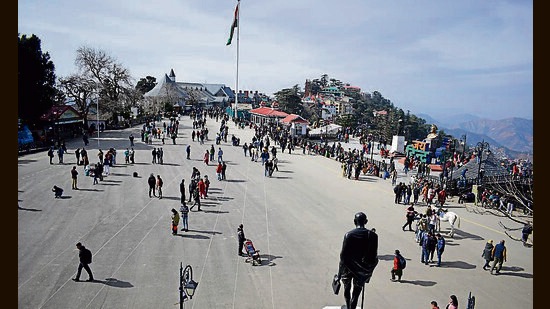
The Ridge is the most photographed wide-open street located on the side of Shimla Mall Road, which is sinking; the PWD had undertaken a project to restore the Ridge last year in June after a 60m stretch between Heritage Town Hall and the Padam Dev Market Complex on the Ridge developed cracks.


Amid the emergency evacuation of residents from Joshimath in neighbouring Uttarakhand, the HimachalPradesh public works department (PWD) sought an additional ₹37 crore from the urban development department to restore Shimla’s “sinking heart”, the historic Ridge.
“The initial cost of the project was ₹30 crore. We faced more geological problems while carrying out restoration. PWD now requires additional funds to restore the sinking portion (area),” said Praveen Kumar, Himachal PWD executive engineer and in-charge of the project.
“A fortnight ago, engineers from Roorkee visited the site and reworked the project cost,” he said adding that an additionalRs 37 crore was required to restore the project.
The Ridge, the most photographed wide-open street located on the side of Shimla Mall Road, is sinking.
“It sank almost two feet in 2019,” said Gopesh Behl, subdivisional engineer, Shimla municipal corporation (MC).
The PWD had undertaken a project to restore the Ridge last year in June after a 60m stretch between Heritage Town Hall and the Padam Dev Market Complex on the Ridge developed cracks.
In 2019, the MC roped in engineering experts from the Indian Institute of Technology (IIT), Roorkee, to find a long-term solution to stabilise the sinking portion of the Ridge, which spans over roughly 10,000 square metres. In 2020, the urban development department had sanctioned an amount of ₹30 crore for stabilisation of the Ridge under the smart city project.
“The cost has escalated from ₹30 crore to ₹67 crore completed by this year-end,” says municipal commissioner Ashish Kohli.
Experts concluded that the Ridge was sinking perpetually due to loose soil strata. The government shifted the Tibetan Refugee Market below the Ridge to Ajvika Bhawan near the Lift.
IIT Roorkee‘s comprehensive Ridge stabilisation plan envisaged construction on walls along the sliding area to stabilise the sliding slopes and fill the loose soil strata with concrete. “There is a water storage tank beneath the ridge which has a storage capacity of the 8 MLD. Over the years, the tank had developed cracks. To check water seepage, the Shimla Jal Prabadhan Nigam carried out repairs. The repairs were carried out at the time of the pandemic-induced curfew. It was during the routine inspection that MC had noticed cracks inside the tank,” said Adarsh Chuahan manager at SJPNL
The reservoir was built in the 1880s with lime mortar and without using any cement.
Apart from the Ridge, there are many portions of Shimla that are sinking due to waterlogging, owing to poor drainage systems. The town and country planning department last year hired Mars planning and engineering services limited to draw the draft of the development plan for Shimla, which identified other portions, including a grand hotel, Lakkar Bazaar, central school, Auckland nursery school building, Dobhi Ghat, which were sliding. The National Highway Authority of India has identified a tract of Shimla Tutti Kandi Bypass, which was shrinking constantly near Mehli last two years. The stretch of Shimla’s ancient Kali Bari Mandir, connecting the Mall Road, is constantly sinking, posing a threat to areas below it, including the headquarters of the Army Training Command. Shimla development plan 2041 draft prepared in 2022 highlighted that the town is growing beyond its seams by leaps and bounds.
Ribbon development along the Highways and even along the minor roads emanating from the city is a common feature. A vast cityscape is in the formation. While the already existing areas have also got congested, the fringes and peri-urban areas, especially prominent ridges like Sanjauli, Cemetery, Dhalli, Bhattakufar, Mehli, Kangnadhar, Khalini, Bharari etc. are acquiring considerable proportions of development.
Former mayor Sanjay Chauhan said, “Actually the town didn’t have any development plan then. An interim was drawn in 1979 but it wasn’t implemented and thus haphazard construction took place everywhere.”
Shimla was originally planned for a population of 25,000 people, but it now accommodates more than 2.4 lakh people besides the floating population of tourists. As per state geologist Puneet Guleria, 90% of the core city area has been built on slopes more than 60 degrees, thus making these constructions against architectural and geological norms. These factors make Shimla susceptible to natural disasters


