
 E-Paper



Himachal to tie up with int’l hotel chain to run Wildflower Hall
Week after getting back possession of prized property at Chharabra in picturesque Shimla hills, cash-strapped Sukhvinder Singh Sukhu-led Congress govt exploring options to find suitable partner to run luxury hotel


The picturesque Wildflower Hall nestled in the Shimla hills -- once the summer retreat of British Field Marshal Horatio Herbert Kitchner in 1902 that was turned into a high-end luxury hotel by the turn of the century -- has been caught in a legal tangle for two decades.
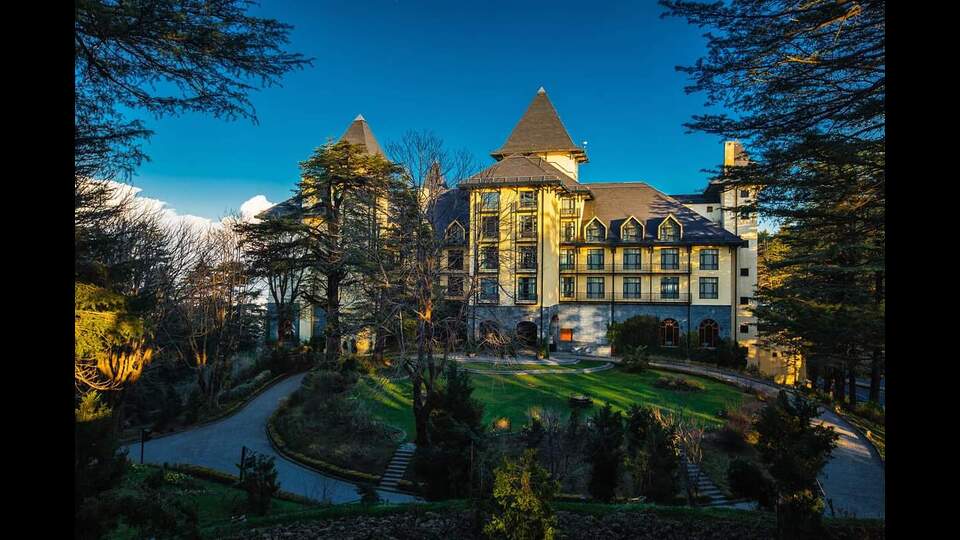
After the Himachal Pradesh high court’s January 5 order to the Oberoi Hotel Group to hand over the possession of the prized property to the cash-strapped state government within two months, it is learnt that chief minister Sukhvinder Singh Sukhu, who also holds the tourism portfolio, has begun exploring options to tie up with an international chain of hotels to run it.
The order comes as a shot in the arm for the Sukhu-led Congress government that has been struggling with a ₹75,000-crore debt burden.
Expressing the government’s commitment to developing and maintaining the luxury property, state additional chief secretary, tourism, Onkar Sharma said, “Our efforts are on track. We have filed a caveat with the Supreme Court also in case the company moves against us.”
Last June, Sukhu had ordered the execution of a 2005 arbitration award under which the Wildflower Hall property spread over 100 hectares, including a pristine deodar forest, was to be taken over by the Himachal Pradesh Tourism Development Corporation (HPTDC).
How govt got back property
HPTDC managing director Manasi Thakur Sahay said the Oberoi Group was liable to pay ₹1.67 crore to the state government as lease rent under the award along with statutory interest due from the date the court ordered both parties to appoint a chartered accountant to settle the financial matters in this regard.
Disposing of the government’s application, the high court said the Oberoi Group had failed to comply with the arbitration award within the stipulated three months. Therefore, the state government became eligible to take over the possession and management of the luxury hotel.
The high court had sent the case to the arbitrator for settlement. The arbitrator upheld the government’s decision to cancel the contract with the company in 2005 and entitled it to take back the property.
The Oberoi Group moved the high court, challenging the single bench’s decision. Rejecting the company’s appeal, the bench ruled that the arbitrator’s decision was correct and logical. “The East India Hotels Ltd (owned by the Oberoi Group) and others had failed to perform their part obligated under the award within three months and hence had lost the rights, titles, and interest in the property, and consequently, the state government had become entitled to resume the property subject to the condition imposed in the award,” a senior tourism department functionary said, adding that nothing has been paid by the company yet.
Rather than performing its part obligated under the award, the company had dragged the litigation for more than 19 years.
Dispute and termination
The dispute over the property erupted after global tenders were invited to re-develop it as a five-star hotel. East India Hotels Limited, a flagship company of the Oberoi Group, also participated and the state government decided to work in partnership with it. Under the joint venture, a company called Mashobra Resort Limited was formed to build the five-star hotel within four years. For not doing so, the company had to pay a fine of ₹2 crore every year to the state government.
In 1996, the government transferred the land in the name of the company. But even after six years, the company could not make the hotel ready for use. The state government terminated the agreement on March 6, 2002, citing a breach of terms amid ongoing issues such as the non-functionality of the hotel within the mandated six years and the non-regularisation of 57 rooms by the town and country planning department.
This decision of the government was challenged before the company law board, which ruled in favour of the company.
The government challenged this decision before a single bench of the high court. The political dimension of the dispute also cannot be ignored, given that the joint venture was established during the Virbhadra Singh-led Congress regime and terminated by the BJP government under PK Dhumal, citing concerns about “selling Himachal’s interests”.
Legacy and history
According to records, Wildflower Hall was originally owned by GHM Batten, the private secretary of the Earl of Lytton. The Colonial-era building was gutted in fire. Batten reconstructed the building and Lord Kitchner, the then commander-in-chief of the Indian armed forces, secured the lease from its owner. He returned to England in 1909 after which it was sold to a British couple, who razed the house in 1925 to erect a three-storeyed hotel with 37 rooms.
After Independence, the property was taken over by the Government of India that ran an agricultural school in it till 1973 when it was handed over to the HPTDC to run a hotel. The HPTDC built 11 cottages and four rooms, a multipurpose hall and a green room.
On April 5, 1993, the building was destroyed in a fire caused by a short circuit. However, the HPTDC kept running the cottages and four other rooms that had survived the blaze till the Himachal Pradesh government signed a joint venture with the Oberoi Group to rebuild Wildflower Hall as a luxury hotel.


