
 E-Paper



International delegates visit museums at PAU, discuss digital storytelling
The 20th International Congress of Agricultural Museums continued with discussions on digital storytelling and the archaeology of food. Delegates also visited various museums at Punjab Agricultural University.


The 20th Triennial International Congress of Agricultural Museums, organised by the International Association of Agricultural Museums, entered the second day at Punjab Agricultural University (PAU) on Tuesday.
Pete Watson, director of Howell Living History Farm, USA, and Dr Debra Reid, curator of agriculture and the Environment at The Henry Ford Museum, Michigan, USA, spoke on agricultural museums as a bridge between land traditions and everyone else.
Sajan Joseph, Ctrl Alt Experience, Hyderabad, and Surajit Sarkar, curator, Neighbourhood Museums Programme, Ambedkar University Delhi; and curator, Kerala Museum, Kochi, coordinated the panel discussion on digital storytelling with thrust on objects, images and stories with technology at agricultural museums.
Kurush Dalal, director of the INSTUCEN School of Archaeology, Mumbai, gave a presentation on “The archaeology of our food, or why we eat what we do?”
Nerupama Modwel, Principal Director, Intangible Cultural Heritage Division, INTACH, moderated discussion on agriculture museums, collections and improving storytelling possibilities.
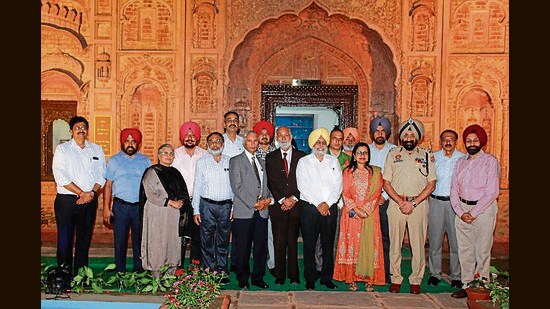
At the Museum of Social History and Rural Life of Punjab, a special evening, featuring fast-paced bhangra and giddha as well as display of a rich collection of phulkari, enthralled the audience. World Food Prize laureate GS Khush, accompanied by his wife HK Khush, vice-chancellor Satbir Singh Gosal, Ludhiana police commissioner MS Sidhu, Ludhiana municipal corporation commissioner Sandeep Rishi and the delegation members were present at the event among others.
The visiting members were shown the Green Revolution Museum which traced the history of pre and post-partition India, revolutionary varieties of wheat (Lerma Rojo 64 and Kalyan Sona 227) and rice (IR 8 and PR 106) which filled the nation’s food kitty, and outstanding contributions of PAU produced agricultural stalwarts –DS Athwal, GS Khush and former PAU vice-chancellors PN Thapar and MS Randhawa in moulding the future of farmers and agriculture.
The delegates also visited Crops Museum where they were apprised of historical development of agriculture via plant breeding, PAU developed landmark varieties and presently recommended crop varieties of wheat, rice, maize, cotton, pulses, oilseeds, forage and millets, and sugarcane.
While visiting Soils Museum and HL Uppal Museum of Land, Water and Power Resources, experts informed about soil formation, soil map, soil heritage, soil conservation, water level depletion and soil health deterioration, soil challenges and region’s water, land and power resources.
During their visit to Farm Machinery Museum, experts explained how PAU catapulted the agriculture to great heights by fortifying agricultural mechanisation. Farm machinery for agricultural and horticultural crops, lined-up in a row, impressed the delegation to a large extent.
At the Museum of Nature History and National Insect, knowledge was exchanged on unveiling of life’s evolution, biodiversity and tiny creatures that shaped the future of the world.


