
 E-Paper



Ludhiana | CSIR-CMERI’s solar tree breaks Guinness World Record
Revolutionising the intertwined fields of agriculture and sustainable energy, the Council For Scientific and Industrial Research’s Central Mechanical Engineering Research Institute (CSIR-CMERI) have broken the Guinness World Record for the world’s largest solar panel

 Prefer HTon Google


Revolutionising the intertwined fields of agriculture and sustainable energy, the Council For Scientific and Industrial Research’s Central Mechanical Engineering Research Institute (CSIR-CMERI) have broken the Guinness World Record for the world’s largest solar panel.
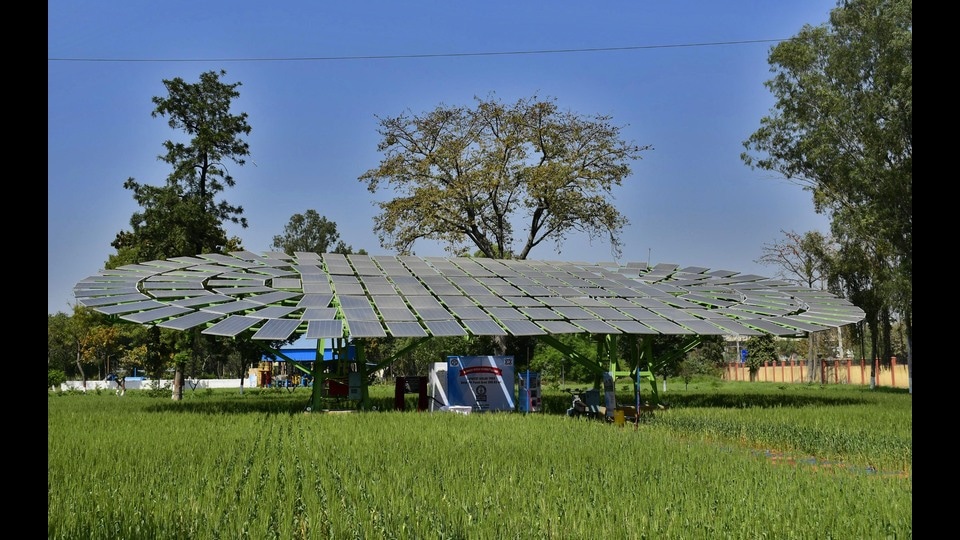
The solar tree, which has been installed at the CSIR-CMERI Centre of Excellence for Farm Machinery in Ludhiana, has a solar photovoltaics panel surface area of 309.83 square metres. The surface area of the last solar tree developed by CSIR-CMER was 67 square metres.
Planting seeds for a sustainable future
With 75% power generation in India dependent on diesel, switching to renewable energy, primarily solar, is the need of the hour.
On how it all started, CSIR-CMERI, Durgapur director professor Harish Hirani says, “We started with six solar trees ranging from 3KW to 11.5KW, which together generated around 50KW power. We then worked on the material and fabrication cost and started developing a single 50KW solar tree.”
Illustrating the viability of the solar tree in the agriculture sector, Hirani said, “Farmers don’t need a roof to install the solar tree. It can be setup in the fields itself, and will not even obstruct wind.”
“The solar tree will power integrated farming activities such as charging e-tractors, e-tillers and electric vehicle charging stations, running agriculture pumps and solar-based cooking systems and powering cold storages,” he said
Hirani said that the future of Indian farming will be drone based. “Drones will spray pesticides and water on the crops. The battery of the drones can be charged by the solar tree,” he said.
Cost-benefit analysis
A 53.6 kilowatts peak(Kwp) solar tree costs around 2.5 lakh crore. Asked if the farmers will be able to afford the cost of such solar trees, Hirani said that the ministry of micro, small and medium enterprises (MSME) will have to pitch in and a public-private partnership (PPP) model will be needed.
“Solar trees will be greatly beneficial to farmers in the long run.Moreover, cost will be controlled as we delve deeper into the concept. It will also cut down carbon dioxide emissions,” he said, adding that despite 14% shortage of food in the country, 30% food in India is wasted. “The schemes under solar integrated projects are such that people in the country will not be hungry and there will be no wastage of food.
What is a solar tree? (BOX)
A solar tree resembles a tree in shape, but has photovoltaic (PV) panels in place of its crown. The “leaves” of the tree capture solar energy and convert it to electricity, with branches funneling that electricity down through a trunk and into a central battery within.


