E-Paper



Out of shadows: When the mountain ghost chose to be seen in Dhauldhar Wildlife Sanctuary
Deputy Conservator of Forests Reginald Royston said the rare image was captured on 21 December 21, 2025, by a camera trap installed at an altitude of 2,836 metres above sea level.

 Prefer HTon Google


For the first time, photographic evidence of the elusive and endangered snow leopard (Panthera uncia), often referred to as the “Ghost of the Mountains,” has been recorded in the Dhauladhar Wildlife Sanctuary through a camera trap, officials said on Friday.
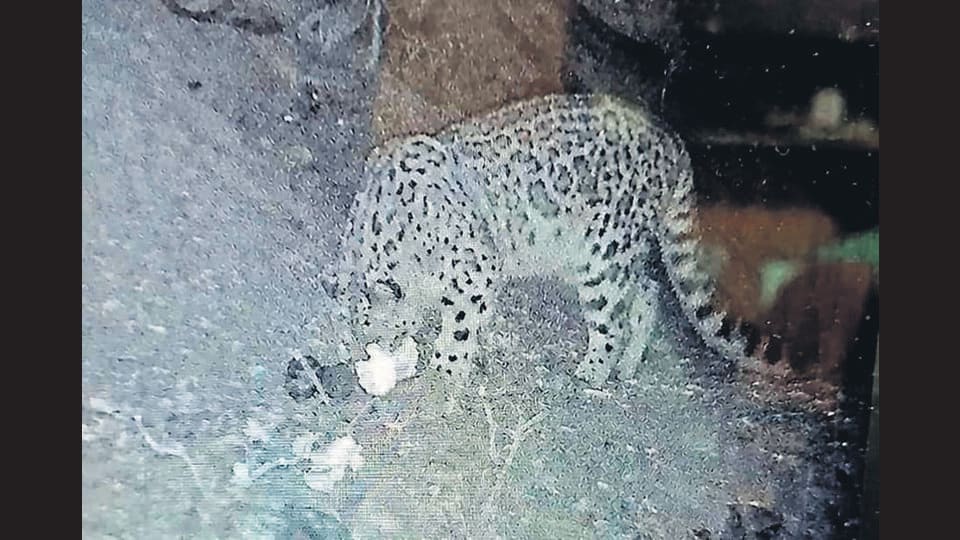
Deputy Conservator of Forests Reginald Royston said the rare image was captured on 21 December 21, 2025, by a camera trap installed at an altitude of 2,836 metres above sea level. Royston said the achievement is the outcome of the most extensive mammalian wildlife camera-trap survey ever conducted in the sanctuary. This marks a historic milestone in the scientific documentation of the sanctuary’s rich biodiversity.
Between 2023 and 2026, a total of 117 camera traps were deployed, generating 4,238 camera-trap days of survey effort. In addition, during the winter of 2025, more cameras were strategically installed along mountain ridges, passes, and natural wildlife movement corridors based on scientific assessments and local ecological knowledge.
The camera traps were installed jointly by the wildlife wing of the forest department and the Zoological Survey of India (ZSI). The image of the snow leopard was captured by a camera trap installed by the ZSI.
Camera-trap data is retrieved manually, a process that takes time. The data from the camera trap that captured the snow leopard’s image was retrieved and analysed recently.
“The confirmed presence of the snow leopard significantly enhances the conservation importance of the Dhauladhar Wildlife Sanctuary. It now joins the selected protected landscapes of the Western Himalayas where four apex predators, the snow leopard, Himalayan brown bear, Asiatic black bear, and common leopard, coexist within the same landscape. This highlights the sanctuary’s exceptional ecological richness and conservation value,” Royston said.
Dhauladhar Wildlife Sanctuary is a high-altitude protected area in Himachal’s Kangra district and spans 944 square kilometers.
According to researchers, the snow leopard photographed in the sanctuary was likely dispersing or moving beyond its usual range.
Royston said the discovery is another significant milestone in the scientific documentation of wildlife in the Dhauladhar Wildlife Sanctuary and stands as strong evidence of the region’s rich biodiversity. “The photographic record of the snow leopard is a powerful testament to the outstanding natural heritage of Dhauladhar range and will serve as an inspiring achievement for Himalayan wildlife conservation,” he said.
Notably, last year, the wildlife wing of the Himachal forest department concluded the state-wide assessment to estimate the snow leopard population, confirming robust snow leopard numbers. The results showed approximately 83 individuals, suggesting an increase in the population of snow leopards from the first population estimation exercise held in 2021, which estimated 51 individuals. The survey, the second of its kind after 2021, employed a large-scale camera trapping exercise across six sites representative of the 26,000 km² snow leopard habitat in the state.
The snow leopard density, as per the study, ranges from 0.16 to 0.53 individuals per 100 km², with the trans-Himalayan regions of Spiti and Pin valley, followed by Upper Kinnaur and Tabo, recording the highest densities.