
 E-Paper



Property tax hike: Hope for relief as Kataria, 11 Chandigarh mayors huddle on ways out
Following detailed discussion on solutions for Chandigarh MC’s deepening fiscal mess, administrator assured to consider the matter, says mayor Harpreet Babla


Amid mounting political pressure and public outrage over the steep property tax hike, Punjab governor and UT administrator Gulab Chand Kataria on Tuesday convened an urgent meeting with the city’s last 10 mayors, the incumbent and municipal commissioner Amit Kumar to discuss the Chandigarh Municipal Corporation’s deepening financial crisis.
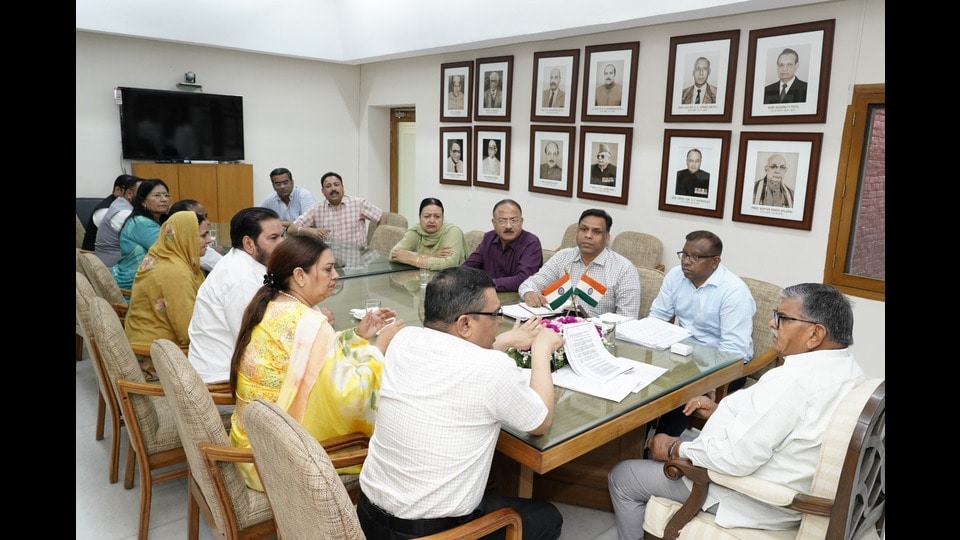
The meeting was marked by a long and detailed discussion on ways to boost MC’s dwindling revenues. While no immediate announcement on any relief from the tax hike was made, Kataria did call another meeting of MC and UT officials on Wednesday, igniting hope for a rebate.
The meeting came a day after a Bharatiya Janata Party (BJP) delegation, led by city party president Jatinder Pal Malhotra and mayor Harpreet Kaur Babla, met Kataria, demanding an immediate roll-back of the tax hike, calling it an “unbearable financial burden” on residents and traders alike.
During Tuesday’s meeting, both former and current mayors expressed serious concern over the civic body’s financial mismanagement and the decision to impose a sudden, sharp hike—tripling residential property tax from 3% to 9% of the Annual Rateable Value (ARV), and doubling commercial property tax to 6%.
“We urged the administrator to reconsider and roll back the hike. He gave us a patient hearing and assured us that the matter would be considered. We are hopeful of the relief soon,” said Mayor Babla after the meeting.
Former AAP mayor Kuldeep Kumar Dhalor said the UT administration had withheld profitable departments while pushing the corporation into deeper debt. “The financial crisis cannot be solved by burdening citizens. Instead of sudden, steep hikes, tax rates should have been increased marginally over time,” Dhalor said, adding that the stalled development work across Chandigarh was a direct consequence of the civic body’s financial mismanagement.
As per BJP insiders, while the hike could be revised, a complete withdrawal was unlikely.
Mayor, former mayor suggest ways to boost MC’s revenue
Former mayors collectively demanded that revenue-generating departments, such as the Registering and Licensing Authority (RLA) and electricity duty collection, be handed over to MC to make it financially self-reliant.
Mayor Babla said, “Maximum works in the city are carried out by MC, but we only have service-providing departments while most of the profit-making departments are with the UT administration. We also pressed for the implementation of the 4th Delhi Finance Commission recommendations and sought an immediate release of additional funds, to resume essential municipal services.”
Former mayor and senior BJP leader Arun Sood said, “We agree that the property tax should be increased but a sudden steep hike is unjustified. Since 2017, the tax has not increased. Instead of a sudden increase, the UT administration should introduce the increase after every few years. Also, we highlighted that the worsening MC financial crisis is not because of mismanagement of funds or excessive manpower, but because of discriminatory sharing of funds between MC and UT administration. As per rules, MC should get 30% of the total grant from Centre to UT, but we are getting just 6-7%, resulting in the fiscal crisis.”
Property tax is MC’s biggest revenue source
For the cash-strapped MC, property tax is the biggest revenue source at present, besides water bills, electricity cess and garbage collection charges.
Plagued by a debilitating fiscal crisis, which has halted development works and delayed staff salaries, and no special assistance from the UT administration, MC had in February this year sought to raise property tax across all categories by four times, which could have boosted its annual revenue by around ₹200 crore.
On March 31, the UT administration, while not accepting the proposal as is, approved an up to three-fold hike, applicable from April 1, 2025.
Chandigarh has around 31,000 commercial properties, contributing ₹36 crore in property tax and around 1,08,500 residential properties that generate an additional ₹9 crore, adding around ₹45 crore to MC coffers annually.
With the hike, this figure was expected to jump by ₹54 crore annually, bringing in ₹72 crore from commercial and ₹27 crore from residential properties —a major boost for the cash-strapped MC.


