
 E-Paper



Ludhiana: PAU frame crop contingency plan to restore flood-hit farms
The flood crisis in the state, triggered by incessant rainfall since July first week has submerged more than two lakh hectares of fields, leaving farmers facing imminent losses


In a bid to alleviate the damage done by the recent flood and provide a lifeline to the agricultural community, experts from Punjab Agricultural University (PAU) have devised a comprehensive contingency plan to aid farmers in mitigating the extensive damage caused by the calamity.
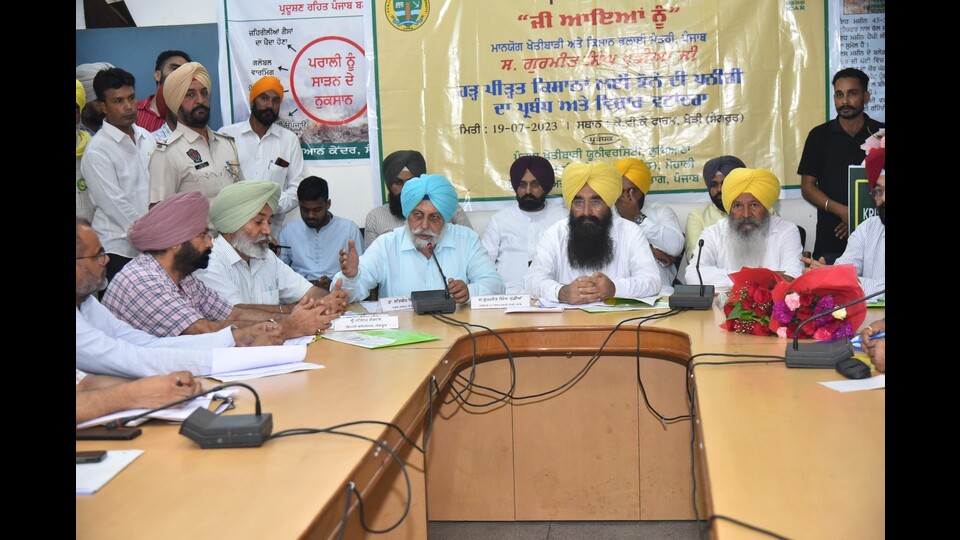
The flood crisis in the state, triggered by incessant rainfall since July first week has submerged more than two lakh hectares of fields, leaving farmers facing imminent losses.
The proposed solution lies in the transplantation of two short-duration rice varieties, PR 126 and pusa basmati 1509. PAU vice-chancellor (V-C) Satbir Singh Gosal elaborated on the rationale behind this choice, highlighting that long-duration rice varieties would prove unfeasible due to their extended maturation period of 110 to 130 days after transplanting. In contrast, the PAU-developed PR 126 boasts an impressive maturity period of just 93 days after transplantation. This early-maturing variety would allow farmers to sow late without incurring significant losses, while also enabling them to sow the next wheat crop in a timely manner.
Ajmer Singh Dhatt, the director of research at PAU, highlighted the benefits of PR 126, emphasising its outperformance compared to other varieties.
To expedite the implementation of the contingency plan, Dr Gurmeet Singh Buttar, the director of extension education at PAU, said utilising their vast network of krishi vigyan kendras (KVKs) and regional research stations/seed farms, PAU has sown PR 126 and pusa basmati 1509 nurseries on approximately 30 acres. These nurseries are projected to be ready for transplanting in just 25-30 days. By August 10, farmers will be able to procure these varieties from various PAU stations, KVKs, the department of agriculture, Punjab, and PUNSEED. Transplanting before August 15 holds the key to safeguarding their yield. Furthermore, PAU’s recently developed surface seeding method after paddy harvesting will allow farmers to sow the next wheat crop on time.
For farmers who seek alternatives to rice, Buttar offered viable options like toria, fodder crops, sugarcane and select vegetable crops. He laid out comprehensive guidelines for each crop type, detailing the necessary steps to recover and minimise further losses amid the challenging floods in Punjab.
Agri varsity inks MoA for apple cider vinegar technology
PAU has entered into an agreement with Sharva Pharmaceuticals, Muzzafarnagar, Uttar Pradesh, for licensing of apple cider (vinegar) technology. AS Dhatt, director of research, PAU, and Pankaj, proprietor, Sharva Pharmaceuticals, signed a memorandum of agreement (MoA) on behalf of their respective organisations. As per the agreement, the university offers non-exclusive rights to the firm for this technology.
Dhatt and Gursahib Singh Manes, additional director of research (farm mechanisation and bioenergy), PAU, congratulated Dr GS Kocher, principal microbiologist-cum-head, department of microbiology, for the commercialisation of this technology.
Manes, director of technology marketing and IPR cell, said PAU has signed 326 MoAs and commercialised 78 technologies, including hybrid lines of mustard, maize, chilli, brinjal, biofertilisers, leaf colour chart, water testing kit and other technologies.


