
 E-Paper



Punjab: Brace for final farm fire burst in Malwa
Agriculture officials say it may take another 8-10 days before the kharif harvest is over in Punjab’s Malwa belt. Ferozepur has recorded the highest number of 2,788 farm fires in the south-west region


There may not be immediate relief from air pollution caused by rampant burning of crop residue in Punjab as till Monday, about two lakh hectares (10%) under rice cultivation in the state’s Malwa belt is yet to be harvested.
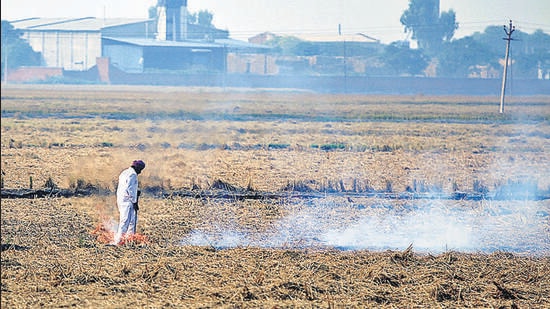
Agriculture officials say it may take another 8-10 days before the kharif harvest is over in the Malwa belt. Harvesting in Majha and Doaba belts has already been completed.
The agriculture department has advised farmers to clear their fields and complete wheat sowing by November 15. As the window between clearing fields of stubble and sowing wheat is narrow, farmers may resort to intensive straw burning.
This kharif season, various varieties of parmal (PR) and basmati were sown on 30.82 lakh hectares.
Total of 14 districts of the Malwa area of Punjab have about 21 lakh hectares under rice cultivation whereas Majha belt has nearly 6 lakh hectares and the remaining 4 lakh hectares are sown in Doaba districts.
State agriculture director Gurvinder Singh said till Monday, rice was harvested in 90% area and the remaining area is likely to be cleared in another week.
“Paddy harvesting is almost over in Majha and Doaba region. It is only the Malwa belt, which has about 68% of the total paddy area where harvesting is in the final stage and farmers will complete the operations to expedite the next rabi crops. In fact, wheat sowing has advanced in different parts of the state and almost 40% area of the estimated 35 lakh hectares has already been accomplished,” he said.
Agriculture experts say the southwest districts are known for growing late-sown varieties whereas Majha and Doaba regions, which have a share of 19% and 13% of the state’s paddy area, respectively, have a tradition of preferring early sown varieties.
All seven districts of the region cultivate about 11 lakh hectares or 35% of Punjab’s total area under rice farming.
Also, these districts are key contributors to the farm fires. Out of today’s reported 2,487 events of stubble burning, 1,694 were from the seven districts of the region, including Bathinda, Ferozepur and Moga.
Traditionally, the region comprises almost 45% of farm fire incidents reported from all 23 districts of Punjab.
According to information gathered from the state agriculture authorities on Monday, Faridkot has 15% kharif crop that is still to be harvested.
Faridkot chief agriculture officer (CAO) Karajit Singh said the district has 1.15 lakh hectares under rice cultivation.
“Out of 1.05 lakh hectares under parmal varieties, 85% has been harvested. About 5,000 hectares of basmati rice are yet to be harvested. We hope that it will be completed in another 10 days,” he added.
Ferozepur has recorded the highest number of 2,788 farm fires in the southwest region and has still 10% area to be harvested.
The CAO said a sizeable part of the 1.87 lakh hectares, farmers sow the PUSA-44 variety known for producing the highest organic waste and consuming more water.
“Farmers have started sowing wheat after harvesting late-sown rice varieties,” he said.
The CAO of Muktsar, Gurpreet Singh said it is premature to opine that farmers do not burn the residue of basmati varieties.
“Harvest of non-basmati on 1.10 lakh hectares is almost over and 70,000 hectares of basmati is advancing. But we are still keeping a track of burning of the crop residue,” he added as the district reported 257 farm fires on Monday bringing it to 1,385 this season.
On Monday, Ferozepur recorded 353 cases, Moga 268, Bathinda 256, Faridkot 217, Barnala 202, Sangrur 180, Fazilka 177, Mansa 165, Ludhiana 177 and Patiala 85 cases.
On Sunday only 599 cases were reported from Punjab. “We are anticipating that farm fires will reduce at the end of this week. However, we can say that the number of farm fires will certainly reduce from that of the last year,” said an official of the PPCB.
“Because of the cloudy conditions on Sunday, thermo-sensors could only detect large fires while satellite images could not catch small fire events,” said an official of the remote sensing department.
--- With inputs from Vishal Rambani & Mohit Khanna


