
 E-Paper



Punjab floods wipe out crops on 3-lakh acres; silt may delay rabi sowing
To date, the assessment of 3.5 lakh acres has been completed, and the state is collating the data of the rest of 1.5 lakh acres; the state government is likely to send a memorandum of losses to the Centre on Wednesday

 Prefer HTon Google


Even as the state government is trying to conclude its special girdawari to assess flood damage, Punjab Agricultural University (PAU) has flagged the issue of thick silt deposits in fields, which, experts say, farmers cannot clear on their own to make the land cultivable again.
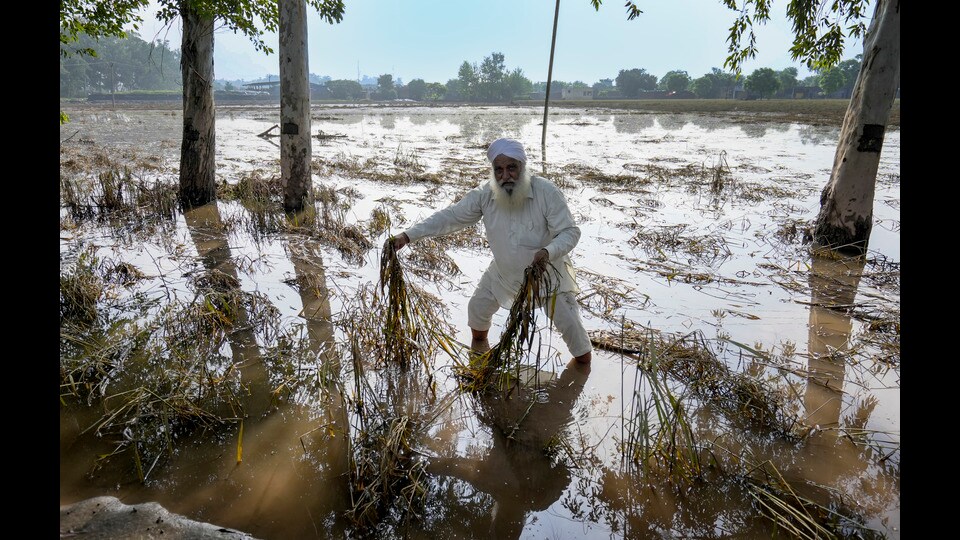
According to preliminary reports collated from the girdawari being conducted by the revenue department, out of the 5 lakh acres of farmland affected due to floods in August-September, the crop over 2.97 lakh acres has suffered 100% damage.
To date, the assessment of 3.5 lakh acres has been completed, and the state is collating the data of the rest of 1.5 lakh acres. The state government is likely to send a memorandum of losses to the Centre on Wednesday.
“We are compiling the report, and a conclusion has been reached that at least 3 lakh hectares of crop is completely damaged,” said chief secretary KAP Sinha. Sinha added that a total of 5 lakh acres was affected by floods, and assessment of loss to 1.5 lakh acres is being ascertained. A revenue department official, privy to the assessment exercise, said that at least 9,000 houses have been reported to be completely damaged.
The assessment of loss to milch animals and other properties is being compiled,” he added, pleading anonymity.
As per the girdawari report, total crop area affected by silt is 85,863 acres, and district Ferozepur is the worst-affected with 25,273 acres covered under silt, followed by Tarn Taran (25,204 acres); Kapurthala (15,803 acres); Fazilka (5,104 acres); and Moga (5,031 acres). However, the layer of silt deposited over the farmland is yet to be ascertained.
Removing silt is a massive task: PAU
Meanwhile, the PAU said that removing silt from the fields is beyond many farmers, and as per their study, at some places the layer is as thick as 5 feet.
Explaining the Herculean task, PAU vice-chancellor SS Gosal explained that one foot thick silt over one acre will require at least 350 trolleys.
“It will take lots of time and cost, which, in my opinion, farmers lack the resources,” the VC said.
Dr Gosal adds that the scale of silt that has accumulated in the fields is so huge that it cannot be removed by the end of the paddy sowing season.
“In several places in the flood-hit regions, most likely the farmers would not be in a position to cultivate the wheat, “ he said, urging the government to come out with a plan to support the dredging work.
“We have allowed the farmers to sell sand until December. Hopefully, a system will be developed for the disposal of the mineral,” said a senior official in the Punjab government.
CM Bhagwant Mann, during the two-day special session of Punjab vidhan sabha had announced a sum of ₹7,200 per acre for desilting of sand from the flood-affected fields and 2 lakh quintal wheat seeds for fresh cultivation.
During his address, Mann had also assured that the government will start disbursing flood-relief compensation to affected individuals before Diwali (which falls on October 20).
While the House had passed a resolution seeking a ₹20,000-crore special package from the central government, the CM had also met Union home minister Amit Shah regarding flood aid.
The state government had announced a compensation of ₹10,000 for per-acre farmland with 26 to 33% crop loss, for 33 to 75% crop loss, the compensation was enhanced from ₹6,800 to ₹10,000 per acre. For 75 to 100% crop loss, the compensation will be ₹20,000 per acre.


