
 E-Paper



Punjab paddy farmers battle fungal disease, discolouration
Agriculture officials have flagged false smut as the most concerning issue; the issue came to light this year because persistent rains during the flowering period disrupted the spraying schedule, says PAU’s plant bacteriologist

 Prefer HTon Google


As early procurement of paddy begins across the state, farmers are facing crop challenges, including discoloration, false smut disease and brown planthopper infestations.
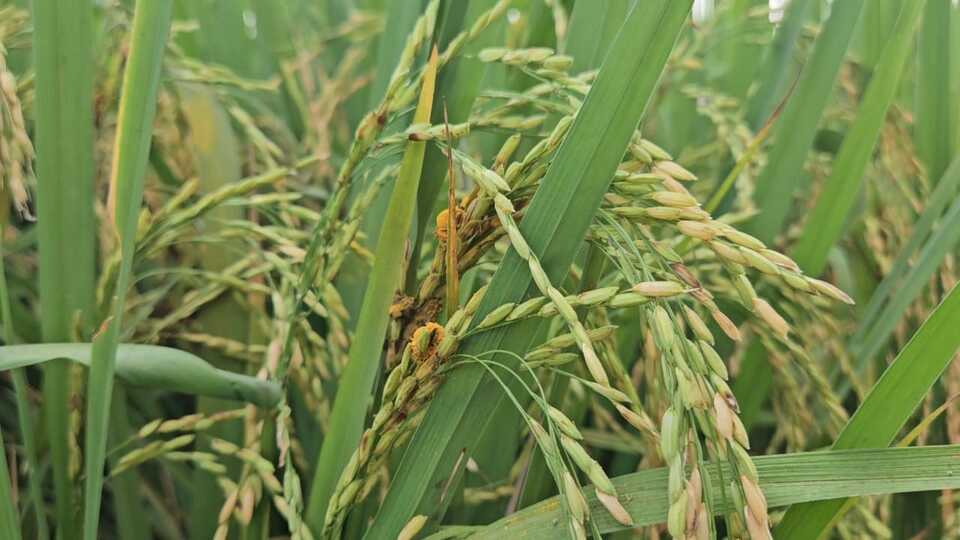
Agriculture officials have flagged false smut—a fungal disease—as the most concerning issue. Narinderpal Singh, agriculture development officer, said the disease, which replaces rice grain with yellow spore ball on the panicle and reduces the paddy quality, has seen a sharp increase this year due to heavy rains and conducive weather conditions.
“While false smut appears annually, this season it is more widespread. Farmers have been advised to apply chemical sprays recommended by Punjab Agricultural University (PAU) to contain the disease,” he said.
Regarding discoloration, he said though it doesn’t affect the crop’s health, it would reduce the luster of the seeds and may lower their market price. He advised farmers to use fungicides to address this issue.
Farmers are also dealing with the brown planthopper, although experts say the pest is under control. Rubaljot Kooner, principal entomologist at the PAU, noted that while it is rising, there is no panic yet. “No widespread hopper burn has been reported, and precautionary checks are ongoing,” Kooner said.
Mandeep Singh Hunjan, principal plant bacteriologist at Punjab Agricultural University, Ludhiana, explained that the infection (false smut) typically occurs during the pollination stage. “The issue came to light this year because persistent rains during the flowering period disrupted the spraying schedule. Overuse of nitrogen fertiliser is also a contributing factor,” he said. Hunjan dismissed concerns that false smut is infectious/communicable and added that while it affects grain quality, it does not significantly reduce yield. He said that once the infection affects the plant, it cannot be converted back into the grain no matter how much spray is used.
The experts, however, are unsure on the scale of damage across the state.
A local farmer, Jagdev Singh, who cultivates six acres of paddy, reported that 15–20% of his crop has already been affected. “Officials should have inspected fields earlier. Many farmers didn’t know about the issue, and now the damage is done. With harvesting still days away, more crop could be impacted,” he said.


