
 E-Paper



Roundabout | Bhiwani Junction and religion of amity
Talking of heritage in which Muslim artisans painted Hindu myths, one is reminded of the precious legacy of the subcontinent that has nurtured a composite culture represented by people of different faiths who followed the religion of amity


Bhiwani Junction was in focus in the art circles of the city this week, with painter Ram Pratap Verma burning the midnight oil and living off his savings for some two years to come up with love’s labour, a beautiful book and a fine film dedicated to his hometown. His theme, of course, is Wall Painting: The Vanishing Treasure.
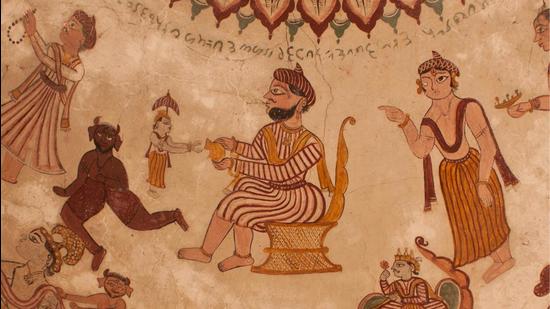
A tremendous task accomplished individually sans any grant or patronage. The Chandigarh Lalit Kala Akademi launched the book at the museum auditorium, with our beloved art historian BN Goswamy doing the honours of releasing it and speaking of vanishing heritage beyond ornamentation on the walls of the old and ravaged havelis.
A couplet that came to mind, while being a part of the delightful evening was one of Bashir Badr’s: Imaraton ki bulandi pe koi mausam kya/Kahan se aa gayi kache makan ki khushbu (The season is celebrating impressive edifices, Wither comes the fragrance of a mud house).
Muslim artisans for Hindu temples
In his narrative on the vanishing wall paintings, Verma points out that some figures with taweez (phylactery) on their arms, and in one painting the attire of Lord Shiva is that of a Muslim imperial pointing to the fact that many of the painters were Muslims.
There is yet another instance of Asura Vaman Avtar with a Muslim style beard and the painting of Mahabali is rendered in the style of the Muslim miniature paintings. Verma says, “Many such evidences point out that there were painters of the Muslim faith who were painting the Hindu themes. It may seem unthinkable now in times of communal polarisation but the paintings give evidence to the fact that there were strong bonds between the members of the communities of the two faiths.”
Commenting on the trend of the times, Goswamy points out: “This was something quite elemental to those times and there is evidence that Muslim artisans built several Hindu temples too”.
Citing the famous Raghunath Temple, which is a collection of seven shrines in Jammu city that was built by Maharaja Gulab Singh and Maharaja Ranbir Singh from 1853 to 1860, Goswamy said the temple had distinct features of Mughal Masonary.
Intrigued, Goswamy checked the papers of the temple in the office as part of his research and found a record of payment made to the masons. “It was interesting to note that the temple had been built by all masons belonging to the Muslim faith. The prejudices we come across in these times cannot negate the fact that the two dominant communities of the sub-continent lived in harmony respecting one another’s religious beliefs and sentiments,” he says.
The tradition continues
What is heartening that no matter what the divisive voices say on both sides, this amity continues in different parts of the sub-continent and is not just a thing of the past. A group of Muslim artisans led by Shaik Rabbani, 40, who learned the art of temple renovation from his late father Shaik Hassan Ahmad, has been renovating ancient Hindu temples in Telangana, Maharashtra and Karnataka.
The team has also built some new temples with assignments coming to them for the quality of their work. The team has also restored the 11th century Chaya Somashekhara Temple in Panagal, some 100 km from Hyderabad. Rabbani says, “The key to renovating temples is to honour the original structure and design. Knowing that it is the abode of God, the rest follows.”
In spite of the demonising of Muslims by certain sections, it is quite a revelation that the a bell weighing 2,100kg was cast together by Hindu and Muslim artisans for the Ram Temple at Ayodhya and the artisan who designed it was a skilled worker named Iqbal Mistri.
The Hindu leader of the team, Dau Dayal, went on record saying that the Muslim artisans had superior design and polishing skills and this helped them execute the task with perfection.
Something to remember
This kind of affinity across religious differences has been part of the Indian way of life in all fields of the arts, including music. There is a very heartwarming story in this regard from the world of Indian film music, which has had immense contribution by singers, composers and lyricists belonging to the Muslim faith.
One of the most memorable bhajans of the Hindi films came from the 1952 film ‘Baiju Bawra’. The bhajan went straight to the heart and soul of listeners. As the story goes a well regarded Pandit from Varnasi was so overwhelmed by spirit of devotion of this bhajan that wanted to meet the musical team that had created this ecstatic number.
When he learned that the composition was a concerted effort by three stalwarts belonging to the Muslim faith, he travelled all the way to Mumbai not only to congratulate them but bow and touch their feet. Yes, the trio who created this spiritual melody were Shakeel Badayuni, the lyricist; Nashaud, the music composer; and Punjab-born Mohammad Rafi, the singer.


