
 E-Paper



Roundabout: Christmas canvas reimagined in bright Indian hues, motifs
A white Christmas is the thing of the West but in the East, it is a brown Mother Mary in an orange sari and a darkling for baby Christ engulfed in a halo of kolam patterns


Why is everything white? This was the question raised by legendary American boxer and activist Mohammad Ali. A delightful video of him questioning racial representation has bounced back on social media in the season of the Yuletide.
Ali recounts in all earnestness that going to church as a boy, he would ask his mother why everything was white: from Jesus and Mary to the Pope to angels, and wonder at the blonde hair and blue eyes of baby Jesus. Baffled, he asked whether they would go to heaven or not. At this, his mother replied of course they would. Pat came the next question: Where had all the black angels gone?
Well, had he got a chance to witness the Indian Christmas, years after the white colonisers had departed, he would have been satisfied with the right representation in which black angels would not have had to go to the kitchen to make milk and honey for the white gathering in the church. This is the spirit that has been evoked in Indian Christmas, a delightful book of words and visuals, published by Speaking Tiger Books.
Madhulika Liddle, who has co-edited the book with Jerry Pinto, says: “This is India. An India where rangolis and kolams, gujiyas and faral, mango leaves and dholaks have all traditionally been part of indigenous celebrations; a land where, instead of mindless importing of Christmas ideas, we have been discerning”.
Pinto relates the celebration of a child’s birth who grew up to be the apostle of love and peace to the miracle of his birth as “our own private miracle, renewing our faith in life, humanity and ourselves.” Not just that, he interprets the reason for the birth in Bethlehem, which moves us so, year after year: “Here is a child in perilous circumstances. His parents are exiles. They are homeless. They are refugees”.
Diversity of celebrations
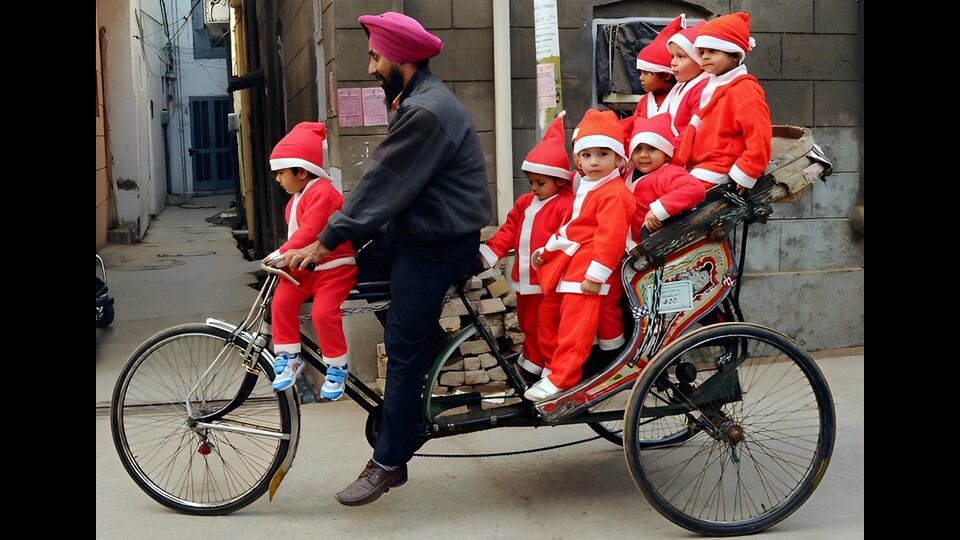
What makes the festive season book so interesting is the wide diversity of the celebration as one moves from one region to the other. Let’s start with Punjab, the closest of the places when it comes to our readers and we find a smiling turbaned sardarji of Fazilka Ecocabs, a cycle-rickshaw service, taking little kids dressed like Santa Claus to the school’s Christmas celebrations. Next, we find enthusiastic Punjabi women singing improvised verses called Tappe in the Bethlehem Punjabi Church far away in New York. Two groups challenge one another in a contest: “Aaayi tappean di vaari hai/ Main kurhi Punjabi Church di/ Tapean ton na haari hai (It is time for the contest of Tappe,/ I, girl of the Punjabi Church/ Never lose in this singing game”. Playfully, they go on to sing of the angel coming to Mary with the message of the Lord.
Mudar Patherya takes us to the ‘Burra Din’ (big day) of the famous Christmas celebrations of Kolkata and says: “ A number of Calcuttans will step out and reach out to the less privileged, visiting Mother Teresa’s Nirmal Hriday with gifts, toys or even a magic show. The kids watch the show wide-eyed or are content to wordlessly hold the visitors’ hands.” He adds that the hoity-toity will brave the thirty-minute care queue to get into Tolly Club’s Christmas Eve party: “Where every pretty young thing wears black, every second dress ends above the knee and every third is spaghetti-strapped”!
Food is the thing
Come festive time and food is certainly the thing and here too, the cuisine varies as the region changes and there is no standardisation of roasted turkey, baked potatoes, and Christmas pudding. Recounting the Christmas fare in Kerala, Elizabeth Kuruvilla gives a tempting account of breakfast starting with chicken curry and appam and onto a grand lunch of mutton biryani with boiled eggs, red hot fish curry, beef cutlets of hand-minced meat, and stir-fried beans with grated coconut. Besides, the spicy fruit cake, which is munched all day.
The Goan festive menu recounted by Anupama Raju includes the time-honoured fruitcake, chicken fry, beef cutlets, vegetable fried rice, and the piece de resistance, pork vindaloo. From Khyubu or the ‘moon place’, a picturesque village in Manipur, Veio Pour recalls community cooking with different host families every Christmas, and the irresistible aroma arising in the open from huge cauldrons, holding a variety of meats. The curries would be accompanied with rice, chutneys, salads, and steaming winter vegetables. With this onto a merry and glutinous Christmas!
nirudutt@gmail.com


