
 E-Paper



Solely blaming farm fires for Delhi’s pollution pangs not right
The govt should phase out industries out of the region to new modern belts with proper air, water pollution management systems

 Prefer HTon Google


Delhi’s air quality has turned extremely bad again with the Air Quality Index (AQI) hovering between severe and very severe category. This deterioration took place over the weekend without the burning of any stubble in the farm fields of Punjab and Haryana.
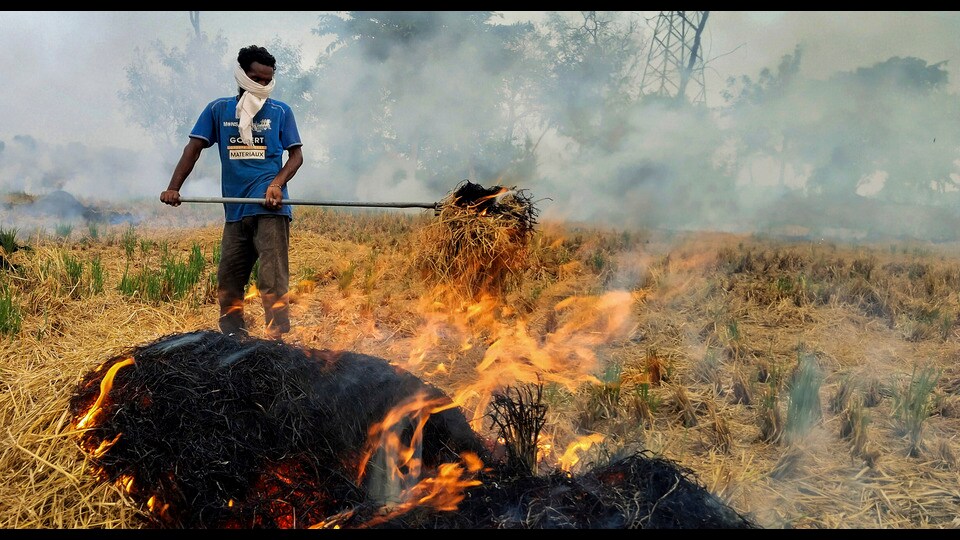
The Delhi AQI on Tuesday crossed 430 and is expected to move upwards this week as the minimum temperature is expected to remain below 5 degrees Celsius range and because wind speed, which helps in disbursal of pollutants, is slow. These facts raise critical questions for policymakers and scientists who have blamed the farmers in Punjab and Haryana for Delhi’ and National Capital Region’s (NCR) air pollution.
Let’s discuss some facts about the annual phenomenon of stubble burning.
Normally the period between September and November 30 is considered the stubble burning period in Punjab and Haryana when farm fields are cleared for the winter crop. Stubble burning incidents in Punjab has come down from 81,042 in 2016, from when the data is available, to 10,909 in 2024, an eight-fold fall in eight years. The year-wise data shows that stubble fire incidents increased during Covid-19 pandemic years of 2020 and 2021 even though the air pollution level in Delhi did not spike as it happened in 2023 and 2024. This clearly indicates a delink between stubble fire incidents and Delhi poor air quality. Similarly, stubble burning incidents recorded in Haryana, where paddy stubble burning is 20% of the crop remains that are burnt, also dipped by almost 90% since 2016. In 2024, Haryana reported only 559 incidents of farm fires.
Eyes in the sky not that reliable
Moreover, the department of science and technology’s air appropriation analysis cannot distinguish between stubble and non-stubble contribution to air pollution as the measurement is through carbon (soot) content in air and comes under bio-mass burning category. Even satellites cannot distinguish between stubble and non-stubble burning. So, if someone is burning leaves or burning wood for cooking or body warmth in Delhi or anywhere in northwestern India, it will count as biomass burning and will be clubbed with stubble burning. If one drives through Delhi in winter nights, one can see many poor and homeless people burning dry wood or grass to keep themselves warm.
The data and historical perspective provide enough evidence that stubble burning is not a major contributor to Delhi’s air pollution levels. (The author, however, does not support stubble burning and wants to promote more eco-friendly ways of dealing with stubble.)
So, why is Delhi-NCR so polluted in winter? The two primary reasons are the region’s very high self-generated air pollution load, which is increasing every year, and very poor dust management by the local authorities. The particulate matter air pollution on whose basis AQI is measured is primarily related to dust and vehicle/industry exhaust.
Vehicular exhaust a major culprit
According to a study done by non-government organisation, the Centre for Science and Environment (CSE), the contribution of vehicular exhaust to the air pollution load in Delhi between October 12 to November 3, 2024, was 51.5%.
The neighbouring districts such as Gurugram, Sonipat, Rohtak and Faridabad in Haryana and Gautam Budh Nagar in Uttar Pradesh contributed 34.97%. The contribution from neighbouring districts was also on account of vehicles. The study said that the farm fires, read total biomass, contribution was 8.19% and dust particles made up 3.7% of the total air pollution in the city.
The analysis was derived from data provided by the Decision Support System for Air Quality Management in Delhi, developed by the Indian Institute of Tropical Meteorology in Pune. Industrial emissions, including sulphur dioxide, nitrogen oxides, and volatile organic compounds, lead to the formation of secondary pollutants like ozone. Vehicle emissions, particularly from heavy traffic, release carbon monoxide, nitrogen oxides, and hydrocarbons, intensifying pollution in congested areas, the study said.
Given the government’s inability to mitigate pollution levels, the Supreme Court intervened to address the crisis and a bench of Justices Abhay S Oka and Augustine George Masih issues slew of measures including prohibition of polluting vehicles from entering Delhi and not to remove Graded Response Action Plan (GRAP) without its approval. The top court ordered the Delhi government and police to ensure effective enforcement of the firecracker ban and action against polluting vehicles on road.
The Delhi-NCR region has been under GRAP since the first week of November but its impact on controlling the pollution levels is not much. It is because the vehicular load is still very high and there is poor disbursal of pollutants generated, especially in the morning when there is a heavy traffic. Hence, the weather plays an important role for high density of pollutants in the city in winters unlike other months when higher temperatures and faster wind speed helps in disbursal of pollutants.
Pollution mgmt should turn into people’s movement
The administration would not be able to combat Delhi-NCR’s high winter air pollution levels until the region has a year-around action plan that includes fixing responsibility of officials in local authorities for carrying out any air management plan throughout the year.
Pollution management should be turned into a people’s movement with resident welfare associations held responsible for greening of parks and open areas. Littering should be made a cognizable offence, road and street cleaning should be fully mechanised and penalties should be imposed on municipal officials for failing to lift garbage.
The government should work on phasing out of industries out of the region to new modern industrial belts with proper air and water pollution management systems, which would ease pollution and population load. For this, a revenue sharing model with Delhi needs to be worked out as the capital will lose the most from such an arrangement. Another way to fix the air pollution problem is by redeveloping a green corridor across the national capital that acts as barrier for dust blowing in with westerly winds. This corridor existed in Faridabad and Gurugram until the mid-1990s when the construction boom hit the two satellite towns of Delhi.


