
 E-Paper



SYL row: Look beyond rhetoric in face of ecological catastrophe
Guest Column: It is the duty of the central and state governments to find out ways to deal with the serious issue of the desertification of Punjab and Haryana. At stake are not only the people, economy and ecology of both the states, but also the food security of the nation


Punjab and Haryana, endowed by nature with the best alluvial soil, are agriculturally the most productive states in the country. Interspersed with four rivers, including the Yamuna, this parcel of land was blessed with ample surface and sub surface sweet water.
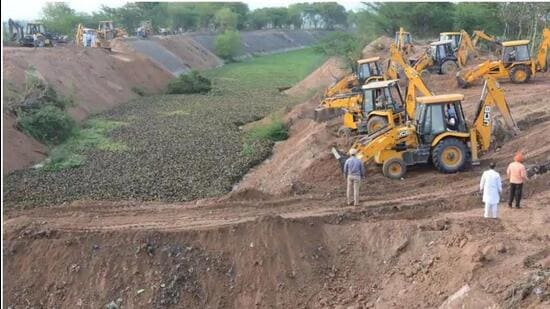
The partition of Punjab in 1947 followed by its reorganisation led to the creation of Haryana in 1966. The two states have been caught in a political slugfest over sharing of waters of the Ravi and Beas rivers for decades. No doubt there is a pressing need of river waters for farming in both the states but the issue of the Sutlej Yamuna Link (SYL) Canal periodically raises its head when temper and emotions run high on account of a political event in any of the two states.
The agreement and dispute
It’s a matter of record that the agreement by the chief ministers of Punjab, Haryana and Rajasthan signed in the presence of then prime minister Indira Gandhi on December 31, 1981, may be legally operative now after (then CM) Capt Amarinder Singh’s Termination of River Waters Act, 2004, has been declared unconstitutional by the Supreme Court (SC). The attempt by Punjab in 2016 to denotify land acquired for constructing the SYL Canal in the state was also stalled by the SC. The execution petition for the implementation of the 1981 agreement as per a decree passed by the SC in 2002 is pending with the apex court in which both the states were advised in 2019 to find a mutually amicable solution. The last meeting of chief ministers of both the states to resolve the dispute in August 2020 ended in a stalemate. The SC is likely to deliver the final order in the case which may order Punjab to complete the SYL Canal. Punjab’s claim that it has not even a drop of surplus water for sharing with Haryana has merit even beyond the hyper technicalities of legal jurisprudence.
Sharing of river waters
According to the 1981 agreement, Punjab is to give 3.5 MAF (million acre feet) water to Haryana out of the surplus water of the Ravi and the Beas. Punjab is already giving 1.62 MAF water out this share through the Bhakra canal system. In addition, 0.20 MAF water is flowing to Delhi. The current dispute is for sharing the balance 1.88 MAF of water for which the SYL Canal was partially built by 1990 before a chief engineer, a superintendent engineer and 30 labourers were killed by extremist elements opposed to the construction of the canal.
As per international norms, the sharing pattern of interstate river water is to be reviewed after every 25 years. Surplus water in the Ravi and the Beas which was estimated to be 17.17 MAF in 1981 as per year 1921-60 flow series has considerably reduced to only 13.38 MAF as per the 1981-2013 flow series. Therefore, being a riparian state, Punjab is not left with any surplus water to be shared with Haryana.
However, as per logic of the 1981 agreement, Haryana could claim only 1.01 MAF additional water instead of 1.88 MAF due to reduced flow of water in the rivers. In this regard, Punjab filed a formal application under Section 3 of Inter State River Waters Act, 1956, with the Government of India in January 2003 for setting up a tribunal for de novo adjudication of river waters sharing. Getting no response, Punjab in 2015 filed a petition in the SC to set up such a tribunal. Nothing has happened in this regard till now.
Incidentally, Haryana, which was using 2.64 MAF of Yamuna waters before reorganisation was allocated 2.01 MAF more water by way of the 1994 agreement between Haryana and Uttar Pradesh among others. This agreement was made by excluding Punjab from the scene which in itself is unjustified and discriminatory. Interestingly, nothing substantial is being done to develop infrastructure to utilise this 2.01 MAF Yamuna water by Haryana.
The way out of the crisis
Both states are facing a crisis of existence as the sub surface water table has depleted to dangerous proportions. The Central Ground Water Board has clearly established that sub surface water in this region shall get extinct in about 17 years. This shall happen irrespective of whether 1.01 MAF of Ravi and Beas waters is shared by both states or not. Therefore, it is the duty of the Centre and state governments to find out ways to deal with the serious issue of the desertification of Punjab and Haryana. At stake are not only the people, economy and ecology of both the states, but also the food security of the entire nation.
India should immediately start the construction of the huge water carrying Sharda-Yamuna Link Canal that is to pass through Haryana. This can fulfil surface water needs of Haryana to a large extent. In the changed circumstances, Punjab can be allowed to use a larger share of waters of its rivers. But even this will not fully solve the issue of the depleting water table. Hence, both the states must undertake the eco-friendly method of direct sowing of rice (DSR) rather than the currently used ecologically non-sustainable method of cultivating paddy in standing water. Cultivation of long duration PUSA variety of rice should be discouraged.
Additionally, the Government of India and both state governments must undertake long-term planning of growing crops other than the water-guzzling paddy in the kharif season. This will not only save water and soil for sustainable agriculture but also conserve the environment and ensure food security of the country. Laxity of each day is bringing catastrophe of civilisational annihilation closer to our doorsteps. Punjabi poet Surjit Patar aptly sums up the crisis:“Murh ta aiya’n machhia’n akhar nu pathhar chattke, Par ohna de murhn takk paani vi pathhar ho gya si (Although fish have returned after finally licking the stone, but by then even their watery habitat had turned into stone).”
The writer is a retired Punjab IAS officer. Views expressed are personal


