
 E-Paper



Wildbuzz: Unsung Kargil donkeys and Capt Manoj Pandey’s PVC
During the Kargil War, donkeys played a crucial role in ferrying weapons, ammunition, and food to soldiers on treacherous terrain in Ladakh/Kargil. They were able to withstand shelling and navigate difficult cliffs. Donkeys also helped with logistics and transportation during World War I. In one instance, donkeys were used to transport computers and generators to a remote location for the writing of citations for gallantry awards. Donkeys proved to be reliable and resilient in war efforts, earning the respect and gratitude of soldiers.


The popular lore that spilled from the Kargil War focused on infantry charges, booming Bofors and strafing jets. But the soldier on the ground swore by an unsung tale, of a war effort shouldered silently and humbly by fighting porters of Ladakh/Kargil and their super-acclimated local donkeys (Bongboos).
The donkeys withstood shelling and treacherous cliffs to ferry critical weapons, ammunition and food with a soldering zeal that the army’s own regulation mules struggled to match. During World War I, war donkeys lugged wounded soldiers from trenches and ferried battle resources.
One famous WWI donkey, Jimmy, was wounded thrice, bestowed Sergeant rank by the British Army, had a monument erected in his honour and is currently a military museum exhibit!
From those unknown Kargil episodes, there is an untold one so startling that it deserves glory’s retrieval from the abyss of anonymity. As the war entered its final phase around July 13, 1999, troops of the 1/11 Gurkha Rifles (GR) assembled at Yaldor, the battalion’s under-fire battlefield HQs and a 12-hour march from the nearest road head at Dah on the Indus. It was time to etch the deeds of the valiant in eternal remembrance by meticulously writing citations for gallantry awards. The citations initiated at the battalion level would go up the chain of command to Army HQs (Delhi) and engage all the way in strenuous competition with other worthy battalions.
The then second-in-command (2IC) of 1/11 GR, Lt Col Amul Asthana (retired as a Brigadier) was entrusted with the formidable task of citations. Incidentally, he was the young officer who had famously jumped the chain of command and written a Forces Inland Letter directly to then COAS Gen VP Malik on May 18, 1999, highlighting acute shortage of resources with his frontline troops ordered into “suicidal attacks” against conventional forces.
Here is when dauntless donkeys won the battle honours! Now, what could the fabled donkey have anything to do with writing citations in the midst of war in Kargil?
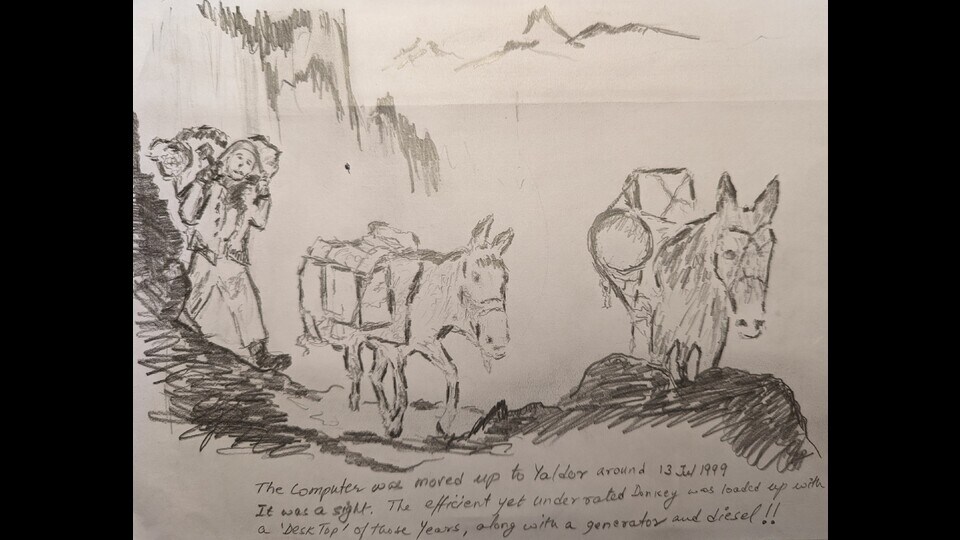
I asked Asthana if he had a photograph of donkeys in action during war. He did not but very kindly agreed to create a sketch specially for Wildbuzz column by drawing upon his vivid memories. Field sketching was taken recourse to by officers and JCOs/NCOs as maps of towering ridgeline layouts were inadequate. Sketches were made for guiding troops and directing artillery fire support onto enemy lodgements on ridges. I will now let Asthana narrate that episode and round it off with his perspective on ‘donkeys in war’.
“At Yaldor, in the second week of July, another battle was on: the ‘battle’ of citations! HQs 3 Infantry Division ordered that these were required in a computer printout, a soft copy in a floppy in Word Star IV and data part in D Base III Plus. For us soldiers, mauled by the operational vagaries of previous months, this was a reality shock, a perplexing but understandably essential requirement. It entailed the move of computers from Nurla (our rear base 100 km midway to Leh) to Yaldor (Batalik) plus induction of a generator/diesel to run the computer! And, construction of a water-proof shelter at Yaldor to house the ‘Computer God!’!” Asthana told this writer.
“But citations were critical. So, a surreal exercise was initiated to establish computers at Yaldor and get software and the citation format from HQs, 3 Division, 150 km away at Kargil. We got the computer transported from Nurla to Dah and from there hastily loaded on donkeys (one donkey with computer monitor and other carrying CPU plus generator and diesel drum). It was for me the sight of a lifetime, as this train of donkeys emerged from the boulders at Yaldor after a 12-hour march guided by a brave local porter. The ‘high end of technology’ being carried by lowly donkeys! The tedious exercise to get the required citation format from HQs 3 Division was completed only by July 24 after which we wrote citations on the Yaldor computer, including that of PVC (Posthumous) for Capt Manoj Pandey,” added Asthana.
Delving on the role played by donkeys in the overall war effort and logistics chain to far-flung Batalik battlefields, Asthana recollected: “In the initial phase of Kargil, troops were operating in fluid actions far away from the logistics base at Dah. The criticality was of food, ammunition, weapons, cold clothing and building-up logistics at Dah. With almost every soldier and even clerks, tradesmen and drivers pressed into the contact battle, it became very difficult to simply move a few bags of ‘purees’ from Dah to Yaldor. Onwards, troops in close contact with the enemy on peaks / ridgelines was another 12 hours. Building up a ‘langar’ at Yaldor was top priority but it required at least 10 porters. In came god-sent civilian porters with humble donkeys. And, within a day, we had food and set up a cook house.”
“The honest donkey could carry large loads with ease and even moved without a human ‘donkey driver’. The donkeys could follow steep and narrow paths and cross nallahs full of water and rickety ‘log bridges’ on their own. They would continue to move nonchalantly despite very close enemy artillery fire and magically reach destinations…without maps...day and night! My regard for this quiet, self-effacing ‘work horse’ caught the imagination of my young officers. On my birthday, August 3, 1999, young officers gifted me a hand-sketched card featuring smiling / laughing donkeys with a cartoon of me amidst them! With the caption, ‘Battle friends of 21C!” he quipped.
“I humbly salute the physically strong, truly patriotic and brave volunteer citizens (which included bank managers, teachers and business persons) of Ladakh and their invaluable donkeys. I would like to place on record the incomparable effort put in by Maj. Vinay Dutta (Ordnance Corps) in organising hundreds of porters from Ladakh in just a few days to galvanise the war effort in Batalik and other warzone sectors of 3 Infantry Division,” said Asthana.


