
 E-Paper



Wildbuzz: Tale of a table in a tree
A leopard in Sukhna Wildlife Sanctuary stored its sambar kill in a tree, likely to avoid scavengers, marking a rare behavior in the region.

 Prefer HTon Google


Snarling leopards with kills slung on trees figure frequently in documentaries and photographs. The “butcher’s hook” hanging in a “window of leaves” is popularly perceived as the leopard’s default behaviour. A leopard did exactly that with a sambar kill not too far away as the crow flies from the heart of Chandigarh, hanging it 20 feet from the ground in the Sukhna Wildlife Sanctuary (SWS). But it was not a commonplace table in the treetops where the leopard would eat at his/her pleasure. In the context of the Shivalik foothills, it constituted a unique moment of its natural history.
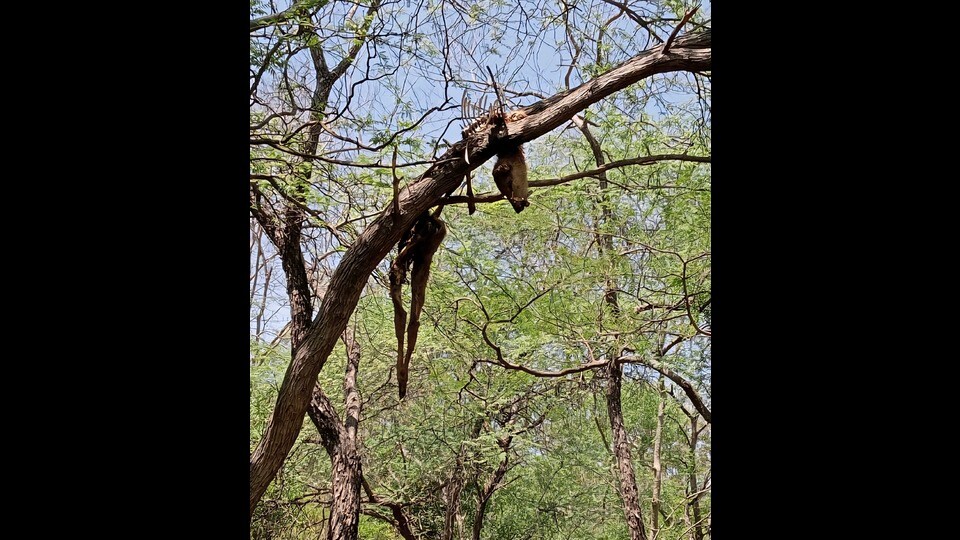
There are no domineering predators here such as tigers and lions to hound leopards into escaping into trees with kills. Nor is the formidable scavenger, the hyena, around to grab the big cat’s kill from under its nose. Anyways, the SWS terrain is not sparse but characterised by intractable thickets providing ground cover for hiding kills. So, why would a SWS leopard expend energy to store the Sambar in an arboreal larder?
The leopard is the “canine king”, the assumed SWS apex predator. But its suzerainty is under challenge. “In my decades of research in the foothills, I have not come across a leopard taking a kill up a tree. I assess this as a rare phenomenon. The leopard was probably intimidated by intrusive packs of free-ranging dogs (stray dogs). Leopards are shy, and rely on stealth and escapism as their core survival strategy. Dog packs (like hyenas) can force a leopard to abandon its kill, so this leopard could have averted the surrender by resorting to a storage place out of reach of dogs. Leopards do not overly heed the threat posed by wild boars or jackals to their kills, so I reckon it was dogs in the SWS case,” Dr Rajiv Kalsi, who has camera-trapped leopards and small cat species in the Kalesar National Park and is currently engaged in a three-year research project on predators (snow leopards, golden eagles and Himalayan wolves) of the high-altitude Spiti region, told this writer.
A leopard is a quick eater. A sambar of moderate size can be picked clean to the ribs in two days, reducing exposure of the kill to scavengers. Dr Vivek Ranjan, principal project associate at the Wildlife Institute of India, Dehradun, led last month’s Rapid Assessment of Biodiversity (wildlife survey) for UT Chandigarh. Ranjan also traversed the Upper Nepli beat of the SWS during the survey where the skeletal remains of the eaten sambar were earlier found hanging by forest chowkidars.

“Boars, jackals, dogs, monkeys etc do pose a scavenging threat to a leopard kill. The tree selected by the leopard for stowing away the sambar was a Neltuma juliflora, whose trunk and branches are curved and easier for the big cat to climb. Lugging a kill up a tree with a straight and tall trunk is dissuasive for the leopard. Another advantage for the leopard could have been that tree storage makes it difficult for vultures to scavenge on a kill as they tear and tug at flesh, not bite it into pieces. Vultures do perch on trees but prefer to scavenge on ground kills,” Ranjan told this writer.
vjswild2@gmail.com


