
 E-Paper



Wildbuzz: The power of war flowers
The past speaks to us in many and oft-surprising ways. So it is with preserved flowers, sent many crescent moons ago by battling soldiers in letters. Those flowers were little bits of life, beauty and hope, transcending the darkness of humanity’s ugliest and most unhinged hours.

 Prefer HTon Google


The past speaks to us in many and oft-surprising ways. So it is with preserved flowers, sent many crescent moons ago by battling soldiers in letters. Those flowers were little bits of life, beauty and hope, transcending the darkness of humanity’s ugliest and most unhinged hours. Soldiers faced the pervasive odour of death that incense could not mask. Some picked flowers with their little scents to retain emotional and aesthetic sanities. When families opened letters to see those flowers slipped in, it lent them hope that if there were flowers growing where men were warring, it couldn’t be a place that bad. The scent of flowers evoked love of the loved one at home, affirming the permanent bonds between the front and the rear.
The poppy is the flower of remembrance for Commonwealth soldiers. In the Tower of London’s moat, 8,88,246 ceramic poppies were installed in 2014 --- one each for soldiers felled by the Great War (1914-’18). English writer Anne Louise Avery preserves a rose her grandfather, Charles Brigden, sent to his sweetheart, May, from the trenches of France in 1915 and it still bears a faint, sweet scent. Maz Finch from the UK’s West Midlands discovered flowers pressed in her grandfather’s Army Bible; he had collected them during WWII battles. The flowers were a tap on her shoulder, a quiet yet powerful whisper from the past.
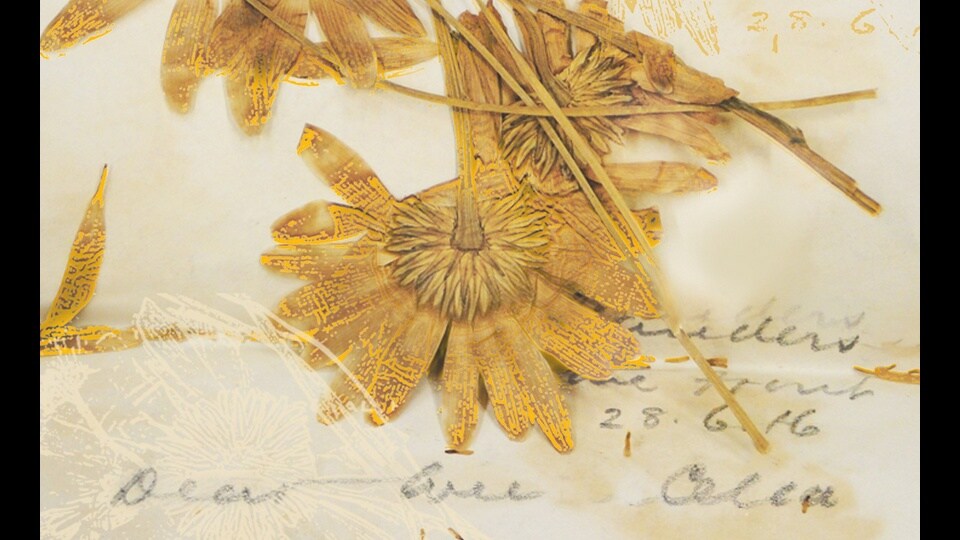
The greatest and most moving war flowers collection is the emotional legacy of Lt. Col. George Cantlie, DSO, who commanded the 42nd Royal Highlanders of Canada. He sailed for war in 1914 when his youngest child, Celia, was a year old in Montreal. Though a tough and rugged soldier, he was a sentimental man. Cantlie was tormented by the thought that he would never see Celia again and she would never know him. Cantlie decided he must do something to make her remember him. So, he sent her flowers from battlefields of the Somme and Flanders in letters dispatched every day. The flowers witness to Daddy’s eyes misting over as he wrote his brief wartime correspondences: “From the trenches & shell holes, My dear, wee Celia, With much love and lots of kisses, from Daddy.” For his wife, Cantlie picked the last rose of summer from the garden of his French billets on September 7, 2016, and dispatched it to “My dear B.B.”.
Cantlie managed to find enough wild / garden flowers to sustain his dispatches; flowers which were fragile, yet standing stubbornly in the shattered fields of France. Petals of hope peeping out, come what may, through mud and smeared blood, till a shell landed on a tiny little head. Poppies flushed scarlet as if having drunk the blood of fallen soldiers and turning it into something beautiful. Amid the gloom of trenches and doom of coffins, the bloom of daisies bearing a blush of faraway bosoms. Above, flowers on a wing and a song: “The larks, still bravely singing, fly, Scarce heard amid the guns below.”

A pining Daddy returned in 1917 suffering from battle fatigue, having escaped eternal rest under a cross in some corner of a faraway field. Had Cantlie been another of the soldiers gone with the Flanders wind, the flower letters would have come to notice much earlier. But since Cantlie and Celia lived happily ever after, the world would get to feel a treasure of war emotions more than a 100 years after his return from the Great War. The flower letters remained forgotten, tied in yellow ribbons and retainRing ghostly hints of their wartime tints. They were stored in a red-satin box by Celia and upon her death, by her niece, Elspeth Grace Angus.
The collection came the way of Viveka Melki, a sensitive film-maker, quite by chance. Melki’s clairvoyant mind --- ever conscious, that with the passage of time, and without care, we are doomed to forget --- exhumed the letters entombed in red. Her aesthetic, emotional recreation of the Cantlie letters --- the War Flowers exhibition --- toured Canada and France to acclaim. A “collision between the tenderness of emotion and brutality of war”.
Elspeth, who adored Cantlie like Celia, said this about the letters: “What is timeless…is one’s own feelings over anything that is sentimental and lovely…anything that moves you, that never changes.”
vjswild2@gmail.com


