Drownings, electrocutions and house collapses. These three issues, which caused the deaths of at least five people on Wednesday night as a heavy downpour pounded the city, underscore an infrastructural malaise that becomes evident in the Capital during the monsoon every year.
This collapse of urban infrastructure also points to the lack of accountability by authorities at various levels who are supposed to ensure the safety of a teeming city that home to tens of millions.
Read more: Pinarayi Vijayan on Wayanad landslides: 'Nobody left to be saved'
Drownings, and blame game
The first reported fatalities on Wednesday night were perhaps the most heartbreaking. A 22-year-old woman and a her three-year-old son were killed after they fell into the Ghazipur drain near Khoda colony. When officials fished out their bodies, they said the mother was still clutching on to the arm of her son.
The story that followed their deaths was all too familiar – authorities traded blame on who caused the tragedy.
The Ghazipur drain is maintained by Delhi authorities on one side, and by Ghaziabad on the other. The victims were residents of Khoda Colony in Ghaziabad. Officials from the Ghaziabad fire department conducted the initial rescue operation, but later handed over the case and the bodies to Delhi Police.
{{/usCountry}}The Ghazipur drain is maintained by Delhi authorities on one side, and by Ghaziabad on the other. The victims were residents of Khoda Colony in Ghaziabad. Officials from the Ghaziabad fire department conducted the initial rescue operation, but later handed over the case and the bodies to Delhi Police.
{{/usCountry}}The spot where the incident took place has a partially covered drain that was submerged in knee-deep water after Wednesday’s rains. The waterlogging made it impossible to decipher where the footpath ended and where the drain started. Debris from unfinished construction work also lies right next to it.
The incident raised several fundamental questions: Why was the drain left open and work unfinished? Why were people allowed to walk near an open drain in the first place? Why was there no signage or barricade warning people against walking near an open drain? How was there no clarity over the jurisdiction of the responsible civic body? And, most importantly, who was responsible?
Even among Delhi officials, the accountability was not clear.
The Municipal Corporation of Delhi (MCD) issued a statement on Thursday alleging that the part of the drain where the incident occurred was under maintenance by the Delhi Development Authority (DDA), which responded with identical allegations. “An incident occurred... in which a lady and her child... fell in an under-construction DDA drain near Ambedkar Gate of Khora Colony… The road and drain where incident took place is under construction by DDA (DDA jurisdiction),” MCD said.
Read more: MCD admits fault for Rajendra Nagar waterlogging
In response, DDA stated that the total length of the drain is 1.35km, out of which, 1km of the drain, along with the adjoining road, was handed over to MCD a “considerable time ago”. The remaining 350m of the drain, DDA said, is under its jurisdiction.
Electrocutions and negligence
At around 7pm, a 12-year-old boy was electrocuted to death when he went to play in a waterlogged street in a DDA colony in Dwarka’s Bindapur. In another incident, also on Wednesday night, a 28-year-old man was electrocuted at his home in Jaitpur. Police said the victim stepped out on his terrace to enjoy the rain when he touched a live wire and died on the spot.
These are not isolated incidents. They were the seventh and eighth deaths from electrocution in the city so far this monsoon, according to a tally by HT’s reporters.
On July 24, a 26-year-old IAS aspirant was electrocuted to death here after he tripped while crossing a puddle and grabbed the gate, which was charged after coming in contact with a live power line. On July 25, another man, a 30-year-old labourer, was killed after he was electrocuted in Karawal Nagar.
On June 28, when over 200mm of rain lashed Delhi, a 39-year-old man was electrocuted in Rohini after brushing past a live wire on a waterlogged road. On July 13, a 34-year-old woman was electrocuted on a waterlogged road in Bhajanpura. Other electrocution deaths this monsoon included that of a BSES employee in Dwarka on June 14, while he was trying to fix an electricity pole. On July 13, a constable died after coming in contact with a high-tension wire on a roof in Najafgarh.
A walk in a residential street nearly anywhere in Delhi will yield sights that are quite dangerous, especially during monsoon – a potentially lethal combination of waterlogging with loose, exposed wires that millions of residents cross daily.
BSES had said that it was cooperating with the authorities during their investigation in the electrocution cases. A spokesperson for Tata Power, while extending condolences to the deceased, had said it had intensified efforts to educate consumers about electrical safety.
Collapses, but no dangerous buildings
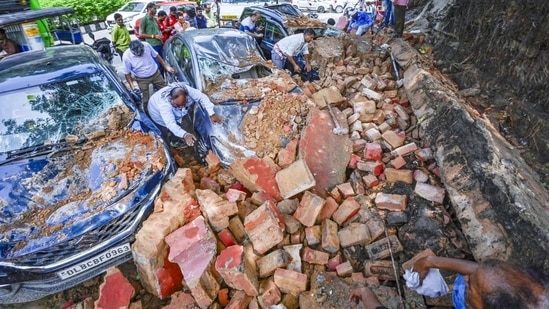
At 9pm on Wednesday, a 62-year-old man died was after the roof of his shop collapsed amid heavy rainfall in Subzi Mandi. The fire brigade, National Disaster Response Force, and earthmovers were deployed to remove the debris and pull the victim out after a six-hour operation. In Daryaganj, a wall-collapse crushed a large number of parked vehicles.
Injuries were also reported due to collapses in Defence Colony and Shastri Park.
Eight people, including six minors, were injured when a wall collapsed in Malviya Nagar on April 23 allegedly due to sudden rainfall and storm.
The city has witnessed numerous such collapses since the onset of monsoon – most of which had not been captured in the pre-monsoon “dangerous building survey”. Experts and stakeholders say the city lacks an efficient mechanism to detect and prevent collapse of dangerous buildings.
In fact, the civic body is yet to officially release the findings of this year’s survey which was expected to cover 2.9 million properties. However, a senior MCD official said that only five properties were found to be dangerous – all located in East Delhi’s Kalyanpuri and Pandav Nagar. “Notices were issued to another 57 buildings for carrying out repairs,” the official added, asking not to be named. The civic body found no dangerous buildings in the Walled City, which has seen many collapses in recent months.
This was the same story last year, when 3.1 million buildings were inspected, but only eight were found dangerous – seven of them in Rohini zone.
These surveys are carried out by the building and maintenance departments of civic bodies as a pre-monsoon exercise. “A ‘visual survey’ is carried out by junior engineer of the area and if engineers notice structures which are bent or show cracks, then they inspect the structure from the inside. A notice to get the building repaired is issued to the owner,” a second civic official said, asking not to be named.
Amid all the red tape, the Capital’s woes continue – unheard and unresolved.
Stay updated with all top Cities including, Bengaluru, Delhi, Mumbai and more across India. Stay informed on the latest happenings in World News along with Delhi Election 2025 and Delhi Election Result 2025 Live, New Delhi Election Result Live, Kalkaji Election Result Live at Hindustan Times.
Stay updated with all top Cities including, Bengaluru, Delhi, Mumbai and more across India. Stay informed on the latest happenings in World News along with Delhi Election 2025 and Delhi Election Result 2025 Live, New Delhi Election Result Live, Kalkaji Election Result Live at Hindustan Times.