
 E-Paper



Ahead of Chhath, govt vows to stop Yamuna froth with chemicals, boats
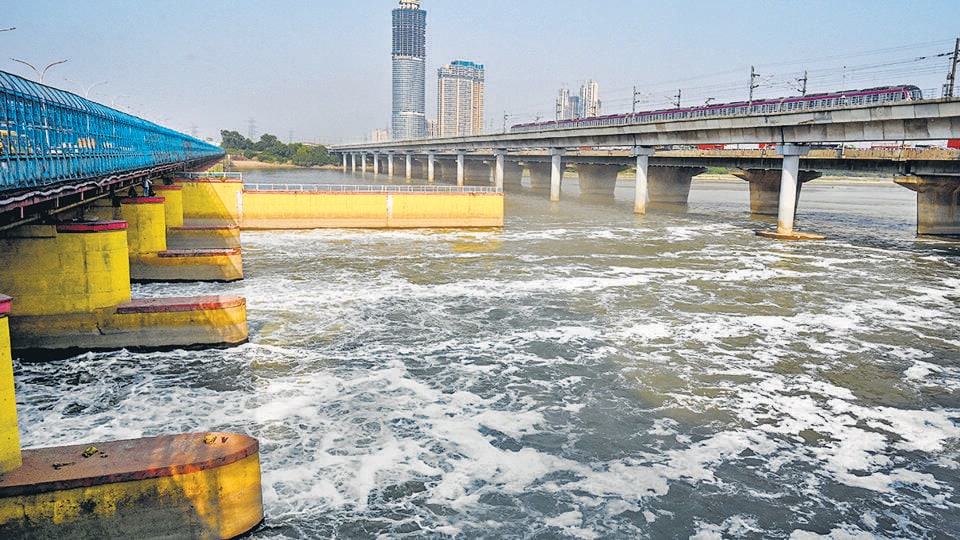
Soap-like surfactant molecules in the polluted waters turn into froth as a result of falling from a height at the nearby Okhla barrage.

 Prefer HTon Google


Ahead of the festive season and amid preparations for Chhath, the Delhi government is planning a series of measures to tackle the formation of froth in the river, including the use of defoaming chemical agents, deployment of power boats and increase in the flow of the river. In the previous years, the BJP, when it was in the Opposition, had criticised the use of defoaming agents in anti-froth drives.
Meanwhile, speaking at the launch of Delhi Jal Board schemes at the Delhi Secretariat, Delhi chief minister Rekha Gupta on Tuesday said no froth will be seen on the surface of Yamuna during the upcoming Chhath festival, asserting that work is underway to rejuvenate it.
“Very soon, people of Delhi will celebrate the Chhath festival on a grand scale. DJB has made all the preparations. I am assuring the people of Delhi regarding the froth that was earlier seen....just like the water-logging problem has been solved at Minto bridge, people of Delhi will see no froth in Yamuna this time,” the CM said.
In previous years, images of devotees wading through foam-covered waters during the festival of Chhath have sparked outrage. The BJP, in Opposition, severely criticised the previous Aam Aadmi Party (AAP)-led Delhi government for failing to tackle the phenomenon, a clear indication of the river’s poor health.
Soap-like surfactant molecules in the polluted waters turn into froth as a result of falling from a height at the nearby Okhla barrage. The issue worsens during the winter months when the temperature drops and the froth bubbles become much more stable. The surfactant molecules are produced as a result of biological, physical and chemical causes—detergents and surfactants in untreated domestic sewage, pollutants from industries and dhobi ghats, as well as materials released by decomposition of dying water hyacinth weeds in the Okhla barrage.
Among the new measures, a senior government official explained, the government is planning to increase the flow of water at the Okhla site by releasing more water from upstream so that the pollutants and any froth formation is washed down and bubbles do not accumulate.
Furthermore, a second official said, the Irrigation and Control Department (I&FC) has carried out the hiring and procurement of ten power boats at a cost of ₹24 lakh for the undertaking of anti-froth drives.
Separately, the Delhi Jal Board (DJB), which specialises in water treatment, has been asked to procure concentrated defoamer chemical agents. “The Wazirabad water works officials are coordinating the work for sprinkling of the defoaming agent which destroys the bubbles,” the second official added.
A defoamer, or an anti-foaming agent, is a chemical additive that reduces foam formation in industrial process liquids. Defoaming drives were started three years ago, in October 2022, following a joint meeting with National Mission for Clean Ganga (NMCG) to control froth formation.
However, there has been controversy over its usage. BJP leaders, during past drives, have objected to use of these chemicals calling them “toxic” and “hazardous”. HT had reported on this special plan to tackle the recurring problem of toxic froth in the Yamuna ahead of the Chhath festival on October 2. A day later, Delhi AAP chief Saurabh Bharadwaj hit out at the BJP over “plans to spray chemicals into the Yamuna”, adding that for five years, it had “misled” the people of Delhi and “indulged in theatrics”.
Experts say that such measures are akin to only treating the symptoms and the froth formation will automatically reduce when the health of the river improves.


Stay updated with all top Cities including, Bengaluru, Delhi, Mumbai and more across India. Stay informed on the latest happenings in World News along with Delhi Election 2025 and Delhi Election Result 2025 Live, New Delhi Election Result Live, Kalkaji Election Result Live at Hindustan Times.


