
 E-Paper



Air curbs eased but old vehicles remain barred
Primary schools in Delhi will reopen from Wednesday, but petrol and diesel vehicles that adhere only to older emission norms will have to stay off the roads for now, state environment minister Gopal Rai announced on Monday, a day after the Commission for Air Quality Management (CAQM) eased pollution control measures on the back of cleaner air over the weekend.


Primary schools in Delhi will reopen from Wednesday, but petrol and diesel vehicles that adhere only to older emission norms will have to stay off the roads for now, state environment minister Gopal Rai announced on Monday, a day after the Commission for Air Quality Management (CAQM) eased pollution control measures on the back of cleaner air over the weekend.
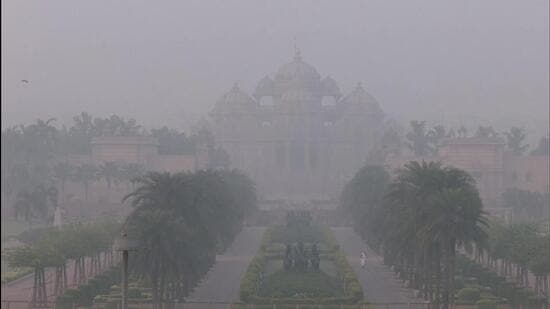
The ban on private constructions is still in place, Rai said, stressing that though curbs under the harshest level (Stage 4) of the Graded Response Action Plan (Grap) have been lifted, measures mandated by the penultimate level (Stage 3) continue to remain in place.
He added that BS-III petrol and BS-IV diesel vehicles are still not allowed, and violations of the rule will invite a ₹20,000 fine. “The restrictions for these two categories of vehicles were imposed according to Stage III of Grap. Therefore, we are not lifting them as all Stage 3 measures are still being followed,” said Rai. There are estimated to be around 300,000 BS-IV diesel and around 200,000 BS-III petrol vehicles in Delhi.
The government has also allowed diesel trucks to enter Delhi again and linear construction projects such as work on highways, flyovers and roads can resume.
The CAQM on Sunday lifted Grap Stage 4 measures after the city’s Air Quality Index (AQI) dropped out of the “severe” zone, as the panel cited forecasts which said that pollution levels are, in the near future, not predicted to go past the “very poor” level.
Delhi logged an AQI of 354 (very poor) on Monday, marginally worse than 339 on Sunday, but better than 381 the day before that and 447 (severe) on Friday. Stronger winds, which have blown in from the east and south-east, have helped disperse pollutants from Delhi’s air to some degree, said weather experts, easing some of the impact of smoke from farm fires in Punjab and Haryana.
An AQI between 301 and 400 is classified as very poor, and one between 401 and 500 is severe.
Government employees will no longer have the option to work from home, he said.
“The work-from-home order has been revoked too and that means all government employees will have to return to office from now on,” Rai said.
Rai said further action will depend on the air quality, which is likely to fluctuate in the coming days. “We are closely monitoring the AQI and further decisions can be taken accordingly,” he said.
Under Grap, the first set of measures come into play when the AQI is predicted to touch the poor zone (from 201 to 300). Stage 2 is imposed when the prediction is “very poor” (between 301 and 400), Stage 3 when it is “severe” (between 401 and 450), and Stage 4 is when the forecast is above 450.
The third stage of the plan bans constructions and demolitions (except for projects of national importance, ISBT, railways and Metro work, sanitation projects), and empowers state governments to impose restrictions on BS-III petrol and BS-IV diesel light motor vehicles, if required. It also mandates the regulation of operations of industries not running on PNG, biomass, or other clean fuels. Brick kilns, hot mix plants and stone crushers not operating on clean fuels are also to be shut, and mining and other linked activities are now banned in the NCR, according to the measures.
Delhi’s AQI will remain in the very poor range till Thursday, with wind expected to predominantly blow in from the easterly to south-easterly direction, reducing the impact of stubble burning on air quality, the India Meteorological Department (IMD) said. The Capital is also likely to see a spell of light rain and drizzle on Thursday, it said.
“Local wind speed is not that strong at the moment, largely hovering around 5-7 km/hr, but the wind direction has been easterly and will become south-easterly by Wednesday and Thursday, under the influence of a western disturbance. This western disturbance is also expected to bring Delhi some drizzle on Thursday,” said RK Jenamani, scientist at IMD.
Satellites detected 2,487 farm fires in Punjab on Monday, a significant increase from 599 a day ago, when cultivators steered clear of setting their ablaze thanks to the strong winds, state officials said. The agrarian state clocked more than 2,000 farm fires on each of the previous four days, with the number so far peaking at 3,634 on November 2.
Wind direction will oscillate between easterly, northerly and south-easterly on Tuesday, the weather office said, with the impact of stubble burning expected to remain low once again.
The System of Air Quality and Weather Forecasting and Research (Safar), a government body, said the contribution of stubble burning to Delhi’s PM 2.5 concentration was 14% on Monday, down from a contribution of 18% on Sunday.
School principals in Delhi welcomed the move to resume in-person lessons for primary classes.
Sudha Acharya, chairperson of the National Progressive School Conference (NPSC) and the principal of ITL School, Dwarka, said repeated school closures were affecting the learning environment.
“Pollution is everywhere, even within homes. Even if children are at home, they indulge in outdoor activities. School closures due to changing pollution levels affect the school ecosystem,” said Acharya.
Vijay Vohra, a resident of Paschim Vihar, who owns two vehicles, one of which is a BS IV diesel vehicle, said continuing the ban made little sense when trucks were being allowed into Delhi once again. “Trucks are just as polluting as four wheelers, if not more, but yet they are still banned. At a time when all restrictions have been lifted, why are diesel four wheelers being singled out as a source?” Vohra said.
Stay updated with all top Cities including, Bengaluru, Delhi, Mumbai and more across India. Stay informed on the latest happenings in World News along with Delhi Election 2025 and Delhi Election Result 2025 Live, New Delhi Election Result Live, Kalkaji Election Result Live at Hindustan Times.


