New Delhi:
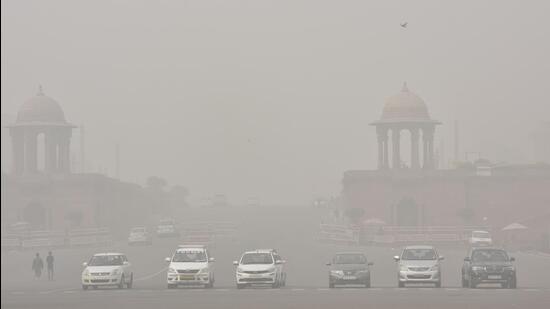
After recording its cleanest air spell over the last three days, Delhi’s air quality slightly deteriorating on Monday even though it stayed within the satisfactory category. However, a haze hung over the city in the morning giving an impression of the smog that envelops the city during winter months when air quality enters the emergency zone.
Experts attributed the haze to a combination of dry northwesterly winds with the moist air that was blowing through the city till Sunday evening.
Forecasts by the India Meteorological Department (IMD) and the Early Warning System (EWS) for Delhi show that with no rain expected in the capital over the next six days and dry northwesterly winds persisting, Delhi’s air quality is likely to deteriorate to the ‘moderate’ category, with this haze to disappear again.
“There has been a change in the wind direction from easterly to northwesterly, which are dry winds that carry dust and cause uptick in pollution levels. The morning haze on Monday was mostly due to a combination of high moisture and these winds combining. The high moisture content was only due to the after-effect of easterly winds and the rain that Delhi saw over the last few days, but such a haze is not expected in the next few days now,” said VK Soni of IMD, who is also part of the sub-committee on the Graded Response Action Plan (GRAP), which has been appointed by the Commission for Air Quality Management (CAQM).
Delhi recorded an overall air quality index (AQI) of 100 (satisfactory) as per Central Pollution Control Board’s daily national bulletin which is released at 4 pm. In comparison, it was 52 (satisfactory) at the same time on Sunday, 54 (satisfactory) on Saturday and 57 (satisfactory) on Friday. This clean spell of air was largely down to spells of rain since Thursday, which saw Safdarjung receive 111.6mm of rainfall over the last four days.
{{/usCountry}}Delhi recorded an overall air quality index (AQI) of 100 (satisfactory) as per Central Pollution Control Board’s daily national bulletin which is released at 4 pm. In comparison, it was 52 (satisfactory) at the same time on Sunday, 54 (satisfactory) on Saturday and 57 (satisfactory) on Friday. This clean spell of air was largely down to spells of rain since Thursday, which saw Safdarjung receive 111.6mm of rainfall over the last four days.
{{/usCountry}}The Central Pollution Control Board (CPCB) classifies AQI as ‘good’ when it is 50 or lower, as satisfactory when it is between 51 and 100 and as ‘moderate’ when it is between 101 and 200. It is ‘poor’ when between 201 and 300, as ‘very poor’ when between 301 and 400 and ‘severe’ when it is over 400.
CPCB data shows there was a significant increase in the 24-hour average PM 10 and PM 2.5 concentration in the capital on Monday. While the average PM 10 concentration rose from 37.5 micrograms per cubic metre at 7pm on Sunday to 94.6 micrograms per cubic metre at 7pm on Monday, the average PM 2.5 concentration rose from 15.9 micrograms per cubic metre at 7pm on Sunday to 40.3 micrograms per cubic metre at 7 pm on Monday. The 24-hour permissible limits for these particles are 100 and 60 micrograms per cubic metre respectively.
Agencies forecast air quality to hover between ‘satisfactory’ and ‘moderate’ over the next three days, with an increase in temperature allowing greater ventilation for pollutants.
“The AQI is in the satisfactory category and dust (size > 2.5 micrometer) is currently contributing to around 57% of PM10. For the next three days (27th, 28th, 29th) peak wind speed is likely to be around 8-16 km/h, causing moderate dispersion and AQI is likely to be within ‘satisfactory’ or lower end of the ‘moderate’ category,” said Safar, an air forecasting body.
Delhi recorded a maximum temperature of 33.4 degrees Celsius on Monday, one degree below normal, and the minimum was 22.7 degrees Celsius, also one degree below normal for this time of the season. IMD has forecast clear skies on Tuesday, with the maximum and minimum is likely to be around 34 and 23 degrees Celsius respectively.
No meeting on GRAP until forecasts show air will turn ‘poor’
While the revised Graded Response Action Plan (Grap) to tackle air pollution spikes this winter will come into force from October 1 onwards, the CAQM sub-committee formed to execute Grap says no meeting has been planned as of now, until forecasts by the Early Warning System (EWS) shows air quality turning poor.
According to the revised Grap, forecasts for air quality for the ‘poor’ category or higher need to be made at least three days in advance of the projected AQI.
“While the EWS forecasts are up to a period of 10 days, we are relying on forecasts for the next 3-4 days and taking action accordingly. As of now, forecasts show air quality is only likely to be within satisfactory or the moderate range. Until forecasts show it will reach poor, a meeting will not be called. Based on the projected poor air quality, suitable measures can be enforced,” said Soni.
Stay updated with all top Cities including, Bengaluru, Delhi, Mumbai and more across India. Stay informed on the latest happenings in World News along with Delhi Election 2025 and Delhi Election Result 2025 Live, New Delhi Election Result Live, Kalkaji Election Result Live at Hindustan Times.
Stay updated with all top Cities including, Bengaluru, Delhi, Mumbai and more across India. Stay informed on the latest happenings in World News along with Delhi Election 2025 and Delhi Election Result 2025 Live, New Delhi Election Result Live, Kalkaji Election Result Live at Hindustan Times.