A missing student, cries for justice, an enduring mystery
Najeeb Ahmed, a JNU student who went missing on October 15, 2016. Having found no clues, the agencies shut the case in 2018. But his family still seeks answers
For most parents, the prospect of their child enrolling in one of India’s best universities would be a matter of joy. For Fatima Nafees, however, it is a source of unending regret. For the last seven years, the 54-year-old has woken up every day with the same thought. “I wish I had not accepted my son’s decision to study at JNU... Maybe he would have still been with us,” she said, her voice trailing off.
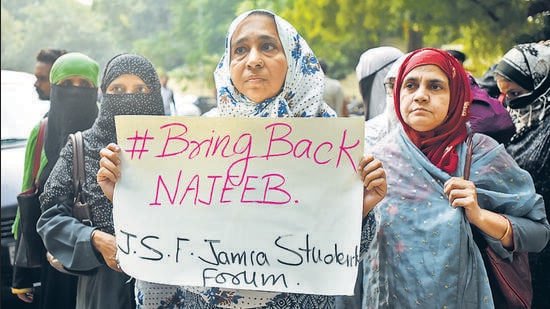
Fatima Nafees, Najeeb’s mother, participated in several protests organised by various student outfits, demanding the authorities find his son. (HT Archive)
Her son, the introverted Najeeb
Najeeb Ahmed went missing from the university’s Mahi-Mandvi hostel on October 15, 2016, less than three months after enrolling in the M. Sc (Biotechnology) course. He was only 27. (HT Archive)
She said he called her on October 14, and said he was assaulted and had sustained injuries. Nafees left for Delhi the same day. But by the time she reached JNU, he was missing.
Soon, she found herself doing the rounds of police stations, courts, and the campus. As some right-wing groups tried to paint her son a terrorist, Nafees protested on the streets, and had one question – “Where is Najeeb?” That question has not had an answer till now.
Both the Delhi Police and CBI investigators say that it was a rare case with no leads. “He was an introvert, and he didn’t have too many friends on campus. We probed it from all possible angles despite knowing that some of those ways will not be ‘acceptable’ for his family... Like probing his alleged links with ISIS. But it could not be proved,” said one of the investigators, requesting anonymity.
“We even intercepted Najeeb’s mother’s calls on many occasions but that too didn’t give us any leads. We verified unidentified dead bodies in and around Delhi but all our efforts proved futile,” said a former CBI officer, who was in the team that probed the case.
A former officer of Delhi Police’s crime branch said that instead of looking at the mens rea (criminal intent) of the people involved in his disappearance, the investigators kept looking for his alleged association with a terrorist organisation. “This was due to our negative approach, and we failed badly in solving this case,” he said, requesting anonymity.
Haseeb Ahmed, the third of Nafees’ four children, was in his final year of engineering when Najeeb went missing. “I was studying in Bareilly then but spent most of my time searching for my brother in Delhi,” he said. A junior engineer in Delhi now, the 28-year-old recalled how this unending search impacted his education.
“Finding my brother was our family’s priority. Days and months passed by, as we moved from one protest to another. Unlike my classmates, I could not take up any job for two years after graduating because I had no time,” said Haseeb.
After Najeeb’s disappearance, Nafees participated in many protests but stopped doing so in 2021. “I do get calls from student outfits every year as October 14-15 draws closer. But due to poor health and possible repercussions for the students, I refuse,” she said.
After years, the family is looking forward to some joy – the wedding of Nafees’s eldest son, Mujeeb, next year. “If Najeeb was around, it would have been different. This will be the first wedding in our family and without him, it will feel incomplete,” said Haseeb.
The disappearance also cast a pall of shadow over the career prospects of his cousins. “He was the first one from our family who got admitted in JNU. Since his disappearance, others in my family have become wary of sending their children outside the city for higher studies. My niece wanted to study outside but my brother stopped her because he didn’t want a repetition of what had happened with Najeeb,” said Nafees.
Much has changed at JNU too. Several students who were involved in the protests initially have joined leading political parties. Najeeb’s disappearance is no longer an active conversation on campus. Barring an annual protest gathering on October 15 by some groups, his memory is fading.
In Badaun, the house that the family has lived in for years has seen some recent change – new tiles adorn the first floor, a fresh coat of paint too. The changes have, however, left Mohammad Nafees – Najeeb’s father – worried.
“He worries that Najeeb might not be able to recognise our house when he returns. But I reassure him that he can never forget his house,” said Nafees.
Sadia Akhtar is a reporter at Hindustan Times where she covers education, heritage, and a range of feature stories. She also writes about refugee communities and tracks stories at the intersection of gender and social justice. Before joining HT's Delhi team, she reported from Gurugram and Mewat where she tracked politics, education, and heritage.
Sanjeev K Jha is a senior journalist with nearly three decades of experience covering a wide range of beats, including bureaucracy, politics, and security issues such as ISI-linked activities in border regions. His reporting also extends to culture, with work on music and Bollywood. Currently part of the Political Bureau at Hindustan Times, he focuses on smaller allies within both the NDA and the INDIA bloc. His work offers insight into coalition politics and the evolving dynamics of India’s political landscape, backed by years of on-ground reporting and a deep understanding of governance and power structures.
Catch every big hit, every wicket with Crickit, a one stop destination for Live Scores, Match Stats, Infographics & much more. Explore now!