
 E-Paper



Anti-Pollution push: Delhi CM launches 6 air monitoring stations, ‘Vayu Rakshak’ drive
Delhi CM Rekha Gupta inaugurated six new air quality monitoring stations, stressing year-round pollution challenges. Delhi now has 46 stations nationwide.

 Prefer HTon Google


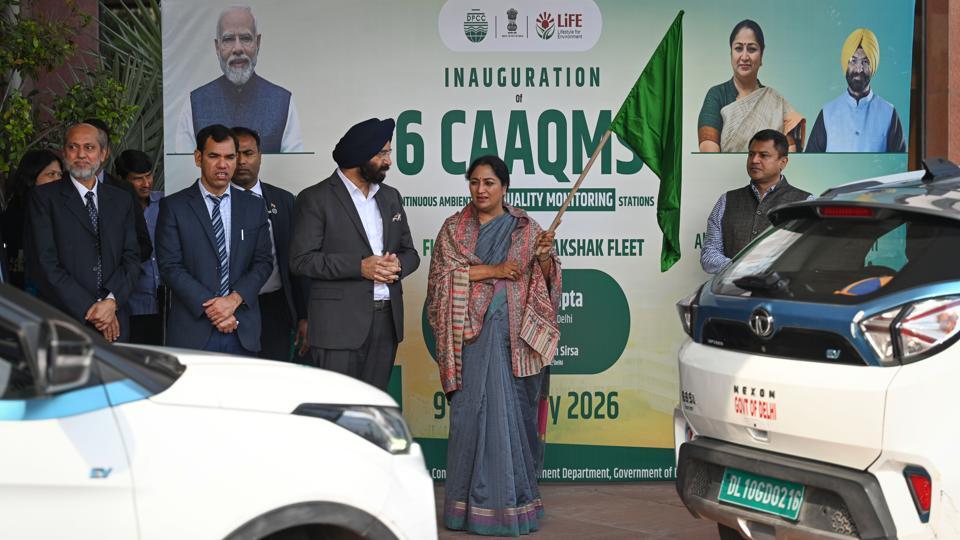
Delhi chief minister Rekha Gupta on Monday inaugurated six new Continuous Ambient Air Quality Monitoring Stations (CAAQMS) and stressed that air pollution remains a year-round challenge and is not confined to any particular season. While the stations have been formally inaugurated, officials said they are still undergoing calibration, with real-time data expected to be made public from next week.
With these additions, Delhi now has 46 CAAQMS, reinforcing its position as the city with the highest number of air quality monitoring stations in the country. Mumbai follows with 30 stations, while Bengaluru and Hyderabad have 14 each.
Of Delhi’s total stations, 30 are operated by the Delhi Pollution Control Committee (DPCC), 10 by the India Meteorological Department and IITM, and six by the Central Pollution Control Board (CPCB). Officials added that 14 more monitoring stations are planned in the coming months.
The six new stations have been installed at Jawaharlal Nehru University, Indira Gandhi National Open University, SPMSPC Talkatora Garden, Commonwealth Sports Complex, Delhi Cantonment, and the Netaji Subhas University of Technology (West Campus).
The chief minister also launched the “Vayu Rakshak” initiative on Monday, under which 100 dedicated vehicles have been deployed for pollution control.
On April 26, HT had first reported that the new stations were being set up largely in relatively green areas, a factor that could potentially bring down the city’s overall average Air Quality Index (AQI). Following this, the government replaced the originally planned station at the ISRO Earth Station near Malcha Mahal with one at the SPMSPC complex on Mother Teresa Crescent, another green area located next to the Central Ridge. SPMSPC Talkatora Garden itself is adjacent to the Central Ridge, while Delhi Cantonment and the Commonwealth Sports Complex are also surrounded by comparatively greener zones.
“Air pollution is a year-round challenge and not limited to a particular season. The Delhi government is committed to addressing the issue on a continuous basis through monitoring, policy intervention and enforcement,” Gupta said. She also stressed that air quality data is fully transparent and available in the public domain, noting that PM10 and PM2.5 data are updated every hour, while other parameters are refreshed every five minutes. According to her, evidence-based policymaking backed by transparent data remains a key focus of the government.
Environment minister Manjinder Singh Sirsa said that monitoring alone was not sufficient and needed to be backed by strict enforcement to yield tangible results. As part of the “Vayu Rakshak” initiative, 100 personnel have been deployed to work with the DPCC on ground-level pollution control. In addition, 600 Vayu Rakshaks, in coordination with the Delhi Police, are monitoring traffic-related and emission-related violations. The teams are intended to strengthen inspections, ensure compliance, and act as first responders to polluting activities.
Experts, however, cautioned that while expanding the monitoring network is welcome, the choice of locations raises concerns about representativeness. “Since these stations are in largely green areas, it is bound to marginally impact the AQI, as readings there are likely to be lower than the city average. This is particularly crucial at a time when data from some existing stations is already compromised,” said Sunil Dahiya, founder and lead analyst at environmental think-tank EnviroCatalyst. He added that the deployment of Vayu Rakshaks was a positive step, especially given Delhi’s weak enforcement record.
In April, a Comptroller and Auditor General report tabled in the Delhi Assembly had flagged concerns about the placement of existing AQI monitors. Auditing 24 DPCC-operated stations, the report found that 13 were not located in accordance with CPCB guidelines, with several positioned too close to trees, roads, high-rise buildings or unpaved surfaces – factors that could distort pollution readings.



Stay updated with all top Cities including, Bengaluru, Delhi, Mumbai and more across India. Stay informed on the latest happenings in World News along with Delhi Election 2025 and Delhi Election Result 2025 Live, New Delhi Election Result Live, Kalkaji Election Result Live at Hindustan Times.


