January is into its last week, and despite the biting chill that has enveloped the Capital, one of the staples of the month -- the dense fog that reduces visibility, causes accidents on highways surrounding the city, and disrupts flights the airport -- has largely eluded Delhi so far.
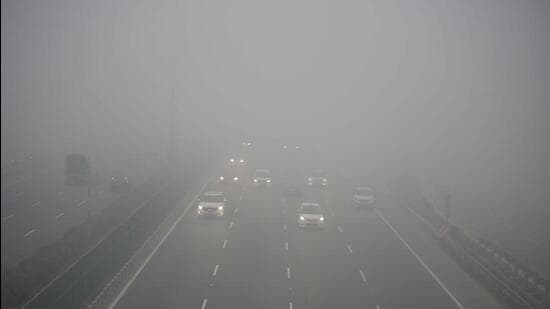
According to data from the India Meteorological Department (IMD), Delhi has so far this month seen only 175 hours of fog (where the visibility is below 1,000 metres). This number is the lowest since 2008, when the Capital got 166 fog hours, and well below the January average of 290 fog hours.
Also Read | Delhi homeless shelters packed to the rafters amid record-breaking winter
Even in December 2021, Delhi recorded only 75 fog hours as compared to a monthly average of 278 hours.
According to IMD data, Delhi saw 75 fog hours over 22 foggy days in December 2021 -- the lowest since December 1982, when the Capital saw a similar low of 75 hours of fog over 14 fog days.
Met officials said December 2021 was largely characterised by weak western disturbances which added little moisture to the air, and January this year saw more upper-level fog, instead of fog formation at the surface –leading to cold day conditions in the Capital.
{{/usCountry}}Met officials said December 2021 was largely characterised by weak western disturbances which added little moisture to the air, and January this year saw more upper-level fog, instead of fog formation at the surface –leading to cold day conditions in the Capital.
{{/usCountry}}IMD declares a fog when the visibility drops below 1,000 metres. When the visibility is between 500 and 1,000 metres, it is categorised as a ‘shallow fog’, between 200 and 500 metres, a ‘moderate fog’. A fog is classified as ‘dense’ if the visibility drops below 200 metres.
While Delhi has seen a spate of extreme weather events every month for nearly a year-and-a-half now, which scientists have flagged as the effects of the global climate crisis, experts said the lack of fog was likely an isolated weather phenomenon.
IMD scientist RK Jenamani said Delhi sees an average of 570 fog hours over 52 foggy days between December and January, when fog formation in the city is at its peak.
“In comparison, we have only seen 44 fog days and 250 fog hours in these two months combined this year, making it the lowest in the last 29 years. While there are five more days still to go in January, not much fog is expected in this period, because wind speeds will pick up once again this week,” said Jenamani.
He said December saw multiple western disturbances, but each remained substantially weak, unable to add enough moisture to the air.
“A western disturbance generally brings some rain. But even if it doesn’t bring any precipitation, a lot of moisture gets added to the air. This did not happen in December this time and we also had strong winds after the western disturbances departed,” explained Jenamani, adding that windy conditions are unfavourable for fog formation.
While Delhi’s air has seen enough moisture air in January, the surface winds are still strong, leading to formation of fog 500 to 1,000 metres over the surface.
“In January, we had two significant rain spells and enough moisture was introduced but instead of fog forming on the surface, it was forming nearly a kilometre above the surface, leading to upper-level fog formation and low clouds hanging over Delhi. This has led to cold day conditions, but at the surface, visibility has been very good and has ranged from 800 to 1,200 metres,” said Jenamani.
Navdeep Dahiya, an amateur weatherman who runs ‘Live Weather of India’, said factors such as adequate moisture, a certain minimum temperature and calm winds are required for fog formation.
“However, wind speeds in the region have generally remained high and instead of fog forming at the surface, the Indo-Gangetic Plains are seeing upper-level fog this year,” said Dahiya.
Dipankar Saha, former head of the Central Pollution Control Board’s (CPCB) air laboratory, said that while extreme weather events are becoming more common, uneven patterns of fog formation couldn’t be linked to the impact of the climate crisis without deeper analysis.
“Some weather events such as extreme rainfall, especially in the coastal parts are becoming more frequent. However, we have seen a similar spell of a lack of fog in 1991-1992 as well. This shows that such spells can happen, albeit very rarely. A long-term trend of fog would have to be analysed to link it to the climate crisis,” he said.
Stay updated with all top Cities including, Bengaluru, Delhi, Mumbai and more across India. Stay informed on the latest happenings in World News along with Delhi Election 2025 and Delhi Election Result 2025 Live, New Delhi Election Result Live, Kalkaji Election Result Live at Hindustan Times.
Stay updated with all top Cities including, Bengaluru, Delhi, Mumbai and more across India. Stay informed on the latest happenings in World News along with Delhi Election 2025 and Delhi Election Result 2025 Live, New Delhi Election Result Live, Kalkaji Election Result Live at Hindustan Times.