
 E-Paper



Calm winds at night mean AQI poorest when kids go to school
Delhi's air quality is at its worst every morning after a night of still winds, leaving children vulnerable to health hazards posed by pollution.


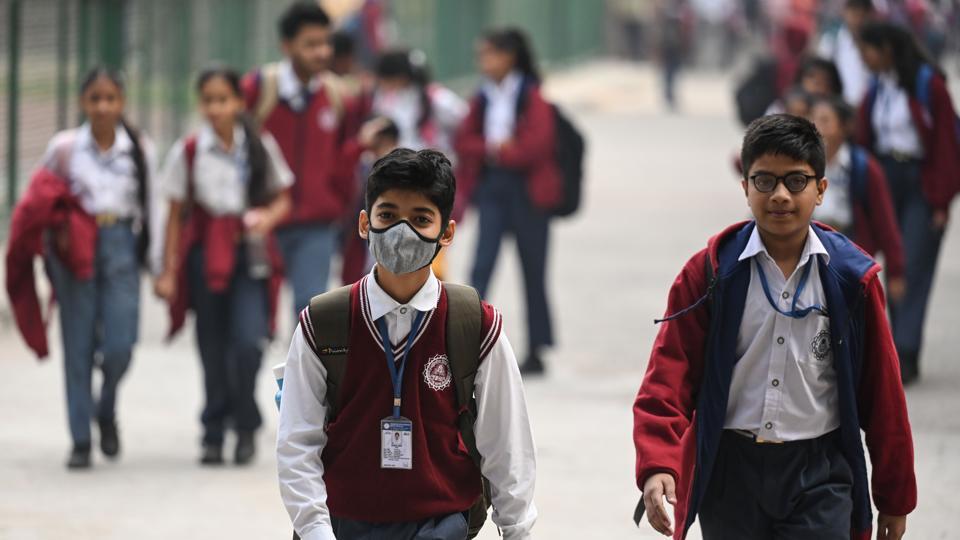
The Capital’s air quality is at its worst every morning after a night of still winds, leaving children heading to school particularly vulnerable to a host of health hazards posed by noxious pollution levels, shows data, underscoring yet another impact of Delhi’s annual smog emergency.
Data from the Central Pollution Control Board showed that Delhi’s real-time hourly average air quality index (AQI) largely remains “severe” all morning, before improving marginally around noon, when the temperature rises and winds pick up.
Delhi’s schools reopened on Monday after the state government imposed an early winter break, prompted by the city’s consistently ‘severe’ air quality index (AQI).
READ | Delhi’s air quality turns ‘severe’; AQI reading stands at 413
On November 6, the Delhi government ordered schools to shut till November 10 for primary classes, as the city’s air quality nosedived. On November 9, as a shroud of smog cloaked the city, the government rescheduled the winter break, ordering schools to remain shut between November 10 and 18 for all classes.
Still, with schools now open, children are exposed to the worst of the city’s air.
For instance, Delhi’s hourly average AQI was 413 (severe) at 9am on Wednesday. It worsened to 422 by 11am, before winds began picking up across the city. The AQI at noon was 420, but by 2pm, improved to 330 (very poor).
It remained in this zone till around 6pm. However, as night crept in, pollution levels worsened again. At 9.30pm, the hourly AQI shot up to 390, according to CPCB’s Sameer app.
READ | Delhi's air quality improves but remains ‘very poor’. Latest updates on AQI
To be sure, hourly averages are not collected for the agency’s official 4pm bulletin, which instead takes into account the 24-hour AQI value.
Climate experts said that even with winds picking up during the day, low temperatures and calm winds at night allow pollutants to accumulate.
Data on levels of PM2.5 (an ultrafine pollutant) highlighted the toxicity of the city’s air every morning.
For example, on Tuesday, Delhi’s PM2.5 concentration was 243 micrograms per cubic metre (µg/m3) at 6am — around five times the 24-hour national standard of 60 µg/m3.
This continued to rise till 11am, touching the day’s peak of 287µg/m3, before beginning to dip again. The day’s lowest PM2.5 concentration was recorded at 4pm, when it was 159µg/m3, and when the surface winds touched a speed of 15 km/hour in parts of Delhi.
On Wednesday, the hourly PM2.5 concentration at 6am was 295 – the highest for the day, dipping only marginally to 278 by 11am. It was only by 12pm — when wind speeds picked up to 8 km/hour, it improved to 239µg/m3, touching the day’s hourly low of 162 by 4pm, showed CPCB data.
Kuldeep Srivastava, scientist at the India Meterological Department (IMD), said winds are strongest between 12pm and 6pm, touching 15 km/hour on Tuesday and around 10 km/hour on Wednesday.
“On Wednesday, winds were strong for around three hours till around 3pm, and gradually began to drop. They are almost calm at night,” he said.
Doctors and healthcare specialists said such deadly air exposes elderly people, who usually head out for morning walks, and children to debilitating health risks.
Dr GC Khilnani, chairman at PSRI Institute of Pulmonary, Critical Care and Sleep Medicine, said morning walks are “ill-advised” when the air is this poor and stressed that it is particularly damaging for children and the elderly, whose lungs are more susceptible to the harmful impact of fine particulates.
“In the early hours, pollutants are at the surface level. As the sun comes and pollution reduces, exercising is much safer then,” he said, adding that since the start of November, there has been an exponential rise in patients with acute attacks of asthma and chronic obstructive pulmonary disease (COPD).
“These patients have been healthy for quite some time, but are now coming in with severe coughs and wheezing. Another group of patients are the ones who do not have asthma or COPD, but are catching mild fever for one or two days, followed by prolonged, troubling cough and at times wheezing,” he said, and added that the elderly, children and those with cardiorespiratory diseases, also need to avoid crowded places and markets.
Khilnani also recommended the use of N95 masks.
“An N95 mask, although not completely proven to provide protection against pollutants, should be used by the vulnerable groups before stepping out,” he said.
Sunil Dahiya, analyst at the Centre for Research on Energy and Clean Air (CREA), said the current AQI data highlights the impact of calm winds over Delhi. “In the morning, we are seeing fog and after 6am, emissions rise with the vehicle rush increasing. If there are no winds, these emissions will continue to accumulate and by noon, levels are fairly high. It is only after noon that we see surface winds and the sun come out, which eventually leads to dispersal of pollutants.” he said.
Meanwhile, Delhi’s 24-hour average AQI veered close to the ‘severe’ zone once again, with a reading of 394 at 4pm, worse than 372 a day ago, showed CPCB data.

Stay updated with all top Cities including, Bengaluru, Delhi, Mumbai and more across India. Stay informed on the latest happenings in World News along with Delhi Election 2025 and Delhi Election Result 2025 Live, New Delhi Election Result Live, Kalkaji Election Result Live at Hindustan Times.


