
 E-Paper



Chhath returns to Yamuna’s banks amid pollution debate
After a gap of four years, the Delhi government has reopened 17 ghats along the Yamuna for immersions and prayers, alongside 1,300 smaller sites across the city.

 Prefer HTon Google


The afternoon sun glints off the Yamuna at ITO ghat, scattering light across bamboo barricades and freshly raised sand embankments. Loudspeakers hum devotional songs as workers rush to set up tents and women in bright saris check the arrangements. Young men wade into the shallows to tie bamboo poles as dredging machines work on the riverbed.
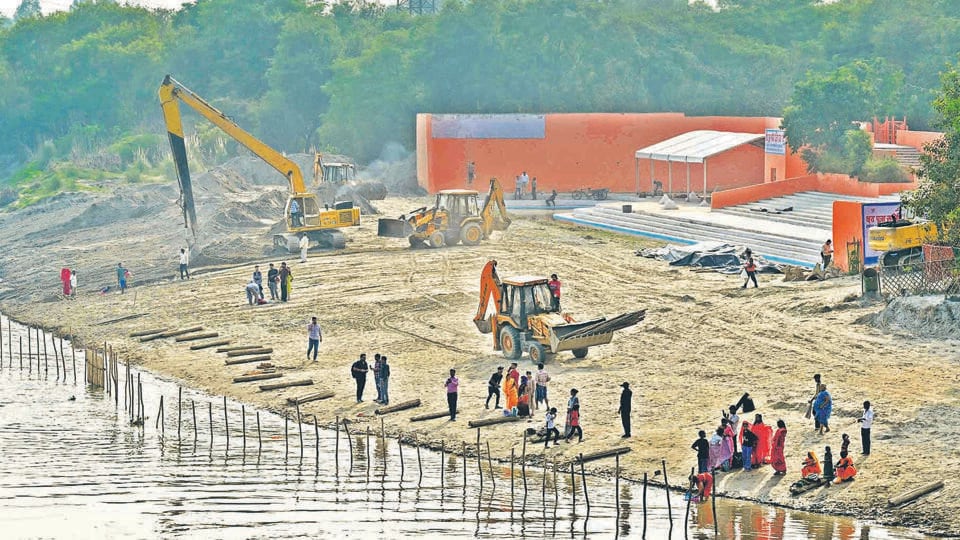
Preparations are underway in full steam for Chhath Puja. From Saturday, the riverbanks will be taken over by thousands of devotees marking a festival celebrates the Sun God and nature itself. But this year’s celebrations carry a different weight.
After a gap of four years, the Delhi government has reopened 17 ghats along the Yamuna for immersions and prayers, alongside 1,300 smaller sites across the city. Officials said the decision was prompted by improved river conditions and the release of fresh water from Haryana’s Hathnikund barrage, ensuring steady flows during the four-day festival.
But the move has also reopened an uncomfortable debate: whether the Yamuna is truly fit for people to take dips in, or whether the move risks public health and environmental progress.
Chhath Puja is celebrated by communities from Bihar and eastern Uttar Pradesh – known better as Purvanchalis, who form a third of Delhi’s population. It involves fasting devotees offering “arghya,” or prayers, while standing in knee-deep water at sunrise and sunset. This year’s main rituals fall on October 27 and 28.
Significantly, the decision to reopen Yamuna ghats comes weeks before elections in Bihar.
Between 2021 and 2023, Chhath prayers were shifted to artificial ponds and water bodies across parks after disturbing images showed devotees standing in froth-covered, toxic Yamuna waters. Government studies and experts had warned of serious health hazards from continuous contact with the river. Experts also cautioned that ritual offerings, often accompanied by flowers, fruits, and plastic packaging, worsened pollution levels in the already-choked waterway.
Differing views
Some experts said that the current pollution trends as per the measurements from the Delhi Jal Board (DJB) laboratory show that it may be safe for people to take a dip in the river. “I visited the DJB lab set up along the river two days ago and the water samples showed Dissolved Oxygen (DO) levels of 4 mg/l, which is a safe level. This could be because it rained more, almost till October and the monsoon rain has also been plenty. So, there is much fresh water available upstream that is diluting pollutants,” said water expert and environmental activist Diwan Singh.
He said that the organic offerings like flowers may not impact the river, especially if there is flowing water. “The river may get polluted only if there is solid waste like plastic thrown in the river, which can be easily managed by the government agencies with little effort,” said Singh.
The Delhi government, on the other hand, has claimed that efforts are in place to ensure that people are able to take a dip in the river without polluting the river. At ITO, Sonia Vihar and Vasudev ghats, cranes dredge silt while workers raise bamboo structures. Medical tents, drinking water points and cultural stages are being readied for the crowds expected over the weekend.
“I just took a dip in the water and it is very clean. I have not seen such arrangements in the past several years. We come here every year and the ghat as well as the water used to always be very dirty” said Meena Devi, who comes from Inderpuri for the Chhath puja at ITO ghat every year.
Still, environmentalists are unconvinced.
Associate coordinator, South Asia Network on Dams, Rivers & People (SANDRP) Bhim Singh Rawat, said the water still has loads of pollutants and exposure to it can result in several health-related issues. “Given the pollution loads reaching the river from three major drains in Haryana upstream Delhi and 22 drains within the national capital, the flows would not make the river water quality fit for bathing or swimming category,” said Bhim Singh Rawat.
“Exposure to toxic contaminants would certainly have adverse health impacts on devotees in the form of skin rashes, allergies, itching, eye ailments and gastrointestinal complications,” Rawat added.
Rawat said that since October 21, the river’s flow has risen to over 7,000 cusecs – an unusual post-monsoon surge. “This may help the ecosystem temporarily, but the decision seems ad hoc. There’s no clarity on why or how this much water was released. It sets a dangerous precedent for river governance – where flows can be stopped or started at will, without transparency or accountability.”
Environmental volunteer Pankaj Kumar of Team Earth Warrior said the quality of water in the river is so bad that it is not fit for bathing, and the government’s decision to allow the celebration in the river could spark a health crisis.
“Some politicians were seen drinking the Yamuna water to send a message across to people that it’s fit for drinking. But according to the requirements laid down by the National Green Tribunal, the water isn’t even suitable for taking a bath,” said Kumar. “By allowing our citizens to go in these polluted waters, we are creating a situation of health crisis,” Kumar added.
But beyond the environmental debate, the timing of the move has raised political eyebrows. In the past few years, Chhath has evolved into a festival of both devotion and political visibility, with political leaders from all parties eager to associate themselves with it. This year, the lieutenant governor and Delhi CM and ministers jointly inspected the Vasudev ghat, describing the arrangements as “historic.”
Yamuna pollution rises
The Delhi Pollution Control Committee’s (DPCC) latest analysis shows a sharp spike in Yamuna pollution levels through October compared to September — when heavy monsoon flows had briefly flushed the river clean.
At the ISBT bridge, just downstream of the Najafgarh drain’s confluence, faecal coliform levels jumped from 3,500 MPN/100ml in September to 21,000 in October. Biochemical Oxygen Demand (BOD), a key indicator of organic pollution, rose from 13 mg/l to 37 mg/l — more than twelve times the safe limit. Dissolved oxygen, essential for aquatic life, dropped to zero at the point where the river exits Delhi. For bathing water, BOD should be under 3 mg/l and coliform counts below 2,500.
To be sure, these samples were collected on October 9 -- before Haryana began releasing roughly 7,900 cusecs of water daily. While the additional flow may dilute pollutants, activists note that froth, though less than previous years, continues to appear near Kalindi Kunj and Okhla.


Stay updated with all top Cities including, Bengaluru, Delhi, Mumbai and more across India. Stay informed on the latest happenings in World News along with Delhi Election 2025 and Delhi Election Result 2025 Live, New Delhi Election Result Live, Kalkaji Election Result Live at Hindustan Times.


