E-Paper



Coaching centres of Delhi: The ecosystem that feeds on aspiration
What started in the 1990s as a few coaching institutes kicked off a trend that led to dawn of a profit-hungry industrial complex feeding on dreams of millions

 Prefer HTon Google


A rickety staircase leads down to a cramped room within the basement of a four-storey building in South Delhi’s Kalu Sarai. Nearly a dozen students are attending a class in a room with no windows, preparing for their IIT-JEE exams. The houses in this lane are so cramped that even sunlight barely makes it through the narrow gaps between the buildings. Low-hanging electricity wires hover barely a few inches above the heads of pedestrians packed into the lanes.
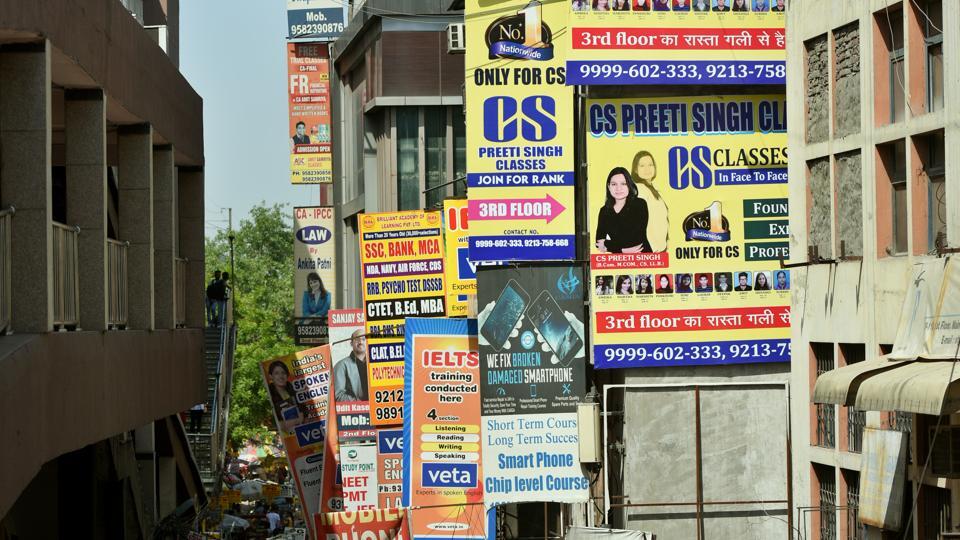
This is one of the 40 estimated coaching centres located in Kalu Sarai, the epicentre for coaching centres that draw IIT aspirants by the thousands.
The first coaching centres in Kalu Sarai were set up in the early 1990s. The first growth phase came in early 2000s with the start of centralised exams, leading to the creation of a parallel education system that offered a fast-track to prosperity for million by clearning competitive professional exams. Since then, they have grown rapidly, creating an ecosystem that feeds and feeds off anyone who is part of India’s unforgiving universe of competitive exams. There are hundreds of buildings offering paying guest (better known as PG) accommodation, book shops, home-cooks and restaurants that offer tiffin services.
The 14th century village may have been among the first areas in Delhi to emerge a coaching hub, but the model has since been replicated across several others, with one constant. Regulations on infrastructure, fees, and protecting the rights of students are either non-existent or ambiguous.
Coaching centres themselves are allowed under Delhi’s Master Plan , but the Municipal Corporation of Delhi (MCD) does not issue any trade licence for them, according to a senior MCD official (and simply because they do not need one). “The entire industry remains largely unregulated,” said the official, who did not wish to be named.
The only rules they are required to follow are all related to buildings, not trade. They include payment of conversion charges, parking charges, conformation to building byelaws, development control norms and approvals from statutory bodies like fire services.
Last year, a massive blaze at a coaching centre in Mukherjee Nagar created widespread outrage when videos of students rappelling down from the windows in an effort to save their lives were published , prompting the Delhi high court to take suo motu cognisance of the matter. In a status report filed in this matter, Delhi Police had informed the high court in July 2023 that of the 583 coaching institutes running in Delhi, only 67 possessed no-objection certificates (NOC) from the Delhi Fire Services.
But even that number is far from accurate.
Industry insiders put the number of such coaching centres at least 4,000-5,000 in the city. And even this number is likely to be an under-estimate as it does not include smaller tuition centres and people running coaching classes in their homes. The floating population of students that patronise these centres and tutors is estimated at anything between 500,000 and a million.
For context , India’s unofficial coaching capital – Kota – caters to around 150,000 students.
Keshav Aggarwal, president, Educators’ Society, an association representing coaching centres, said: “The real growth came after 2007 when MPD (master plan Delhi) 2021 came out and coaching centres were permitted under mixed land use provisions” He admitted that the rules and infrastructure requirements for these remained unclear, leading to “unplanned growth.”
A person who runs a coaching centre, said on condition of anonymity that all that MCD requires is a ₹500 registration fee and parking and conversion charges .
“The industry largely remains unregulated with no clear set of rules. Every government department tries to pass on the responsibility. MCD is willing to take lakhs of rupees in conversion charges, but does not provide any conclusive proof of legitimacy,” this person added.
Under Clause 15.7.3 of the Master Plan of Delhi 2021, coaching centres and tuition centres are permissible up to two-thirds of the maximum permissible floor-area ratio (FAR) of the plot size, up to a maximum of 500 sqm built up area.
MCD officials said that tuition centres for school children are permitted in the ground floor of group housing societies up to a maximum floor area of 100 sqm or 50% of the floor area of the flat.
The latest push in expansion of coaching units in the city came after the Covid-19 pandemic.
During the pandemic, there was massive demand for digital coaching centres – leading to the emergence of celebrity tutors, a phenomenon fuelled by social media platforms.
After the pandemic, many of these people sought to leverage their celebrity, setting up coaching centres on their terraces, or basements. In the aftermath of the July 28 tragedy, MCD has so far sealed 28 basements where coaching centres were being run. One such sealed basement was being used by Drishti IAS, a popular UPSC exam coaching institute, MCD has said in an official statement.
Vikas Divyakirti, who runs Drishti IAS institute, said in a statement that the problem related to coaching institutes is not as simple as it appears.
“It has many aspects which are due to the ambiguity and contradiction of laws. There is inconsistency in the rules of DDA, MCD and Delhi Fire Department. Similarly, there is a lot of contradiction in the provisions of ‘Master Plan of Delhi 2021’, ‘National Building Code’, ‘Delhi Fire Service Rules’ and ‘Unified Building Bye Laws’. Except ‘Master Plan of Delhi 2021’, no document has clear provisions for coaching institutes. We are hopeful that when the committee appointed by the Union home ministry submits its report in a month, most of the above-mentioned points will be resolved,” Diyvakirti added.
His reference is to the committee set up by the Union home ministry on July 29 to investigate the Rajendra Nagar case. In addition, on Wednesday, the Delhi government said it would come up with a law for coaching centres. Divyakirti said that one solution is for the government to identify a handful of areas in Delhi and designate them specifically for coaching institutes.
Aggarwal said that certain clauses such as fire safety NOC end up being tricky to implement for coaching centres as they only operate on a few floors, or parts of a building and often don’t own the structure outright.
“For structural changes to items like staircases, one needs to have complete ownership of a building.”
He added that the smaller tuition centres meant for students in residential localities need to be separately defined with number of students and space requirements.
“The larger centres with hundreds of students may need separate regulations. It should be clearly defined on how these units can be run, space, area,” he added.
MCD commissioner Ashwani Kumar on Tuesday said that there is a huge demand for coaching and that many students from other regions come to Delhi to study in these centres.
“We should also identify space for people to open coaching centres legally and formally where all services are provided. It is a requirement of the city so that illegality can be prevented.”
AK Jain, former commissioner (planning) , Delhi Development Authority (DDA), who worked on the MPD-2021 said that the mushrooming of such dangerous units has been spurred by high profit margins and lack of any enforcement.
“MPD 2021 tried to regulate this activity. Coaching centres were not allowed even on mixed land use streets till 2006. The first time such units were permitted was in February 2007, but with very specific conditions like 18m wide road, approved building plans, a minimum 200sqm plot payment of conversions charges among others,”he added.
But regulations and the law can go only that far in an ecosystem where supply far exceeds demand, forcing students to seek out any advantage they can access and which is within their mans to do well in exams that often offer them (and their families) an opportunity to change their fortunes.
Sumit Saurabh, a 29-year-old who moved to Delhi from Kaimur in Bihar in 2023, said that the students who attend these classes are generally left with no option but to stay in the area and around to be able to cut transportation cost, adding that a major chunk of their expenses are consumed by the exorbitant fees charged by the coaching institutes.
“Most of us spend years here, and our parents fund our education. If we must spend on transportation, where will we go? That’s the reason we compromise on our living conditions and pay high rents” he said, adding that they end up sitting in whatever classes they can due to the heavy competition that even admission to coaching institutes have.
Another aspirant Abhishek (single name), 29, said that he eats outside every day because the food offered by his PG owners is “inedible” and pays ₹18,000 for a bed and a small study table in Old Rajendra Nagar.
“This is how everyone who comes here lives. With lack of options. The incident is extremely unfortunate but we hope that the students’ deaths remind the authorities that they need to act,” he said.
Students also recalled incidents where they were packed heavily inside classrooms at these institutes.
Satyam Pandey, 26, who had come from Kannauj in Uttar Pradesh to Delhi in 2020, narrated how he attended classes in a reputed institute with more than 1,000 students in a class. “The teachers for whom we come here don’t even know who we are. There are between 500 to 1000 students in a class. It’s just that they know the subjects so well that we feel it’ll help us. And another aspect is that not only libraries are running in the basement, even classes are taken there,” he said.