
 E-Paper



Delhi airport gears up to handle flight ops amid dense fog
The Airport Predictive Operations Centre (APOC), which plays a central role in operations, will integrate real-time data, predictive weather models, and airside operational inputs into a single command environment


New Delhi
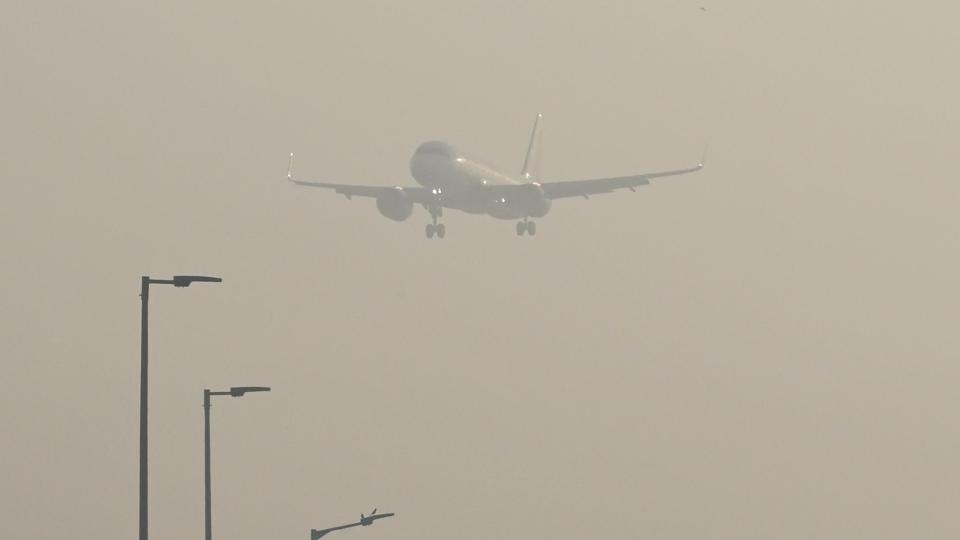
The Indira Gandhi International (IGI) Airport is all geared up to minimise disruption in operations due to low visibility in winter, deploying advanced AI systems, predictive analysis and runway upgrades undertaken over the past few months, leading to interim runway closures. Airport operator Delhi International Airport Limited (DIAL) said on Wednesday that a combination of these upgrades and technology should help ensure safer and more efficient flight operations during low visibility.
The GMR Aero-led DIAL said the Airport Predictive Operations Centre (APOC), which plays a central role in operations, will integrate real-time data, predictive weather models, and airside operational inputs into a single command environment, officials said.
“This will enable faster decision-making and more accurate resource deployment during fog,” a DIAL spokesperson said, adding it will further help with runway utilisation, improving gate and stand allocation, prioritising aircraft sequencing, and ensuring timely communication with all partners.
“This coordinated, data-driven approach significantly enhances the airport’s ability to maintain operational continuity even during rapid visibility fluctuations,” the spokesperson said.
Ahead of peak winter, the Dwarka end of Runway 10/28 (the second runway) has been equipped with a CAT-3 Instrument Landing System. With this enhancement, three runways (10/28, 11L/29R, and 11R/29L) at the airport are now CAT-3 compliant at both ends, enabling safe landings even in dense fog. This is also expected to cut fog-related recovery time by nearly four hours.
“The newly upgraded runway, along with the existing runway, enables around 30 landings per hour during low-visibility conditions,” the DIAL spokesperson said.
Further, as a pilot project, DIAL will be using Winter Fog Experiment (WiFEX) data on fog, a model launched by the Pune-based Indian Institute of Tropical Meteorology (IITM), in collaboration with the India Meteorological Department (IMD) and DIAL in 2015.
The model aims to provide 85% fog prediction accuracy and should help in anticipating fog build-up well in advance.
“Data related to temperature, humidity, wind profiles, aerosols, pollution particles, radiation, microphysics of fog droplets, and visibility changes are collected through sophisticated instruments like LIDARs, ceilometers, radiation sensors, aerosol counters, and remote sensing towers. This will help in building advanced fog prediction models (1 to 36 hours in advance), understand local meteorology behind dense fog, improve airport operations and safety through accurate visibility forecasts, and create long-term datasets for fog research,” the spokesperson said.
DIAL’s chief executive officer, Videh Kumar Jaipuriar, said fog is a natural and unavoidable part of Delhi’s winter, but the airport has strengthened its preparedness to combat it. “This will be done with next-generation AI tools, advanced predictive analytics and data from WiFEX, which allows us to predict fog well in advance,” he said.
“While weather-related disruptions cannot be eliminated completely, these upgrades will greatly improve our ability to plan, respond, and recover quickly. Our focus remains firmly on ensuring a reliable, safe, and comfortable travel experience for all passengers throughout winter season,” he said.

Stay updated with all top Cities including, Bengaluru, Delhi, Mumbai and more across India. Stay informed on the latest happenings in World News along with Delhi Election 2025 and Delhi Election Result 2025 Live, New Delhi Election Result Live, Kalkaji Election Result Live at Hindustan Times.


