
 E-Paper



Delhi faces green hurdle in Munak Canal elevated corridor plan
Haryana’s irrigation and flood control department, which oversees the entire length of the canal in Delhi and is also the landowning agency, has apprised that the land for the proposed corridor is a “protected forest” and necessitates additional clearances

 Prefer HTon Google


New Delhi
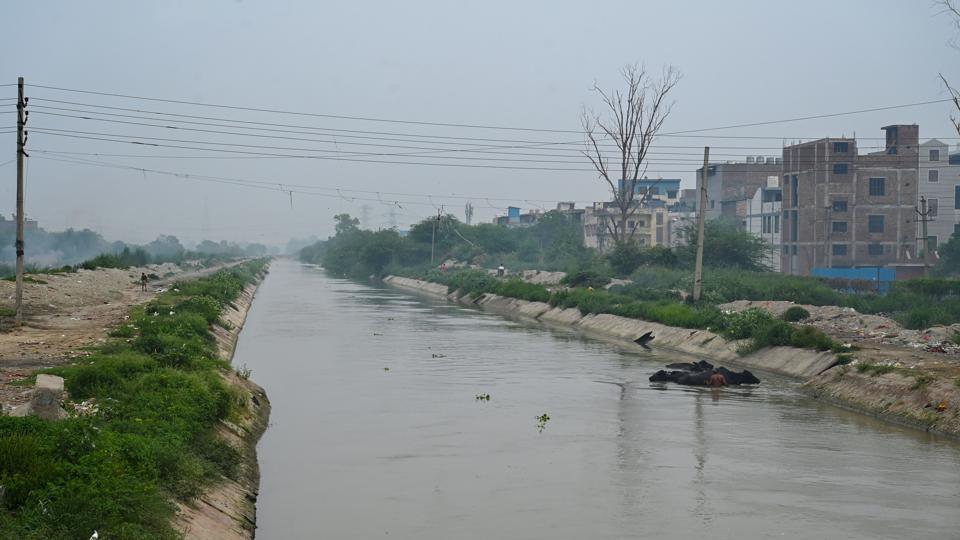
The Delhi government may face a green hurdle in its bid to develop a 20-kilometre elevated corridor along the Munak Canal from Bawana to Inderlok, as part of the canal revamp project, officials aware of the development said. Officials of the Public Works Department (PWD) said that Haryana’s irrigation and flood control department, which oversees the entire length of the canal in Delhi and is also the landowning agency, has apprised that the land for the proposed corridor is a “protected forest” and necessitates additional clearances and approvals for infrastructure work.
According to a PWD report on the project dated July 10, there are more than 2,000 trees along the canal.
“The Irrigation and Flood Control Department of Haryana has informed that the land under the proposals has been declared as a protected forest through a notification issue dated March 6, 1972. There are approximately 2000+ trees,” the report reads.
PWD officials said that the issue of trees was flagged in a review meeting attended by Delhi chief minister Rekha Gupta earlier this month.
Forest department did not respond to queries from HT.
A government official said that forest areas are covered under the Forest Conservation Act, and that the agency will have to file an application with the local tree officer, following which the state will send an application to the Union environment minister.
“Besides their clearance, it will also need approval of the Central Empowered Committee (CEC), a statutory body established by the Supreme Court. It is a lengthy process,” a PWD official said.
The project, which will run from the Urban Extension Road-II (UER-II) to Inderlok, aims to improve connectivity, alongside creating recreational and environmentally sustainable public spaces, officials said. The proposed corridor will include at-grade development, focused on beautification and rejuvenation of the canal front, apart from the elevated road.
Built between 2003 and 2012 as part of the Western Yamuna Canal system, the Munak Canal carries over 1,000 cusecs of Yamuna water daily to Delhi via two offshoots—the Carrier Line Channel (CLC) and the Delhi Sub Branch (DSB). The canal starts from the Munak regulator in Karnal, Haryana, and flows south via Khubru and Mandora barrages before ending in Delhi near Haiderpur. The initial memorandum of understanding between Haryana and Delhi was signed in 1996, but political disputes delayed concreting the canal’s lining until 2012.
According to PWD plan, the 20km corridor will be divided into three phases: a 14km four-lane viaduct on pillars between Bawana to Outer Ring Road will run to the right side of the canal and then vary in two three-kilometre sections between ORR and Mahatma Gandhi Road and Mahatama Gandhi Road to Inderlok. The four key hurdles outlined for the ₹3,000-crore project are 2,000 trees, land acquisition hurdles, nod from Haryana government and NOC from other stakeholders and utilities.
PWD has initiated the process for a detailed project report (DPR), which will include the design of all structural and landscape components, and environmental and social feasibility assessments. “The consultant will also be asked to consider various alignment options in consideration of trees and other features. We will try to save as many trees as possible,” the official said.
According to the mandate of the consultant, a tree count survey of the entire stretch will be carried out for marking locations of the trees with girth more than 15 cm (measured at 1m height from the ground level) and all the trees along canal will be numbered and marked with paint “including the identification of trees, which can be saved without cutting”. The work includes a GPS tree survey in the central verge as well as sides, and in the complete ROW (right of way) of the whole stretch for the work, the report adds.
“Identification of impacted trees in the proposed redevelopment of roads. Marking and numbering of trees impacted on site will be carried out and field data collection of the impacted trees with details of geographic location coordinates, species, diameter & girth, spread diameter of tree, health status of tree, photograph of each tree and reference number will be collected,” it said.
The consultant will also help prepare reports for tree felling permissions for impacted trees within the tree officer’s jurisdiction and alignment, the official said, adding that it will also assist in the preparation of presentations for higher authorities.
Several of Delhi’s infrastructure projects in recent years, including Barapullah Phase-3, Punjabi Bagh flyover, Gagan Cinema flyover and Anand Vihar flyover, among others, have been delayed due to poor planning and lack of tree felling permissions.
Last year, courts issued a complete ban on tree felling permissions for a series of infrastructure projects. For instance, at the Anand Vihar flyover, the trees have been left in the middle of the carriageway due to a lack of permission.
Environmental activist Diwan Singh, who has worked on restoring multiple water bodies in the city said that the national capital is already saturated with traffic and rather than facilitating projects that bring in more vehicular flow and may harm thousands of trees, we should focus on restricting and regulating the traffic.
“Elevated corridor is a hugely resource intensive project and this money should be spent on improving city ecology. Traffic problem has to be solved on ground. Building flyovers is like flying over the problems rather than tackling them. Delhi faces severe pollution issues and outer Delhi is the only green buffer. The green corridor along the canal needs to be saved,” he said.


Stay updated with all top Cities including, Bengaluru, Delhi, Mumbai and more across India. Stay informed on the latest happenings in World News along with Delhi Election 2025 and Delhi Election Result 2025 Live, New Delhi Election Result Live, Kalkaji Election Result Live at Hindustan Times.


