
 E-Paper



Free 20 litre water per day at 500 water ATMs: Delhi CM Kejriwal
Kejriwal said that the project aims to eliminate dependence on tankers which provide water in areas without piped water supply

 Prefer HTon Google


In areas having inadequate piped water supply, the Delhi government plans to install 500 Reverse Osmosis (RO) plants equipped with “water ATM machines” to provide free and safe access to potable water to residents of such areas, including JJ clusters, chief minister Arvind Kejriwal said on Monday.
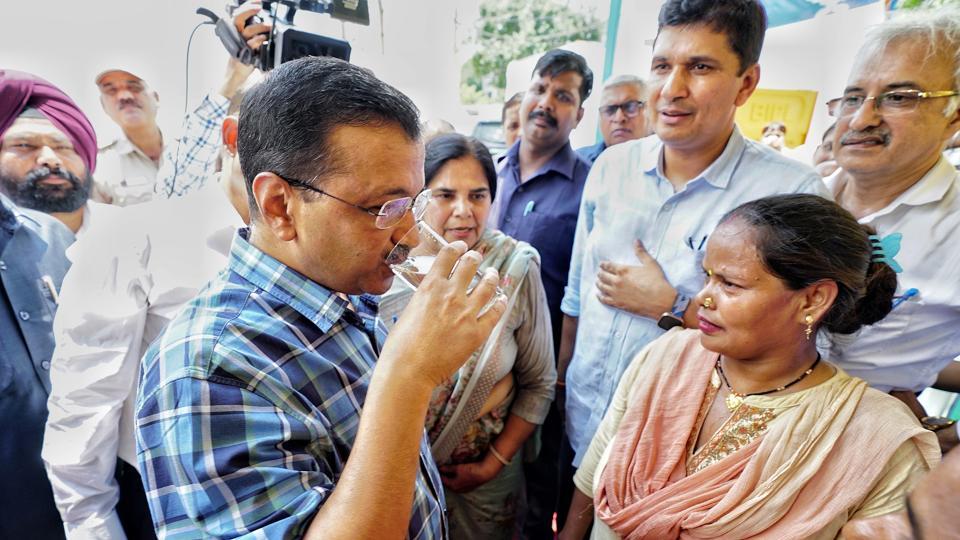
Kejriwal, who was inaugurating one such plant on pilot basis in West Delhi’s Mayapuri Khajan Basti, said that the project aims to eliminate the dependence on tankers which provide water in such areas.
“The underprivileged sections of Delhi will now have access to the same quality of RO water that has long been accessible to the more affluent segments of society. The residents in areas without water pipelines will no longer have to rely on water tankers or compromised water sources,” he said.
The project will be implemented by the Delhi Jal Board (DJB). It has already three more such plants in the city on a pilot basis.
A DJB official said that under the project, the 500 RO plants of 30,000 litre capacity each will be installed in areas based on the availability of tubewells. While the plant will be managed by an operator on a land allocated by the government for free, the ₹10 lakh cost of the plant will be borne by DJB, the official said.
The filtered water will also be supplied for free through water ATM machines to residents of these areas, provided they have RFID (Radio Frequency Identification) cards, the official added.
“The tubewells will supply raw groundwater to RO installations, which will be then purified. After passing through RO and microfilters, the water will undergo high-pressure pumping. The rate for purified water will be ₹1.60 rupees per 20 litres (8 paise per litre), but the JJ cluster residents will receive this water for free,” the official said.
One person having an RFID card can avail 20 litres of water in a day for free. But beyond that, they will be charged at a rate of 8 paise per litre, the official said, adding that consumers not having RFID cards will be charged at the same rate.
DJB, at present, supplies 990 million gallons a day (MGD) water to 21 million consumers in the Capital. The water utility body has laid pipelines in approximately 93% of areas, with remaining areas posing challenges in the form of unplanned development and cramped settlements. DJB faces a demand supply gap of over 250MGD and it plans to add another 20MGD water supply by installing a wide array of such RO plants.
“Under the pilot project, four RO plants have already been established, and the process of setting up an impressive network of 500 additional RO plants is currently underway,” Kejriwal, who also consumed the output water from the Mayapuri facility, said.
Kejriwal said that there are several areas in Delhi where it is not possible to lay out new water pipelines due to high population density. “In the mission of providing clean water to every house in Delhi, we are also doing a unique experiment like Water ATM. We will start Water ATMs wherever we have to supply water through tankers,” he said in a tweet.
“We will be installing tubewells, but this can only be done in areas where the water level is high. Usually, the issue with installing tubewells is that the quality of the water is not very good. So now we will pass the water that is taken out by the tubewells through an RO,” Kejriwal said at the event.
Besides Mayapuri Khajan Basti, the three other operational water ATMs are located at Shakurbasti, Kalkaji, and Jharoda, said water minister Saurabh Bharadwaj. The government is in the process of installing 500 more such plants, with 2,500 cards already issued to local residents, he added.
Delhi BJP President Virendra Sachdeva criticised the extraction of water through tubewells instead of laying down water pipelines. “Delhiites faced a worst ever summer water crisis and now even in monsoon when Yamuna is flooded Delhiites are facing acute water crisis. It is shocking that Kejriwal government is increasingly relying on tubewell water extraction instead of laying water lines and supplying purified river water. The contamination level in Delhi’s groundwater was found too high by the Delhi government itself a couple of months ago. One fails to understand how the ROs will clean the highly contaminated ground water,” he said.


