
 E-Paper



Ministers use public transport; NDMC puts two-thirds of employees on WFH
Delhi government officials adopt austerity measures, prioritizing public transport and carpooling to conserve fuel amid PM Modi's appeal for energy savings.

 Prefer HTon Google


Delhi government ministers and senior officials on Wednesday began adopting a series of austerity and fuel-conservation measures following Prime Minister Narendra Modi’s appeal to reduce petroleum consumption amid the prevailing global situation. Government sources said ministers are prioritising the use of public transport and carpooling, restricting official vehicle usage, and halting foreign travel.
Chief minister Rekha Gupta said the government has decided to reduce the use of official vehicles and encourage ministers, legislators and officials to rely more on public transport and carpooling.
“The Prime Minister has called upon citizens to conserve petrol and diesel and turn energy conservation into a mass movement in view of the current global situation,” Gupta said, adding that the government has started “minimising vehicle usage”.
Also Read: ‘India loses hours daily in traffic’: Techie backs PM Modi’s work from home push
Urging residents to follow suit, Gupta said a shift from private vehicles to Metro trains and buses would not only help save fuel but also reduce traffic congestion and air pollution.
Formal departmental orders were also issued by the Public Works Department (PWD), Delhi Jal Board and the irrigation and flood control department, instructing officials to prioritise virtual meetings, promote electric mobility and observe a weekly “No Car Day”.
The order stated that officials should minimise vehicle usage and that “vehicle pooling/carpooling should be adopted for inspections, field visits and travel to office”.
Departments were also directed to promote public transport and electric vehicles while accelerating electrification of government fleets. The order mandated the use of electric pumps in place of diesel-operated systems wherever possible and instructed all offices to install and operationalise EV charging infrastructure. It also barred officials from undertaking foreign travel until further orders.
Also Read: PM Modi's WFH push explained: How the US-Iran war is impacting India's economy
“No officer/official shall undertake any foreign visit, whether in personal or official capacity till further orders. All such proposals, if any, shall be dropped immediately, and any leave already sanctioned for foreign travel shall stand cancelled,” the order stated.
PWD minister Parvesh Verma said the departments under him were implementing the measures “not as a formality, but as a commitment”.
“From minimising vehicle use and promoting electric mobility to encouraging officers to travel together and hold virtual meetings, every step is aimed at making governance more efficient and grounded,” Verma said.
The New Delhi Municipal Council has also adopted a series of measures, including putting two-thirds of its employees on work from home to reduce fuel consumption. The remaining employees have been urged to use public transport, while the civic body is formulating a mechanism to disburse travelling allowance through digital commuting cards. Dedicated shuttle buses will also operate from NDMC employees’ colonies to discourage private vehicle use, officials said.
“Up to one-third of the Group ‘B’ and Group ‘C’ staff of any department of NDMC may work from home. The respective heads of departments shall identify the employees who will work from home and prepare a day-wise roster. HoDs shall ensure that employees commuting from faraway areas using personal vehicles are preferably included in the work-from-home list,” the order stated.
Physical attendance will continue for sanitation and public health field staff, besides employees of hospitals, dispensaries and emergency services. Electricity and water supply operational staff, along with maintenance, enforcement and inspection staff, will also be physically present.
Also Read: Why PM Modi's save-fuel, work-from-home appeal is not an ‘austerity’ drive
Meanwhile, the Municipal Corporation of Delhi (MCD) on Wednesday issued an advisory urging its officers and officials to minimise the use of personal vehicles. The advisory, issued by the additional commissioner, encouraged maximum use of public transport, carpooling and virtual platforms for official meetings wherever feasible. Staff members have been advised to prefer the Metro, buses and other shared transport systems for daily commuting, avoid unnecessary travel, and conduct interdepartmental discussions through video conferencing. Department heads have also been asked to promote awareness and ensure compliance with the measures, aimed at reducing fuel consumption, vehicular pollution, traffic congestion and carbon emissions across the city.
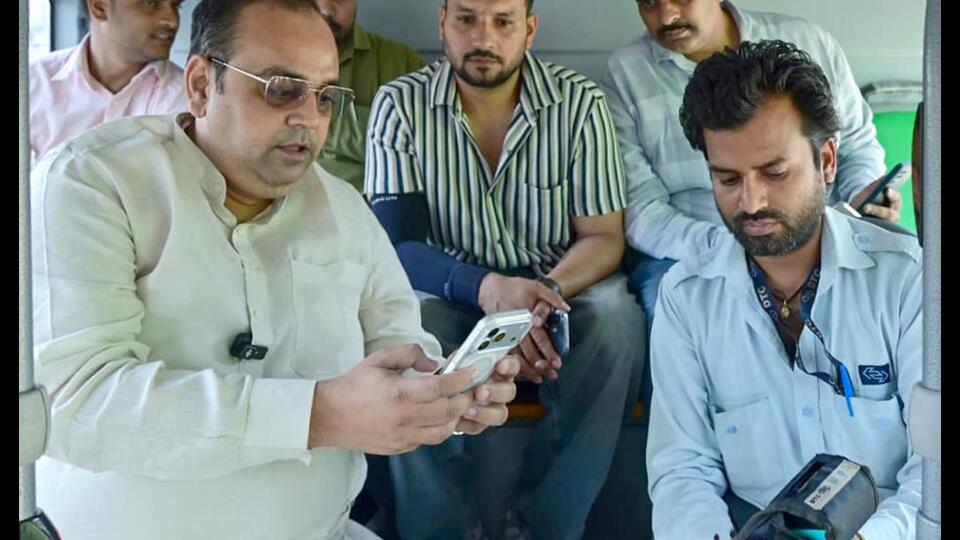
Transport minister Pankaj Kumar Singh travelled on a Delhi Transport Corporation bus from Vikaspuri to Delhi Secretariat on Wednesday as part of the campaign to promote public transport. During the journey, Singh interacted with commuters and reviewed passenger feedback.
“The Delhi government is committed to providing better, safer and more comfortable public transport facilities while building a cleaner and more sustainable Delhi,” Singh said.
He added that ministers would regularly use buses and Metro services to assess commuter concerns directly. “This will also help us understand public grievances firsthand and ensure timely resolution of issues,” he said.
The transport department said Delhi currently operates 6,300 DTC buses, including 4,538 electric buses.
Separately, minister Kapil Mishra travelled by Delhi Metro Rail Corporation and appealed to residents to adopt public transport and reduce dependence on private vehicles. He also urged residents to walk or use bicycles for short distance travel and said conserving fuel during the present global situation was “a national duty of all citizens”.
Mishra said the chief minister has reduced the size of her convoy and that ministers would increasingly rely on a limited number of official vehicles. According to government officials, the chief minister and cabinet ministers have decided to restrict their fleets to one or two vehicles and gradually shift towards hybrid or electric vehicles for official movement.
Officials said departments would submit weekly compliance reports on implementation of the measures with immediate effect.



Stay updated with all top Cities including, Bengaluru, Delhi, Mumbai and more across India. Stay informed on the latest happenings in World News along with Delhi Election 2025 and Delhi Election Result 2025 Live, New Delhi Election Result Live, Kalkaji Election Result Live at Hindustan Times.


