
 E-Paper



New Delhi will have 13 districts from Jan 1
Officials said mismatched boundaries have long caused delays in grievance redressal, enforcement, land record management, and disaster planning.

 Prefer HTon Google


The Delhi government on Thursday notified a major administrative restructuring, reorganising the Capital’s 11 revenue districts into 13 to streamline service delivery, reduce jurisdictional overlaps, and improve coordination with civic agencies. The new framework will take effect on January 1, 2026.
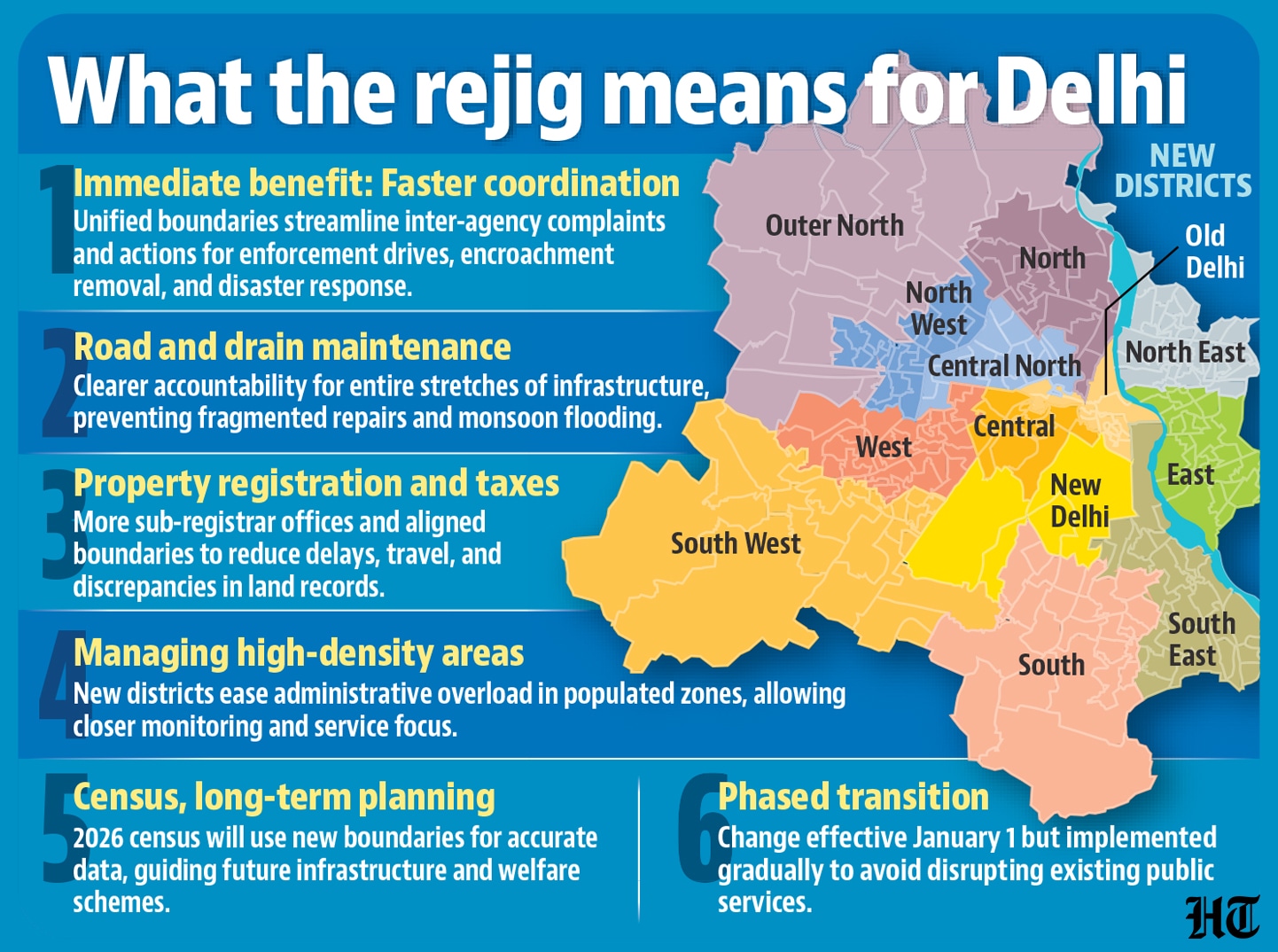
The reorganization, approved by the Delhi cabinet on December 11 and formally notified after the lieutenant governor’s assent, aims to align revenue district boundaries with those of the Municipal Corporation of Delhi (MCD).
Officials said mismatched boundaries have long caused delays in grievance redressal, enforcement, land record management, and disaster planning.
Under the revised structure, the 13 revenue districts will be: South East, Old Delhi, North, New Delhi, Central, Central North, South West, Outer North, North West, North East, East, South, and West. The former Shahdara district has been removed, while three new districts -- Old Delhi, Central North, and Outer North – have been created. The number of sub-divisions and sub-registrar offices will increase from 22 to 39.
“Several districts had become too large and congested over time, leading to backlogs in routine revenue services. The redistribution is aimed at balancing workloads and ensuring quicker response times, particularly in high-density areas,” a senior official said.
The revised sub-divisions reflect this rebalancing. The three new districts include Old Delhi that will have Sadar Bazar and Chandni Chowk, Central North will have Shakur Basti, Shalimar Bagh and Model Town while Outer North will cover Mundka, Narela and Bawana.
A key feature of the restructuring is the planned creation of district-level Mini Secretariats in each of the 13 districts. These integrated hubs will house Revenue, SDM, ADM, Tehsil, and Sub-Registrar offices, along with other public-facing departments—all under one roof. Currently, citizens often must visit multiple offices across different locations for services like property registration, affidavits, and certificates.
An important component of the restructuring is the creation of district-level Mini Secretariats in each of the 13 districts. These hubs will house offices of revenue, sub-divisional magistrate (SDM), additional district magistrate (ADM), tehsil and sub-registrar under one roof along with all other departments that are involved with public dealing. Currently, citizens often must visit multiple offices across different locations for services like property registration, affidavits, and certificates.
Until the mini secretariats are operational, the government has issued a list of existing SRO and SDM offices that will function as interim service points in each new district to ensure continuity. “This initiative aims to maintain uninterrupted public services and minimize inconvenience during the transition,” a government order stated.
Officials said one of the key drivers behind the restructuring was the persistent mismatch between revenue and municipal boundaries. In several colonies, residents fell under one revenue district but were linked to a different municipal zone, often delaying complaint resolution and complicating disaster management planning. Aligning the boundaries is expected to improve coordination during inspections, enforcement drives and urban planning exercises. “The aim is to make district administration more accessible. Citizens should not have to travel between offices for closely linked services,” a senior government official said.
The government has sanctioned ₹25 crore in the current financial year for the first phase of the transition, officials added. The government expects the new districts and sub-divisions to be operational by the end of December 2025. The restructuring will be closely monitored to ensure that routine services are not disrupted during the transition.


Stay updated with all top Cities including, Bengaluru, Delhi, Mumbai and more across India. Stay informed on the latest happenings in World News along with Delhi Election 2025 and Delhi Election Result 2025 Live, New Delhi Election Result Live, Kalkaji Election Result Live at Hindustan Times.


