
 E-Paper



Delhi set to roll out a single emergency helpline — 112
The common helpline number is being developed under the Union government’s Emergency Response Support System (ERSS) 2.0

 Prefer HTon Google


The Delhi government on Monday announced that it was developing a common emergency helpline — 112 — with the objective to “free people from the burden of remembering multiple numbers during crises and ensuring swift help”.

The common helpline number is being developed under the Union government’s Emergency Response Support System (ERSS) 2.0 and several states, including neighbouring Uttar Pradesh, Gujarat, Himachal Pradesh among others have already switched to using an integrated emergency response number.
In a statement, Delhi chief minister Rekha Gupta said that the initiative is being undertaken to make emergency services in the Capital more effective, faster, and technology-enabled.
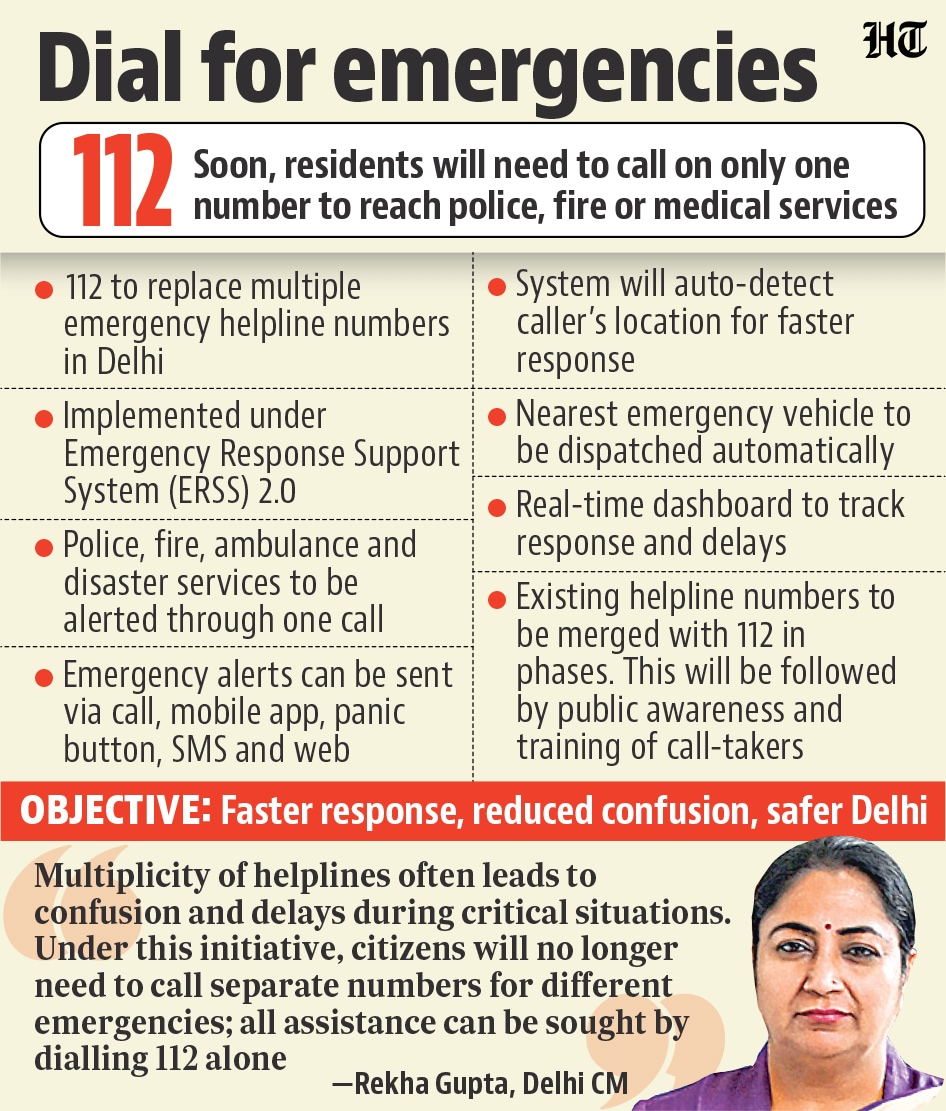
At present, different helpline numbers are used for various emergency services for seeking assistance — 100 for the police, 101 for fire services, 108 for ambulance and health services, and 1077 for disaster management and relief services, among others.
“This multiplicity often leads to confusion and delays during critical situations. Under ERSS 2.0, citizens will no longer need to call separate numbers for different emergencies; all assistance can be sought by dialling 112 alone,” the CM said, adding that the Ministry of Home Affairs (MHA) had declared ‘112’ as the national emergency number, and in line with this, Delhi is moving towards its implementation.
A government official explained that the ERSS 2.0 is a modern, unified signal-handling system that will receive all emergency calls, mobile app alerts, panic button activations, SMS, and web alerts at a single public safety answering point. “From here, depending on the nature of the emergency, the police, fire services, ambulance, and disaster management agencies can be alerted simultaneously... Even if a citizen is unable to speak, they can still send a distress signal with ease,” official added.
Official said that one of the key features of the system is its automatic location identification. “As soon as a call or emergency alert is received, the system automatically detects the caller’s location, eliminating the need for the victim to explain where they are. Once the location is identified, the nearest police vehicle, ambulance or fire tender is immediately dispatched from the control room. This saves crucial time during the golden hour (the first 60 minutes) and ensures faster assistance,” official added.
Gupta said that ‘ERSS 2.0’ will feature a modern dashboard in the control room, enabling real-time monitoring of where an incident has occurred, which vehicle has been dispatched, and how long it will take to reach the site. “In case of any delay, an alternative vehicle can be deployed immediately. This ensures continuous oversight and enhances accountability,” she added.
The government has said that the system will be implemented in phases. In the first phase, all existing emergency numbers will be integrated into 112. This will be followed by technical upgrades, public awareness campaigns, training of call-takers and, finally, evaluation of the system
“An extensive public awareness campaign will be launched to promote the use of 112. Displays will be installed in government offices, public spaces, Metro stations and buses to publicise the number. In addition, regular mock drills and outreach programmes will be organised to assess preparedness across departments,” the CM added.


Stay updated with all top Cities including, Bengaluru, Delhi, Mumbai and more across India. Stay informed on the latest happenings in World News along with Delhi Election 2025 and Delhi Election Result 2025 Live, New Delhi Election Result Live, Kalkaji Election Result Live at Hindustan Times.


