
 E-Paper



Return of breathalysers help cops nab more drink-driving violators in Delhi
Tests for drink driving were halted for close to three years after the Covid-19 outbreak in March 2020.


On average, close to 60 people were issued challans every day for being inebriated while driving during the first three months of this year, compared to fewer than five a day in the last two years, as the Delhi Traffic Police resumed breathalyser checks to catch those driving drunk.

Tests for drink driving were halted for close to three years after the Covid-19 outbreak in March 2020 over concerns that these checks – which involve people blowing into a breathalyser device – could spread the coronavirus.
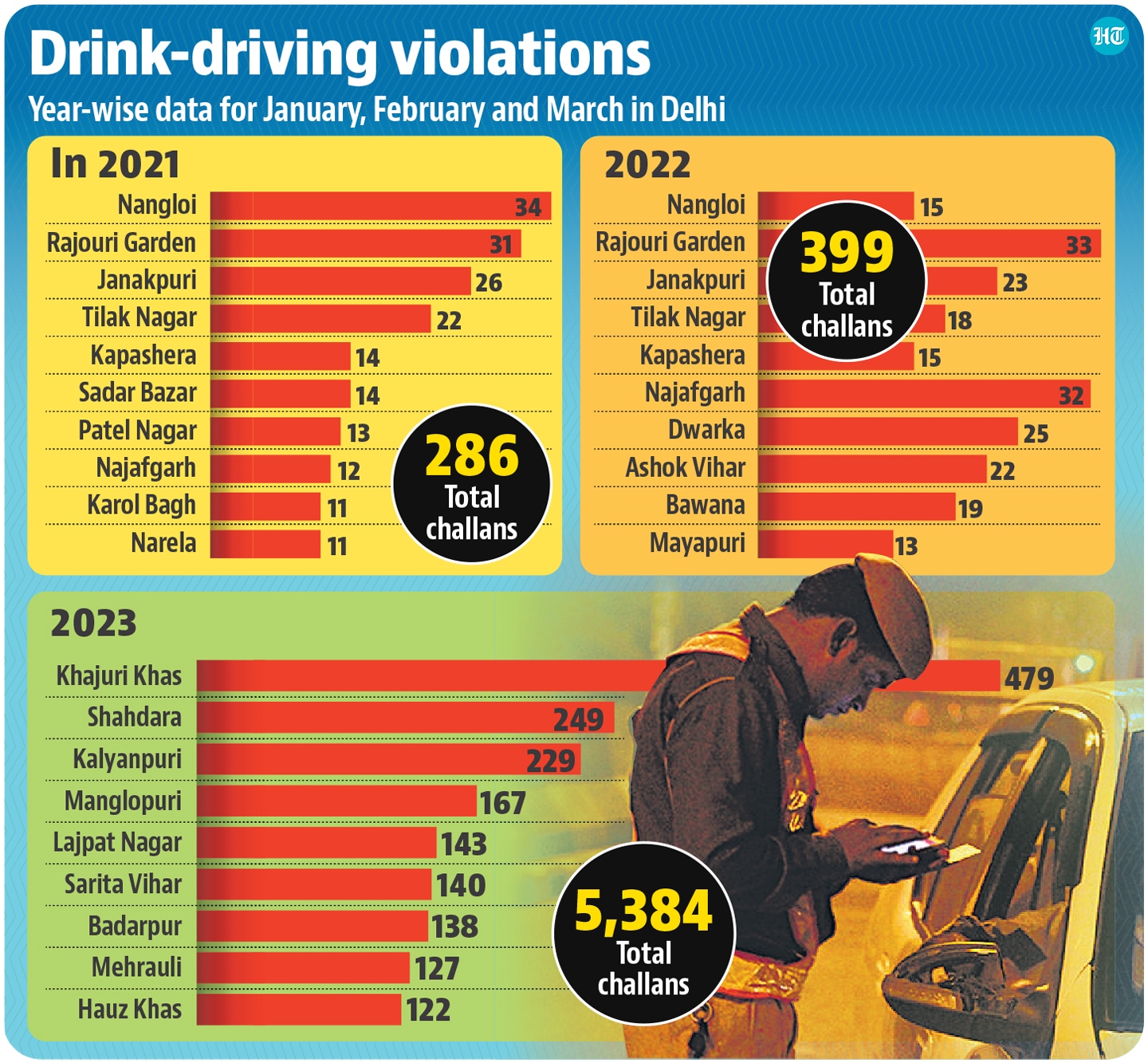
As a result, while only 399 and 286 people were issued challans in 2022 and 2021 respectively, this year, this number surged to 5,384.
“With the lifting of Covid-related restrictions, and restaurants and bars being back in business, public mobility in the city has increased. As instances of drink driving are also increasing, we decided to resume our special drives against drunk drivers and use our breath-analyser machines to catch and prosecute violators. As a result, there has been a steep rise in such challans this year as compared to the two previous years when Covid-related curbs were in effect,” said special commissioner of police (traffic) Surender Singh Yadav.
Senior traffic police officers said they have been identifying traffic circles with maximum drink driving challans every year to analyse the reasons and find solutions, since a majority of road accidents at night are caused by people driving under the influence of alcohol. They also said special drives against drink driving and resumption of the use of breathalysers, especially at night, was also driven by the Sultanpuri hit-and-drag case, in which four allegedly drunk men hit 20-year-old Anjali Kumari with their car and dragged her under it for nearly 13 kilometres resulting in her death on January 1.
Breathalysers use the amount of alcohol in exhaled breath to calculate the amount of alcohol in a person’s blood, also known as the blood alcohol concentration (BAC). In India, motorists are not allowed to drive if BAC is over 30 milligrams per 100 millilitres of blood.
Driving under the influence of alcohol is punishable by a court challan. According to the Motor Vehicles (Amendment) Act, 2019, a person is liable to pay a fine of ₹10,000 or face imprisonment up to six months or both in case of first offence.
For the second and subsequent offences, a fine of ₹15,000 or imprisonment up to two years or both are applicable.
Police are authorised to digitally seize the driving licence or registration certificate of the offender in such cases. If the person is from another state and has a booklet or a simple paper driving licence, it is seized physically. Unless accompanied by a sober person with a valid driving licence, the police are also authorised to seize the vehicle of the drunk person.
According to Delhi Traffic Police statistics, the 10 traffic circles that reported the most such challans between January 1 and March 31 this year were Lajpat Nagar, Hauz Khas, Sarita Vihar, Mehrauli, Badarpur, Khajuri Khas, Shahdara, Kalyanpuri, Najafgarh and Mangolpuri.
“A look at the top 10 drink driving-prone areas of the last three years will show that most of the traffic circles that were on previous year’s list are not in this year’s top 10 list. This is because multiple preventive steps, ranging from prosecution to awareness, were taken by our traffic police unit,” added Yadav, explaining how interventions are designed to ensure a neighbourhood where the police concentrate their efforts have the problem in check.
According to the traffic police assessment report, Rajouri Garden, Najagfarh, Dwarka, Janakpuri, Ashok Vihar, Bawana, Tilak Nagar, Kapashera, Nangloi and Mayapuri were the top 10 traffic circles that witnessed most drink driving challans in 2022. Of them, only Najafgarh found its place in this year’s top 10 list. To be sure, Najafgarh was on the 2021 list as well. Last year, Rajouri Garden reported the maximum challans but this year, it was not on the top 10 list, the data showed.
The area-wise analysis of the last five years, a traffic police officer said, found that the most violations are reported in Punjabi Bagh Club Road, Rajouri Garden, Najafgarh Road, Lajpat Nagar, Sarita Vihar, Badarpur, Mehrauli, Hauz Khas and Vasant Kunj.
According to police, besides prosecuting road violators, they also organise road safety awareness camps from time to time in schools, colleges, and at major intersections, and provide drivers with information on road use.
“Among many steps that Delhi Traffic Police take to curb drink driving in the city, the main is submitting the history of repeat violators in courts along with the challans and details of the vehicle they were caught driving under the influence. The objective is to convince courts to impose maximum fine and punishment prescribed in the rulebook. If we really want to discourage drink driving, it is important that repeat violators do not get away with lighter fines and punishments. The punishment should be determined by the number of violations the driver has committed in the past and the amount of alcohol in his blood. The higher the alcohol intake, the maximum punishment the driver should get,” said Muktesh Chander, former special commissioner of police (traffic) from 2015 to 2016.


