E-Paper



Native trees’ plantation to rid Delhi Ridge of colonial kikar
Delhi's forest and wildlife department will restore a 100-hectare plot of the Central Ridge by planting native Aravalli tree species

 Prefer HTon Google


Delhi’s forest and wildlife department will restore a 100-hectare plot of the Central Ridge, and a tender has been allotted to carry out the plantation of native Aravalli tree species, officials aware of the development said on Friday.
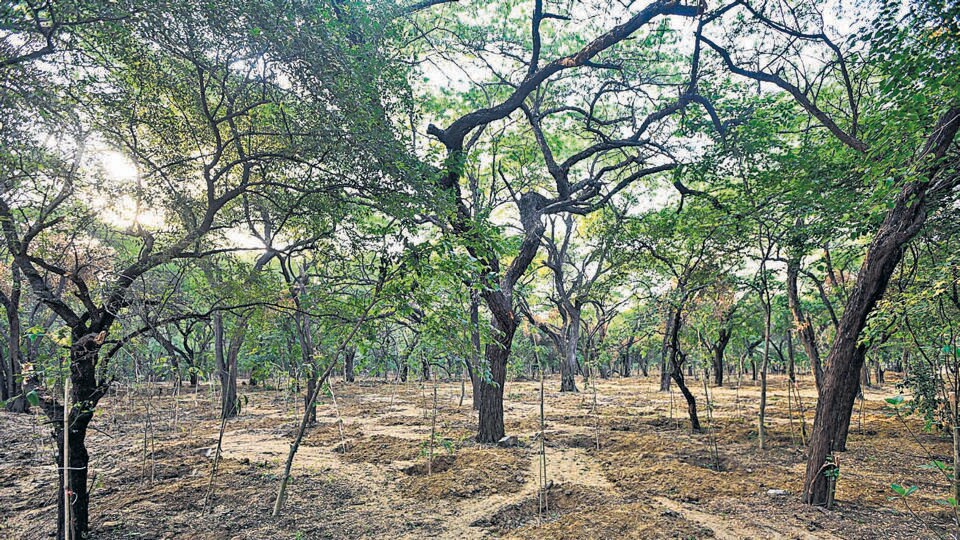
With this project, the department aims to diversify the species in the Ridge by adding more native species to an area largely monopolised by the invasive vilayati kikar (Prosopis juliflora), which is said to comprise 70% of all trees in the Central Ridge.
The move comes after the department in April 2022 carried out a pilot project on a 15-hectare plot of the 864-hectare Central Ridge. As part of the pilot project, officials said, the department planted native species in a small patch of land around vilayati kikar trees, and officials said that the survival rate of these native saplings is 80-90%.
A senior forest department official, under whose jurisdiction the Central Ridge falls, said, “The pilot has been a resounding success and we are seeing good growth of native species around vilayati kikar. The tree normally does not allow any other tree species to grow around it, but we ensured that the top canopy of vilayati kikar trees was pruned, and with enough sunlight reaching the saplings at the surface, we have seen a steady growth. A 100-hectare plot is now being taken up by the department.”
A second forest official said, “We are providing nourishment and water to these native saplings and the vilayati kikar canopy is reduced significantly. The tree is not being felled as it still forms a part of Delhi’s green cover, and the trees still provide oxygen.”
The first official said a tender was awarded recently to carry out the plantation of native species like hingot, banyan, bahera, chamrod, pilkhan, amaltas, siras, arjun, dhak and palash among others, and the work is expected to start soon.
“The tender was awarded earlier and we were waiting for the monsoon to arrive, as the survival rate of sapling is highest in this season. With the rains now here, we will soon start work,” the official said, stating the same plan can also be replicated over time in other Ridge areas in the city.
In Delhi, the Ridge is an extension of the Aravallis, and is divided into four prominent zones —the Northern Ridge (87 hectare), the Central Ridge (864 hectare), the South-Central Ridge (626 hectare) and the Southern Ridge (6,200 hectare).
The plan to carry out an ecological restoration of the Central Ridge was devised in 2018, but cabinet approval for the project came only in February 2021. The forest department was unable to start work in the same year, largely owing to differences in opinion among the expert members of a technical committee constituted for the project.
This committee was eventually scrapped, and the project was executed by the forest and wildlife department starting April 2022. While the initial plan was to eliminate vilayati kikar completely, the forest department tweaked the strategy and began planting native species instead.
CR Babu, head of the Centre for Environmental Management of Degraded Ecosystems (CEMDE), who was part of the now-scrapped expert committee, said the vilayati kikar will naturally die off after the native species grow taller than them.
“Vilayati kikar is a very high light-demanding species and so, when the native trees grow taller than it, their canopy will not allow the kikar to get enough sunlight. Over time, it will naturally die,” Babu said.
Noting that even though it is an invasive species, vilayati kikar cannot all be felled or removed, he added, “This way of naturally killing the trees over a period of time is a better way of taking care of the longstanding problem of this invasive species. If they are all felled, for example, the topsoil of the Ridge, which is very thin, can easily erode. Removing so many of the trees is also harmful when it comes to combating air pollution.”