
 E-Paper



Delhiwale: Into the world of Jagat
Jagat cinema in Old Delhi, closed since 2004, reveals haunting remnants of its past, with desolate interiors and memories of classic screenings.


In the crowded bazar, a deserted building. Inside this silenced building, a strange sort of diffused luminosity. A scratchy wall is glowing in insipid gold. Otherwise not much to be seen.
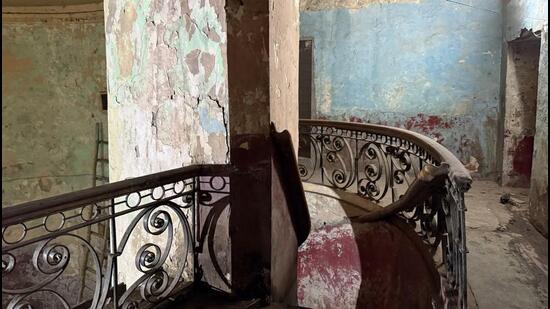
Gradually, eyes adjust to the darkness. A staircase emerges, bending slowly smoothly along its upwards spiral. The staircase’s baluster is stylish. So is the metallic handrail.
Old Delhi’s Jagat cinema has been shut for years. This afternoon, by a freak chance, the entrance was open, making it possible to step into the darkened lobby—and into the vacant ticket counter, into the manager’s bare room, and up the stairs into the empty balcony.
Nowhere else in the city might anyone experience a sight as haunting as Jagat, closed since 2004. The hushed interiors are marinating in utter desolation; colourful walls with their severely peeled paints resemble abstract art. In the lobby, a bulky hook hangs from the vaulted ceiling like the ghost of a long-gone chandelier. A wooden board by the box office window is displaying the ticket rates. The adjoining sliding bars slide as effortlessly as the beads of an abacus; the manually operated slides would indicate the show’s “full” or “open” status.
During the 1960s, Jagat had the privilege of screening Mughal-e-Azam. During the 2010s, this reporter excavated Jagat’s Rear Circle ticket of that classic film from the “kabad” of a famous Walled City recycler, the late Shanky. (The earlier owner-collector had it laminated).
Today, the cinema’s wide screen is gone, revealing a derelict brick wall.
During the 1970s, the cinema screened the Meena Kumari musical, Pakeezah. According to a book by Delhi’s single-screen scholar Ziya Us Salam, a resident of nearby Matia Mahal would daily attend Jagat’s Pakeezah screening with his family. The entire party would wait for the song Chalte Chalte, after which they would exit, not bothering for the remaining film.
Today, the cinema’s huge auditorium is left with not even a single seat. But the markings of those hundreds of absent seats continue to exist on the expansive floor, as palpable as the stains left on walls by photo frames. But the auditorium’s roof is so severely disfigured that it is difficult to determine if it is of wood or tin. Doesn’t matter—the roof is as leaky as a sieve, daylight freely falling through the many gaps.
Then there are other corners preserving other wonders. A toilet decked with exquisite tiles. A tall mirror dotted with mirror rust. A lobby board showing the “hall exit plan”— the only thing here that hasn’t corroded a bit.
Later in the day, the cinema is again seen locked.


Stay updated with all top Cities including, Bengaluru, Delhi, Mumbai and more across India. Stay informed on the latest happenings in World News along with Delhi Election 2025 and Delhi Election Result 2025 Live, New Delhi Election Result Live, Kalkaji Election Result Live at Hindustan Times.


