This is a story on the connect between Maulana Abul Kalam Azad and Hazrat Sarmad Shahid.
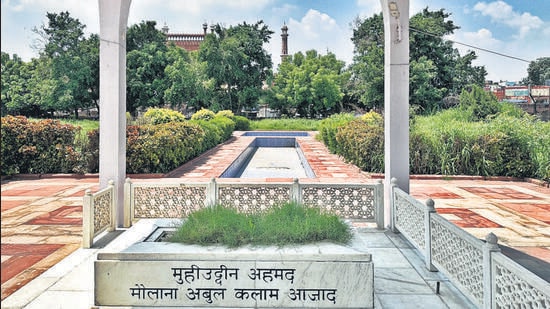
Their tombs lie close to each other, outside Old Delhi’s Jama Masjid, and together tell us something of India’s history.
Sarmad, a mystic, was executed by Mughal emperor Aurangzeb on charges of apostasy. Meanwhile Azad, born more than 200 years after Sarmad’s death, was a freedom fighter and independent India’s first education minister.
In the book Same-Sex Love in India: A Literary History, historian Saleem Kidwai devoted a chapter on Sarmad, detailing that “Sarmad was born a Jew in Kashan (in modern-day Iran), around 1590. He became a trader and acquired knowledge of mystic traditions and of Arabic and Persian poetry. Before he arrived in the port city of Thatta (in modern-day Sindh) in 1632, he had converted to Islam. In Thatta he met a Hindu boy named Abhai Chand. The attraction was mutual and soon after meeting him, Sarmad abandoned his trade and became a naked fakir.”
A distinguished Islamic scholar, Azad was among the most outspoken opponents of the Partition and of Pakistan founder Jinnah. When he was in his early 20s, he wrote an essay titled Sarmad, the Martyr. Some Azad scholars trace in this essay the origins of his religious thought and political ideals. Azad wrote: “In his search for the goal, he (Sarmad) discarded the distinction between temple and mosque. Just as he bowed his head in humble request before Muslim dervishes, so he showed faith in Hindu ascetics.“
{{/usCountry}}A distinguished Islamic scholar, Azad was among the most outspoken opponents of the Partition and of Pakistan founder Jinnah. When he was in his early 20s, he wrote an essay titled Sarmad, the Martyr. Some Azad scholars trace in this essay the origins of his religious thought and political ideals. Azad wrote: “In his search for the goal, he (Sarmad) discarded the distinction between temple and mosque. Just as he bowed his head in humble request before Muslim dervishes, so he showed faith in Hindu ascetics.“
{{/usCountry}}Sarmad’s tiny tomb has no dome or minaret, though Azad referred to a metaphoric minaret in his essay, saying: “Sarmad stood on that minaret of love from which the walls of Ka’aba and temple were of equal height.”
Designed by architect Habib Rahman, Azad’s minimalist garden-tomb is marked by a white marble canopy. The grave has grass growing on it (see photo). Glimpses of Jama Masjid flash out from between the trees, but Sarmad’s tomb, though nearer, remains invisible. The serene place is nevertheless an idyllic space to read this most poignant passage in Azad’s Sarmad essay: “Of whatever kind it may be, love (ishq) is always the first step towards the station of truth and reality (haqiqat)… or, better, love is the door to be passed through before man can become man. Whoever’s heart is not wounded, and whoever’s eyes are not wet with tears—how can he fathom the meaning of humanity?”
PS: The passages are quoted from the book Abul Kalam Azad: An Intellectual and Religious Biography by Ian Henderson Douglas, published in 1988 by Oxford University Press
Stay updated with all top Cities including, Bengaluru, Delhi, Mumbai and more across India. Stay informed on the latest happenings in World News along with Delhi Election 2025 and Delhi Election Result 2025 Live, New Delhi Election Result Live, Kalkaji Election Result Live at Hindustan Times.
Stay updated with all top Cities including, Bengaluru, Delhi, Mumbai and more across India. Stay informed on the latest happenings in World News along with Delhi Election 2025 and Delhi Election Result 2025 Live, New Delhi Election Result Live, Kalkaji Election Result Live at Hindustan Times.