People would slip walking here. The Old Delhi road was notorious for its slippery surface, with fish scales littering the ground. Even scooters would skid. This was Machhiwalon ka Bazar, the fish market whose stalls once crowded the road between Daryaganj and Jama Masjid.
The market has long disappeared. A few decades ago, the fish business was shifted to Ghazipur, on Delhi’s eastern edge. Yet the colloquial name survives in conversation, part of muscle memory among Old Delhi wale.
The road is now officially called Jama Masjid Road. The wider area, however, is known as Urdu Bazar, recalling the many Urdu bookstores that once lined the road. The name Machhiwalon ka Bazar survives along part of the same road.
Truth be told, an enigma lingers around these Old Delhi’s place-names. They outlive the things that gave them meaning. No imli tree is left in Pahari Imli, no amrood tree is left at Amrood Wali Masjid. The names remain long after the objects and trades they described have disappeared. Sometimes they live on even in the names of nearby landmarks. Jagat Cinema, which closed some years ago and lies in the former fish market, is referred to as “Macchliwallon ka Talkies.” Kasturba Hospital is known as “Macchliwallon ka Aspatal.”
In its prime time, Machhiwalon ka Bazar extended into several lanes. In one of them, Gali Khan Khana still has a few fish stalls, along with shops selling fishing nets. Fishing nets are also hawked on the main road, under a peepal tree that additionally shelters a bone setter’s stall.
{{/usCountry}}In its prime time, Machhiwalon ka Bazar extended into several lanes. In one of them, Gali Khan Khana still has a few fish stalls, along with shops selling fishing nets. Fishing nets are also hawked on the main road, under a peepal tree that additionally shelters a bone setter’s stall.
{{/usCountry}}The market was more than a fish market. It also became a weekly kabadi bazar, selling used clothes, sandals, suitcases, transistors, handbags and shoes. Delhi’s Sunday Book Bazar, now held at Mahila Haat, traces its original site to this same market.
The fish market’s history in fact goes back much further. Long ago, when the Yamuna was relatively clean, the fish trade was closely connected to the river. During the time of Mughal badshahs, the Yamuna would flow close to the Red Fort walls. In the monsoon months, the river would swell, and crocodiles would be carried into the floodwaters. Some of the crocodiles would end up at Machhiwalon ka Bazar. Their oil was extracted and sold, along with their skin and teeth.
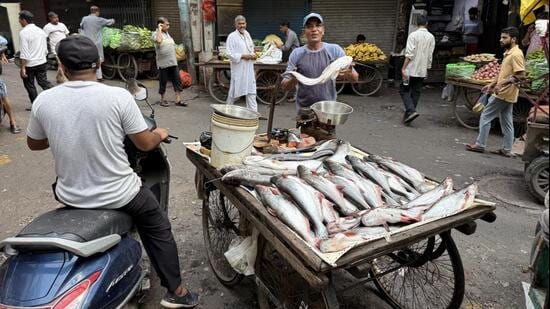
Today, nobody slips because of fish at Machhiwalon ka Bazar. But each morning, a few minutes’ walk away at Chitli Qabar Chowk, street trader Parvez sells fish from a cart stationed at the centre of the square. See photo.
Stay updated with all top Cities including, Bengaluru, Delhi, Mumbai and more across India. Stay informed on the latest happenings in World News along with Delhi Election 2025 and Delhi Election Result 2025 Live, New Delhi Election Result Live, Kalkaji Election Result Live at Hindustan Times.
Stay updated with all top Cities including, Bengaluru, Delhi, Mumbai and more across India. Stay informed on the latest happenings in World News along with Delhi Election 2025 and Delhi Election Result 2025 Live, New Delhi Election Result Live, Kalkaji Election Result Live at Hindustan Times.