
 E-Paper



Delta variant of Covid detected in 99% samples collected in October: Delhi govt
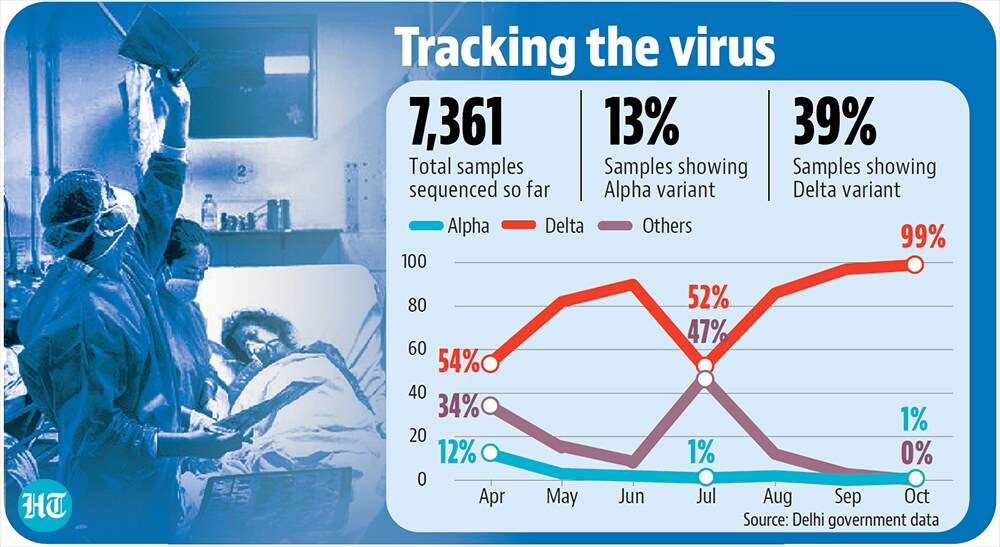
Delta variant was found in 54% of the samples that were sequenced in April, and 82% in May, according to the government data.

 Prefer HTon Google


Delta variant and its sub-lineages of Sars-CoV-2 virus that causes coronavirus disease (Covid-19) were detected in 99% of the patient samples from Delhi that were sequenced during October, according to the Delhi government data.
Over 7,300 samples have been sequenced from Delhi since Indian Sars-CoV-2 Genomics Consortium (INSACOG) was set up early this year.
Delta variant was found in 54% of the samples that were sequenced in April, and 82% in May, according to the government data. This was when Delhi witnessed a massive second wave of Covid-19 reporting over 28,000 cases in a single day at its peak. The data suggests, 39% of the total samples sequenced are that of delta variant.
HT reported in June that the Delta variant of Sars-Cov-2 out-competed the Alpha variant within weeks and went on to spark Delhi’s most devastating wave of Covid-19, according to a study by the Institute of Genomics and Integrative Biology that found delta to be more transmissible and better able to escape immunity generated through a natural infection or vaccination.
The most commonly found variant is still delta (B1.617.2) that is found in almost half the samples, followed by AY.4 sublineage, according to researchers who conduct the sequencing.
“The original delta continues to be the most common sequence, which is followed by AY4 sublineage of delta,” said Dr Ekta Gupta, who heads the regional INSACOG laboratory at the Institute of Liver and Biliary Sciences in Delhi.
Another senior scientist from INSACOG said AY4 was the most common delta sub-lineage found in Delhi, however, there was no clinical significance of the variant yet, meaning it is not so far known to cause more infections, more severe infections, or infections in those who have been previously infected or have been completely vaccinated.
According to the latest INSACOG bulletin, many sequences labelled as AY4 have now been reclassified as AY33 on the Pango (Phylogenetic Assignment of Named Global Outbreak Lineage) software used by the researchers to classify the variants.
“It has been noted that due to greater diversity of Delta in India, PANGO classifications may sometimes be inaccurate, especially for new sub-lineages,” the bulletin said.
Dr Ekta said, “The virus keeps mutating and gets re-classified, but there is no clinical significance of these variants yet. Being closely related to the original delta variant they are unlikely to affect a high number of people in Delhi, many of who have already been exposed to delta.”
The September-October round of sero-surveillance in Delhi showed that 97% of the population has developed antibodies against the virus. “Now, there are very few cases and very few sequences that are being done. And, whatever we sequence we find delta variants, which is a good sign. It will be a matter of concern if we notice something else,” said a senior doctor from Lok Nayak hospital, which is also a regional sequencing centre.


