The Delhi government’s door-to-door ration scheme will create an “opaque” public distribution system (PDS) that will put at risk numerous beneficiaries, especially migrant workers, who are covered under the National Food Security Act (NFSA) in the national capital, the Union government has submitted in the Supreme Court.
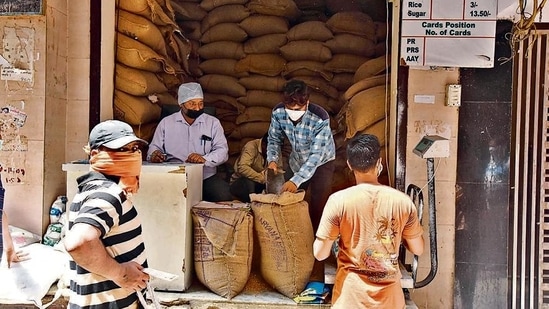
The move marks a new chapter in a long-running tussle between the Union and Delhi governments over the scheme that the former opposes for being a “violation” of rules, and the latter describes as a “pro people” policy.
In its appeal against the Arvind Kejriwal government’s ambitious scheme, the Centre has told the top court that door-to-door ration scheme not only has “material deficiencies” but is also in stark contradiction to the NFSA, 2013.
The scheme, claimed the Centre’s petition, would also have adverse implications in the implementation of the “one nation, one ration card scheme” of the central government, meant to safeguard the interests of migrant beneficiaries and giving freedom of choice to beneficiaries to get their entitlements through any fair price shop (FPS) of their choice through biometric authentication.
The petition added that the central government has time and again requested to Delhi government against the implementation of the door-to-door ration scheme because it is against the provisions of the NFSA. “However, Respondent No.1 (Delhi government) is adamant on creating a parallel PDS scheme utilising the resources under the NFSA by completely diluting the purpose and purport of NFSA, 2013,” stated the plea.
{{/usCountry}}The petition added that the central government has time and again requested to Delhi government against the implementation of the door-to-door ration scheme because it is against the provisions of the NFSA. “However, Respondent No.1 (Delhi government) is adamant on creating a parallel PDS scheme utilising the resources under the NFSA by completely diluting the purpose and purport of NFSA, 2013,” stated the plea.
{{/usCountry}}The Centre has appealed against the Delhi high court’s September 27 order, which allowed the Aam Aadmi Party (AAP) government to stop supplying foodgrains to FPS for patrons who have chosen doorstep delivery over physical collection of ration.
As the Delhi government claimed that “an overwhelming majority has opted for supply of rations at their doorstep” the high court said that authorities could supply only such quantities of ration to FPS that are required for those who want to collect it from shops, while the rest can be held back by the government for door-to-door delivery. The high court further asked the government to share the details of ration cardholders who have opted to receive their rations at doorsteps instead of collecting it from shops with the FPS owners.
Challenging this order, the Union government has said that the high court erred in failing to consider that the Delhi government tried to create a parallel scheme without conforming to NFSA, besides not realising that the door-to-door scheme will create an “opaque parallel PDS scheme” while adversely impacting the beneficiaries under NFSA. The Centre has also pleaded for a stay on the high court order till the issue is finally settled.
The Centre’s petition came up for a hearing on Tuesday before a bench of justices L Nageswara Rao, BR Gavai and BV Nagarathna. The case was, however, adjourned to Friday on a request made by Solicitor General Tushar Mehta, who appeared for the central government.
The Delhi government’s doorstep delivery of ration scheme was launched on March 25, but the Union food and consumer affairs ministry wrote to the Delhi government on March 19 raising two objections — the use of the term “mukhyamantri (chief minister)” for a scheme involving the distribution of food grains allocated under the National Food Security Act (NFSA), and that any change in the delivery mechanism requires an amendment in NSFA that can be done only by Parliament. The term “mukhyamantri” was later dropped from the scheme’s name.
Meanwhile, Delhi Sarkari Ration Dealers Sangh -- a body of the fixed price shop owners, moved the high court in February challenging the tenders issued for the doorstep delivery scheme. Later, the petition was amended to challenge the ration delivery scheme with the association demanding that it should be declared ultra vires (beyond the scope of legal power).
On March 22, the high court directed the Delhi government not to stop or curtail the supply of foodgrains or flour, to the members of the petitioner association, for operationalising the doorstep delivery. However, on September 27, the high court allowed the government to stop supplying foodgrains to FPS to the extent of food grains for those who have chosen doorstep delivery over physical collection of ration.
The Delhi government maintained in the high court that the scheme does not violate NFSA, and that several states were already running similar programmes. It has further claimed that 6.9 million people out of the total 7.2 million registered beneficiaries opted for the scheme.
In June, the government sent the file back to LG, contending that its provisions are in accordance with the NFS Act, and that it will simultaneously implement the Centre’s “One Nation, One Ration Card” scheme.
On October 5, after the high court’s order of September 27, the government sent the file again to the LG office. In a note on the file, Delhi chief minister Arvind Kejriwal said he sincerely hoped that Baijal will review his decision to stop implementation of the doorstep delivery scheme, so that the orders of the high court can be implemented and doorstep delivery of ration can be processed for the beneficiaries opting it.
“People are asking if pizza, burger, smartphone and clothes can be home delivered then why cannot the poor citizens of Delhi get their share of ration home delivered,” Kejriwal wrote in the note.
Nearly 7.2 million people in Delhi are eligible for subsidised food, including 1.7 million ration card holders and nearly 3 million priority households, besides other food insecure categories identified by the Delhi government.
Stay updated with all top Cities including, Bengaluru, Delhi, Mumbai and more across India. Stay informed on the latest happenings in World News along with Delhi Election 2025 and Delhi Election Result 2025 Live, New Delhi Election Result Live, Kalkaji Election Result Live at Hindustan Times.
Stay updated with all top Cities including, Bengaluru, Delhi, Mumbai and more across India. Stay informed on the latest happenings in World News along with Delhi Election 2025 and Delhi Election Result 2025 Live, New Delhi Election Result Live, Kalkaji Election Result Live at Hindustan Times.