
 E-Paper



DU at 100: How St Stephen’s College grew with Delhi
Celebrating a hundred years of Delhi University, a special series by HT commemorates the institution, its academics, students, schools, colleges, canteens, culture and the impact it has had on life in general in Delhi, and the country at large


Away from its manicured lawns, red brick building and subtle Mughal motifs in its current setting at the University enclave on the north campus, the St Stephen’s College finds its origins in the bustling lanes and narrow katas in the walled city near Chandni Chowk. Just behind the infamous ‘Paranthe wali gali’ moving towards the Kinari Bazar one comes across lanes lined with havelis owned by rich Jain jewellery merchants. A rather nondescript lane called Katra Kushal Rai leads to the ‘Sheesh Mahal’ the original site where the college was founded by the Cambridge Mission to Delhi in 1881 before later moving to Kashmiri gate building a decade later. “Welcome to Sheesh mahal, the 17th-century Mughal haveli. Just enjoy the view-photographs, selfies and videos are not allowed,” a notice on the gate of the arched gate notifies the visitors.
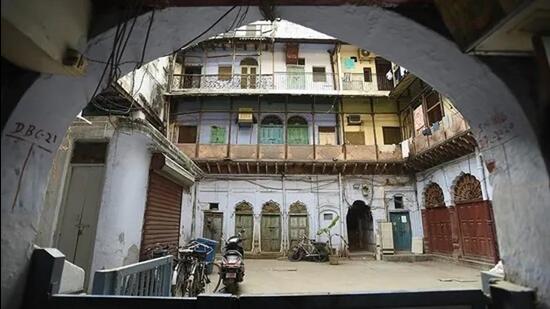
Walter Menezes, a worker in the office operating in the four-storey building with a large courtyard, said that the gentle warning was put up as many tourists and backpackers come to visit the place and sometimes it gets difficult for the families. From several decades, the building is now owned by over a dozen related Dugar Jain families who all own different parts of the complex and some parts are used as embroidery workshop with constant whirring sounds of sewing machines clearly audible.”
Originally, the Shish Mahal belonged to Ashraf Beg, a favourite vizier of the last Mughal emperor. His daughter Aliza Begum was one of the emperor’s wives. The only visible marker of buildings association with the college is a 125th-year commemoration plaque that underlines that St Stephens School has operated from the building from 1853-54 and for some time the college and the school operated under the same premises. The college was started by Cambridge mission, dons from various colleges of Cambridge university, with just five students and three teachers. It was initially linked with the Calcutta University later Punjab University as a constituent college, before becoming one of the three constituent colleges of Delhi University in 1922.
In 1881, the subjects taught in College were Logic and Literature, Psychology and History, Mathematics and Persian. Brooke Foss Wecott, a professor of Divinity at Cambridge whose large portrait hands in the hall staircase of the existing college, and has been under the possession of the college for over a century, is considered as one of the founders who shared the dream of a college to teach western subjects to students brought up in culture of East to find a meeting point between East and West in hopes that college would become an Alexandria in banks of Yamuna--as the schools of Alexandria used Greek philosophy to interpret Christian Culture to people of Eastern Mediterranean.
Father Monodeep Daniel, who chairs the Delhi Brotherhood Society-the moderns avatar of the brotherhood said that the demand for a higher education institution was raised by the citizens of Delhi as there was no operational college at that time and the government college of Delhi had been closed down. “Cambridge mission was a group of Cambridge educated priests and founder principal Samuel Scott Allnutt served as principal of both the school and the college. Once the number of students expanded and more space was needed, the college shifted to Kashmere gate building in 1891 which now serves as the Chief Election Officer’s office,” Fr Daniel said. He added that while the college has become much more autonomous the brotherhood continues to be associated with spiritual activities and some members have also served on the governing body from time to time.
The second site of the college is also a unique cultural heritage in Delhi. With the number of students growing to 40 by 1888, the brotherhood felt the need of developing a new college building for which Lahori Gate and Kashmere Gate sites were considered. The Kashmere gate site close to the historic St James Church was finally selected and the unique building was developed by Sir Swinton Jacob. An anonymous writer in The Engineer criticized the College for not adopting a Gothic but a Moghul style of architecture for the Kashmere Gate buildings. Swapna Liddle, author historian and an alumna, said the locations of the college and its various avatars also indicate the journey of Delhi as a city. “The Sheesh Mahal haveli in the Chandni Chowk was the main centre city in the 1880s. The college moved to a second location only when they needed more space. The Kashmiri Gate building designed by Swinton Jacob is a very unusual building of Indo-Saracenic architecture (Indo-gothic). It is a heritage of the city and there are not many such buildings,” she added. The college started further consolidating the elements which still form the elements of the self-identity of the institution. In 1896 the inscriptions from the Gospel: Jesus said, “ I am the light of the world; he who followeth me shall not walk in darkness but shall have the light of life”; and from the Mundaka Upanishad “ Satyameve Jayate Nanritam “ went up on the College Hall walls and they continue to be present at the current location.
The institution also expanded in terms of number from five students at inception to 69 students in 1892 at Kashmere gate, 355 students by 1930 to over 1200 students in its current site. The college and some of its members also played roles in the independence movement. The front lawns facing the current college building are named Andrews lawn after Revd. Charles Freer Andrews, also known as Deenbandhu Andrews, was instrumental in persuading Mahatma Gandhi to come to India to lead the freedom movement. Mahatma Gandhi also visited and stayed in the college starting from 13th April 1915 when Mahatma and Kasturba Gandhi first visited the college. He also laid down the foundation stone, consecrated by the Bishop of the anglican church and the Imam of the Jama Masjid, for the current building at the University enclave in 1939- a site where the 54th Bengal Native Infantry was housed on the site during 1857. Some of the other revolutionaries linked with the freedom movement include Lala Hardayal, who formed Ghadar party; Sir Chhotu Ram from the unionist party; Amir Chand, who was allegedly involved in a bomb attack on the Viceroy, Lord Hardinge in 1913 was defended by the principal Allnutt in court and Avadh Behari, from Delhi Conspiracy Case.
While an element of elitism and snobbery has been associated with the institution owing to a well-connected alumni network and a large number of bureaucrats in the establishment. Satish Jacob, an author, former journalist and an alumnus who joined college for BA in 1959, says that it is wrong to say that the college was an elite space and it is more of a perception developed by people outside. “It was the only college in the beginning in the city and it developed a reputation. Boys from some of the best schools from Dehradoon and Darjiling came to study here. While it was founded by the brotherhood and SPG, religion had no direct role and nothing was forced even though it is perhaps the only college with a morning assembly,” he said. Jacob added that the increase in reservations led to the reputation of the college dwindling.
He recalls his time in college to be a lovely insular atmosphere with a host of societies sports and activities. “There used to be a popular figure called Father Jarvis who was an expert in Shakespeare plays and played an instrumental role in Shakesoc. Bhaskar Ghose used to act in Hamlet. Unfortunately, it was an all-boys college at that time,” Jacob jocularly added. The present-day Shakespeare Society of college was created in 1926-the oldest collegiate society in India. The college has produced many performing artists including Safdar Hashmi, Shekhar Kapoor, Roshan Seth, Kabir Bedi among others. In his memoir, Stories I Must Tell, the actor Kabir Bedi recalls that he was the secretary of the Shakespeare Society and shared a jokey friendship with Kapil Sibal who was president of the college union. “At St Stephen’s, my production of Julius Caesar had Kapil Sibal as Caesar while I played the lowly Casca. Kooler Talk, the irreverent student rag, said Caesar had been murdered twice. Once by Brutus, once by Kapil Sibal,” the memoir states. After 1950, with the departure of women students from college, the custom of inviting women from Miranda House started.
The college has some of the oldest college societies in the country from Shekesoc, Social Service League, and students’ union to Criterion Club. The insular world also has its own phrases. The community still insists on formally calling students and teachers as junior and senior members of the college, helpers as gyps, hostels as residences, wardens as block tutors, a cafe not a canteen. Many old clubs and traditions have slowly phased away.
While the college is associated with it “all boys” institutional image, it has had several periods of female students’ enrolment. Women were first admitted to the College for the M.A. course in 1928-9. They were first admitted to undergraduate courses in 1943 which was stopped in 1949, with the establishment of the Miranda House. Women were readmitted in 1975 and 1993-94, they were also admitted into BSC(G) and the B.A. Pass courses. Supriya Guha, an alumnus who was part of the first batch of female students in 1975 recalls that the emergency had just been declared in June 1975 and the classes in the college used to begin after Freshers lunch on 15th July. “We were 45 girls out of a batch of around 1100 students. Around 16 girls were from the same school so were familiar with each other and Delhi was also a much smaller place. A lot of young boys said that they did not want the college to become co-education arguing that it will ruin the culture but it was only a laddish kind of awkwardness as everyone came from single-sex schools,” she stated.
Guha said that in the beginning when the female students sat in the college hall no one would talk to them barring exceptions like Paranjoy Guha Thakurta who was pursuing master’s. “These were all 16-17-year-old boys and girls who came from narrow social circles and in no time the initial show of hostility vanished. I am sure there must have been sexist crude remarks being made but we had no idea as there was no social media,” she added. Guha spent 5 years in college between 1975-80 which she describes as small insular and comfortable. “We were asked to dress modestly in these days of bell-bottoms and boys’ residence were no-go zones. Once we were listening to Bob Dylan songs near the window of a boys’ residence and principal Rajpal sent a gyp to call us and later scold us,” she added. In 1981, the college celebrated its centenary when PM Indira Gandhi was the chief guest and released a 35p commemorative stamp of the College in 1986 the Imperial Avenue, the road between SSC and Hindu college, was renamed Sudhir Bose Marg to honour Sudhir K. Bose (1902-1988) a professor Emeritus of College- a mark of victory over the famed rivalry often cited by the alumni of two colleges.
While the Stephens-Hindu college rivalry forms the popular lore and the two colleges have been neighbours for over a century, there have been several instances of support as well. In 1947 during the Partition riots, a mob came armed with kerosene tins and rags to set fire to St Stephen’s College. The then Principal of Hindu College, N.V.Thadani, came to know of this and along with a couple of staff members stood at the gates of St Stephen’s and prevented the mob from entering. He said that if they wanted to burn educational institutions, they could start with Hindu College which then had its campus at Kashmere Gate, the compilation of a college history in 2004 recalls.

Stay updated with all top Cities including, Bengaluru, Delhi, Mumbai and more across India. Stay informed on the latest happenings in World News along with Delhi Election 2025 and Delhi Election Result 2025 Live, New Delhi Election Result Live, Kalkaji Election Result Live at Hindustan Times.


