
 E-Paper



Last Mughal emperor’s summer palace in dire need of restoration
Peeling plaster, ugly graffiti engraved on moss, empty alcohol bottles, garbage, and paan stains dominate the eyeline at palace

 Prefer HTon Google


Zafar Mahal, the summer palace of Mughal emperor-poet Bahadur Shah Zafar II, has seen better days. Once upon a time, red sandstone and marble work on the palace added to its glory; and festivities around the annual Phoolwalon ki Sair would begin from here.
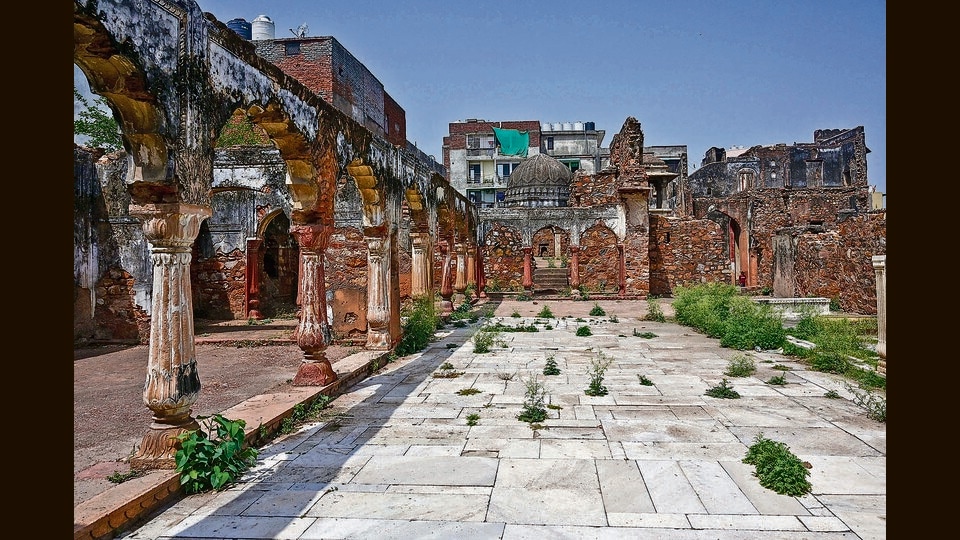
But over 200 years later, the summer palace in Mehrauli stands in a decrepit state — plaster peeling off its walls, ugly graffiti engraved on moss, empty alcohol bottles, garbage, and paan stains dominate what is known as the city’s last Mughal monument.
Last December, the marble jaali that encloses the graves was broken by vandals. And even now, all that pretends to protect Zafar Mahal from vandals is a few metres of concertina wire around it.
Though protected by the Archaeological Survey of India (ASI), little work has been done to restore it. Last April, a senior ASI official told HT that conservation work at Zafar Mahal was set to begin soon as the monument’s condition is not up to mark.
During a spot visit this month, a year later, only concertina wire had been put up around the monument. “We hope to begin work this financial year. When it comes to conservation, priorities change, so it is difficult to give an exact time for when the work at Zafar Mahal will begin. Every circle of ASI is sanctioned funds each year. Zafar Mahal’s condition was pointed out last year, as it has been this year. It is still on the agenda,” said ASI’s superintending archaeologist Praveen Singh.
Many legends
The three-storey structure was built in the 18th century by Mughal emperor Akbar Shah II and was restored by Zafar in the 19th century. The palace has accommodated many tales over the years. It was Zafar’s desire to be buried next to the tomb of Sufi saint Qutbuddin Bakhtiar Kaki, in Delhi – a city he loved greatly.
Legend is that the grave there was left “empty” after Zafar was exiled to Burma (now Myanmar). Historians, however, flagged it as a false, romanticised tale. “In family enclosures like these, the area around the grave was paved with marble after a burial. To make space for another grave, the marble would be removed, and then repaved. No space would have been left empty. The story that his grave was left empty is manufactured,” said historian Swapna Liddle, who wrote 14 Historic Walks of Delhi.
In the 18th and 19th centuries, Zafar Mahal was of great cultural importance. “It was a space meant to be interconnected – Sufi saint Bakhtiar Kaki’s dargah, Moti Masjid built by another Mughal emperor Bahadur Shah Zafar I, and then Zafar Mahal,” said Liddle.
One-man army
To get to Zafar Mahal, one traverses the tapered lanes of Mehrauli, anchored by houses plugged one after the other. The structure, located southwest of Qutub Complex, appears out of nowhere once you reach the chauraha, and is flanked by shops, a temple, and Kaki’s dargah.
Both Qutub Minar and Zafar Mahal are ASI-protected monuments – the former is a tickted monument, while the latter is not – yet their upkeep differs greatly. “Residents lament that little effort has been made to restore the Mughal monument. “Officials come and go. In case a VIP visits, they spruce up the area around it. Sometimes, they put up a scaffolding and make it look like work has been undertaken. But I have not seen any change in the appearance of the monument... It continues to be neglected,” said Om Prakash Saluja, 77, who runs a shop next to Zafar Mahal.
Aside from the urgent need for conservation, an equally acute problem that plagues its rapidly eroding insides is vandalism. Once the summer palace of the last Mughal emperor, it is now frequented by anti-social elements. This dissuades the locals from visiting this heritage site right next to them.
A security guard, who asked not to be identified, works here from 10am to 5pm, and fights a daily battle between protecting himself and protecting the monument.
“Many people visit daily but they are not here to look at the monument. They do not listen to me and climb the walls, throw bottles and smoke beedi. I can only ask them not to. They often come in groups. It is not always easy to be assertive,” he said.
Apart from those who take refuge inside Zafar Mahal to smoke, drink, and vandalise, the palace is also a favourite with social media content creators. “These people come with their bandobast (camera and equipment). I tell them they can do photography here, but they want to shoot an entire film. It is in writing that such things cannot be allowed without permission. But they think I am making up rules and speak to me rudely,” said the guard.
Once he leaves at 5pm, the monument stands unguarded, and locked up. But a smaller door can be maneuvered to create an opening that would fit one person at a time, allowing anyone to enter at any time.
Liddle stressed that the problem especially surfaces when such sites are surrounded by living communities. “Instead of looking at the population as a problem, the people in the neighbourhood can be made custodians of the historical site. This approach adds security. Right now, the structure is alienated from the neighbourhood it inhabits,” said Liddle.
For Saluja, the shopkeeper next door, Zafar Mahal is home to his childhood memories. He arrived in Mehrauli in 1948 from Pakistan. “We spent a lot of time inside Zafar Mahal... I have grown old with it. When our homes would get stuffy, we would spend a breezy night on its verandahs. Now we find it unsafe. The wires are a recent addition, but this monument has been neglected for 25 years,” said Saluja.


