It was bigger than a dog, smaller than a nilgai, but its very sight was enough to petrify 35-year-old Virender Singh. In the last 12 years, Singh had crossed Baandh road – which connects his home in cramped Devli to Sainik Farms, a swanky, gated (and unauthorised, in government books) south Delhi colony, where he works as a guard – twice a day, every day.
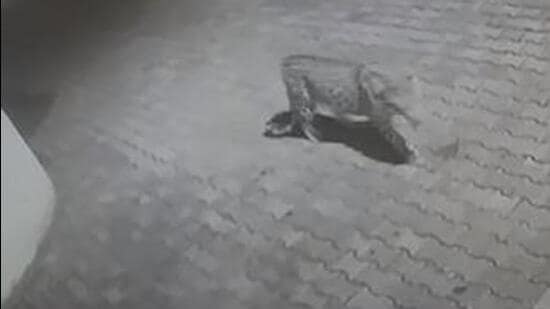
Mongrels, monkeys, cats, cows, peacocks, even a nilgai, he had encountered before, but never this.
According to a year-long mammal census carried out between 2021 and 2022, the Delhi Forest department and the Bombay Natural History Society (BNHS) found that there were at least eight leopards in the Asola Bhatti Wildlife sanctuary – the highest number of leopards spotted there ever.
In January this year, another two cubs were captured on camera at the sanctuary. “It was rare to spot a leopard here till as recently as 2015, but things have changed due to habitat restoration such as introduction of different native Aravalli grass varieties, and creation of more watering holes,” said Sohail Madan, an ecologist and the former centre manager of the sanctuary.
Experts say that anthropogenic pressure on the Aravallis has increased in the last decade.
“The Aravallis have been massively encroached, with greater pressure on the Haryana side. Trees such as the vilayati kikar (a kind of acacia), which dominate the Aravallis, were cleared up for construction purposes. This has likely disturbed the animal,” Harsana said.
He said that this encroachment and loss of habitat means that leopards are bound to migrate to avoid humans.
Vijay Dhasmana, an ecologist who is also the curator at the Aravalli Biodiversity Park in Gurugram, said, “More people are heading out into these forests to encroach them. Increasing pressure on the Aravallis translates into leopard movement, which in cases has led to (their) deaths on the Gurugram-Faridabad road.”
Since 2015, around 10 leopard roadkill deaths have been reported around the Aravallis, primarily in the Gurugram-Faridabad region. This often includes juveniles, that try to cross from one forest patch to the other, while moving further north, towards Delhi. Such roadkills includes a young female leopard that died near Mangarbani in May 2015. In May 2016, a male juvenile was found dead near Haryana’s Gairatpur Bas village; a four-year-old leopard was found dead near Mewat’s Bhango village in November 2017; a 1.5 year old juvenile was found dead near Gairatpur Bas in May 2018; a 10-month cub was found dead on the Gurugram-Faridabad road in January 2019. More recently, the carcass of a two-year-old female leopard was found on Surajkund-Pali road in Faridabad in June 2021.
Sainik Farms, which was developed as a cooperative society for defenCe personnel and their families in 1961, was to have 102 farm plots spread across 161 acres. Over the years, however, the neighbourhood has grown, eaten into the forest, and inched closer to Asola.
Faiyaz Khudsar, scientist-in-charge of Delhi Development Authority’s biodiversity parks programme, said that restoration of wildlife habitat in Delhi is another reason that has attracted the big cats to the capital. “Over the last few years, there have been concentrated efforts to develop Asola Bhatti and Tilpath Valley – which are a few kilometres apart – as a conducive habitat for mammals, reptiles, and birds,” said Khudsar.
Leopards, he said, have a tendency to move over time in a bid to expand their home territories, and are generalist feeders. “They kill and eat small mammals such as chital, nilgai calves, peafowl, and wild or stray dogs. So, they learn to adapt adjacent to human settlements.”
More sightingsFor Singh, the guard in Sainik Farms, the morning of December 2 was the first time he had spotted a leopard there, but he had heard stories. “My brother, who also works in this area, had told me six months ago that he had spotted a leopard here. I didn’t believe him at the time,” he said.
Scared after his last encounter, Singh is now more vigilant. “We have guns and sticks, but even then, one does not know exactly what to do when you see a leopard,” he said.
In March 2022, residents of Sainik Farms spotted a leopard, claimed Sushil Kumar Jain, a 57-year-old businessman, who lives opposite the forest patch where the leopard was spotted this month.
This is not the first leopard to have been caught on camera in Delhi, as there have been sightings since 2015 in areas such as Usmanpur, the Yamuna Biodiversity Park, Narela, Tilpath Valley biodiversity park, and Najafgarh.
The leopard will keep visiting the city, said Madan, and it’s about time residents learnt to coexist. “We started workshops for villagers living near the Asola sanctuary where we taught them why leopards are not likely to attack them unless provoked. They were also taught to not engage with the animal and if they spotted one, to calmly move away and alert rescue officials. The forest department needs to continue these workshops and realise that capturing a leopard is not the solution.”
What Mumbai doesThis is the model that Mumbai follows. The Sanjay Gandhi National Park (SGNP) located in Mumbai’s northern part, near Thane, is spread across 120 sq km, and is home to approximately 40 leopards. Like in Asola, these leopards are known to wander out to forest patches that ultimately lead them to densely populated human settlements.
Over the years, there have been sporadic incidents of human-leopard conflicts, including deaths.
In 2011, SGNP and the Wildlife Conservation Society of India launched a project called “Mumbaikars for SGNP,” with the aim to help residents cope with the idea of coexisting with leopards. Between November 2011 and April 2012, a camera trap study identified at least 21 leopards in the area, that preyed on sambhar deer and chital – both abundant in SGNP.
“Posters on precautions to take when one encounters a leopard were distributed. The forest department set up control rooms. People were told not to attack the animal, and to not venture out alone in the area at night. If there’s a small child, pick it up and calmly move away from the leopard,” said Nikit Surve, programme head, human wildlife interaction programme at Wildlife Conservation Society, who has been working on the issue of leopard-human conflict in Mumbai since 2015.
These awareness workshops, he said, replaced the requests for translocating the leopards and putting up cages.
“Mumbai, for the longest time, had been doing what Delhi is doing now – capturing leopards and trying to release them far away, but research has shown that they come back, as they have strong homing instincts,” said Surve. He said that capturing them, surrounded by hundreds of human beings, leads to the animal going through trauma, which can cause a change in behaviour.
“In a study carried out by ecologist Vidya Athreya, she found that post-translocation of leopards, attacks on human beings increased by 200%,” said Surve.
Athreya said that carnivores are known to prowl urban settlements due to the easy availability of discarded meat and the presence of stray dogs – a favourite food of leopards.
High alertSince December 2, forest guards of the Delhi Forest department have been patrolling patches of the forest in Sainik Farms. Mandeep Mittal, deputy conservator of forest (DCF), south division, said, “Teams patrolled the forest area for the first four days, where multiple sightings were made by both locals and forest officials. Now we believe the leopard has probably returned to Asola. We also used drones to try and locate the animal from a height. Nets were also installed to cordon off the forest area to prevent the leopard from coming towards the residential side.”
On December 8, a rumour spread that a leopard had been spotted at a different forest patch in the area. “When the area was checked later, pug marks were found, which were later found to be of a civet’s,” said Bhalla.
The colony has set up a quick-reaction team (QRT), comprising only the colony’s security guards, who rely on sticks and rusty rifles.
A guard, who asked not to be named, said, “I have never dealt with a leopard before, but it is something I will have to do now. It is a scary thought that a leopard is on the prowl, but if we won’t deal with it, who will? Our employers won’t step out for this.”
On December 6, the Western Avenue, Sainik Farms, RWA installed banners on the edge of the forest, which said, “There is a leopard in the area. Please be careful and avoid walking or riding two-wheelers here.”
Bhalla, the RWA president, said they are also planning to light up the forest area and will install CCTV cameras facing the forest. “We are observing the most activity at night-time, with both stray dogs and pet dogs howling. There was a sighting on December 6 night too,” said Bhalla.
Bhalla said that the residents have requested the officials of the Delhi Forest department to install barbed wires on the periphery of the Asola Bhatti sanctuary.
“The leopard is likely to come from there.”
Which is understandable -- it was the leopard’s home long before it became Sainik Farms.
Stay updated with all top Cities including, Bengaluru, Delhi, Mumbai and more across India. Stay informed on the latest happenings in World News along with Delhi Election 2025 and Delhi Election Result 2025 Live, New Delhi Election Result Live, Kalkaji Election Result Live at Hindustan Times.
Stay updated with all top Cities including, Bengaluru, Delhi, Mumbai and more across India. Stay informed on the latest happenings in World News along with Delhi Election 2025 and Delhi Election Result 2025 Live, New Delhi Election Result Live, Kalkaji Election Result Live at Hindustan Times.