
 E-Paper



Mungeshpur drain breach floods Geetanjali Enclave, Najafgarh drain at capacity
Officials confirmed that a portion of the Mungeshpur drain — a sub-drain of the Najafgarh drain from Haryana — had collapsed on Tuesday, flooding farmland in Jharoda Kalan and forcing the evacuation of thousands from Geetanjali Enclave

 Prefer HTon Google


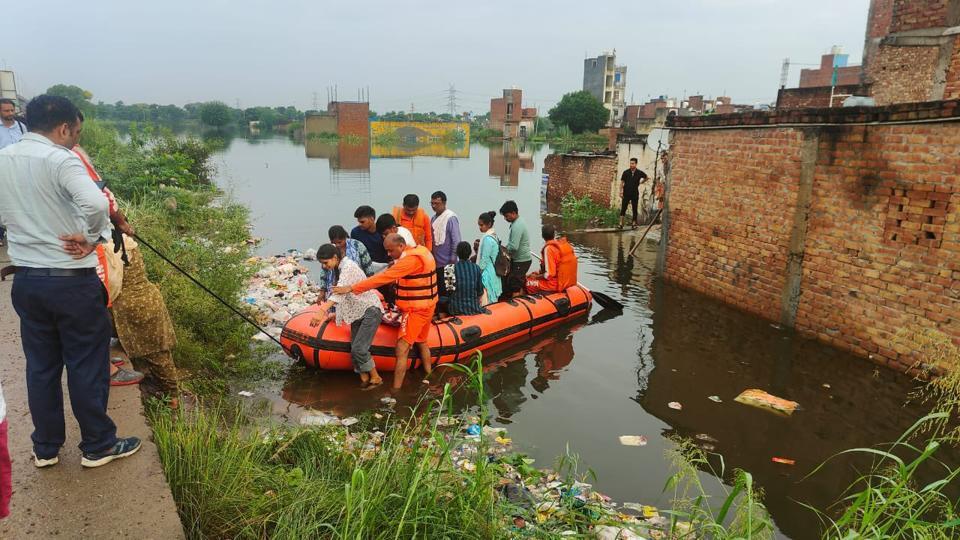
When water burst through a collapsed portion of the Mungeshpur drain on Tuesday, it first swept across the farmlands of Jharoda Kalan before surging into neighbouring Geetanjali Enclave. By evening, streets had turned into rivers and homes were submerged shoulder-deep, forcing more than 2,500 residents to abandon their belongings and flee.
“It was raining incessantly and then we heard the drain wall had collapsed. Within hours, water rose inside our homes,” said Sandhya Gupta, who waded out with her family. “My children were in school. We had to carry them home on our shoulders before evacuating with nothing but the clothes we wore.”
Officials confirmed that a portion of the Mungeshpur drain — a sub-drain of the Najafgarh drain from Haryana — had collapsed on Tuesday, flooding farmland in Jharoda Kalan and forcing the evacuation of thousands from Geetanjali Enclave. The water levels expected to stay high for the next two days, they said.
Delhi Police and NDRF teams began pulling people out on Tuesday night. Some residents were carried to safety on boats, others on foot. SHO Balram Singh Beniwal, who led rescue efforts, said more than 700 people were shifted to safer places that evening, including infants, the elderly and people with disabilities. “By night, the entire Geetanjali Enclave had been evacuated. On Wednesday, as the water spread to nearby areas, we began evacuating over 500 more people,” he said.
By Wednesday, the entire colony had been evacuated, with families now sheltering in a converted MCD school.
Chief minister Rekha Gupta said she had spoken to her Haryana counterpart Nayab Singh Saini and that repair work on the drain was being carried out on a “war footing”. “So far, over 2,000 people have been moved to safer locations. Officials from both states are working in coordination to evacuate residents and carry out relief work. Police, the administration, DTC buses, NDRF, ambulances and rescue teams have all been deployed on the ground,” she said.
Local councillor Amit Kharkhari said at least 600 people are currently being housed in the Jharoda Kalan school. “Food and shelter are being provided but most families have lost everything inside their homes,” he said.
Another resident, 33-year-old Vijay Shukla, said his family of five was rescued on Tuesday night after the water rose above shoulder level. “By evening, it had already seeped into the walls of our homes. Police began evacuating everyone—some were taken out on boats, others were carried to safety. People are still being rescued from our neighbourhood,” he said, adding, “Everything we owned is now under water.”
The Central Water Commission said the Sahibi river, or Najafgarh drain, stood at 211.25 metres on Wednesday—just shy of the 211.44-metre warning mark and the 212.44-metre danger mark. The Irrigation and Flood Control Department noted the all-time high of 213.57 metres in August 1977, warning that the drain is already at full capacity and any further rise could worsen waterlogging in its catchment.

Stay updated with all top Cities including, Bengaluru, Delhi, Mumbai and more across India. Stay informed on the latest happenings in World News along with Delhi Election 2025 and Delhi Election Result 2025 Live, New Delhi Election Result Live, Kalkaji Election Result Live at Hindustan Times.


